Manila & nearby
5 kW or 10 kW Solar in Manila? A Worked Comparison Worksheet
Use an explicitly hypothetical same-household worksheet to compare 5 kW and 10 kW solar offers, direct use, surplus and the evidence a real quote needs.
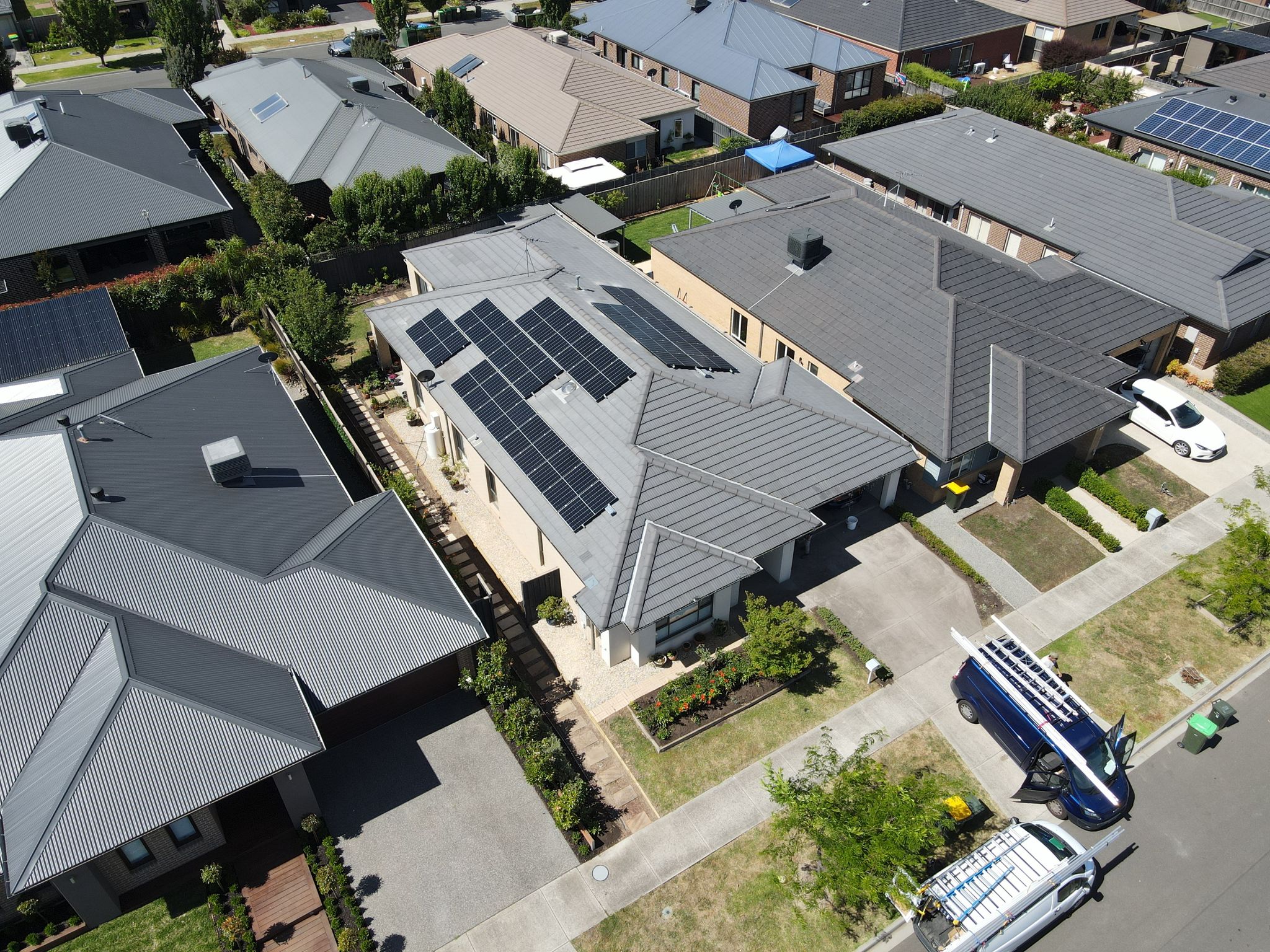
Comparing 5 kW and 10 kW solar packages in Manila becomes easier when both offers use the same household assumptions. This worksheet shows the arithmetic with invented numbers, then identifies the evidence an installer must supply before those numbers become a property-specific proposal.
Every energy figure below is a teaching assumption, not a Manila yield estimate, customer case study, savings forecast or quotation. No tariff, installed price or payback period is assumed. The purpose is to trace where additional generation goes, not to recommend either system size.
Define one household and two clearly labelled options
In this exercise, “5 kW” and “10 kW” refer to arrays rated at 5 kWp and 10 kWp DC. The real proposal must separately identify the AC inverter rating. Assume, only for the calculation, that suitable layouts and equipment could deliver the invented AC energy figures below. There is no battery in either option.
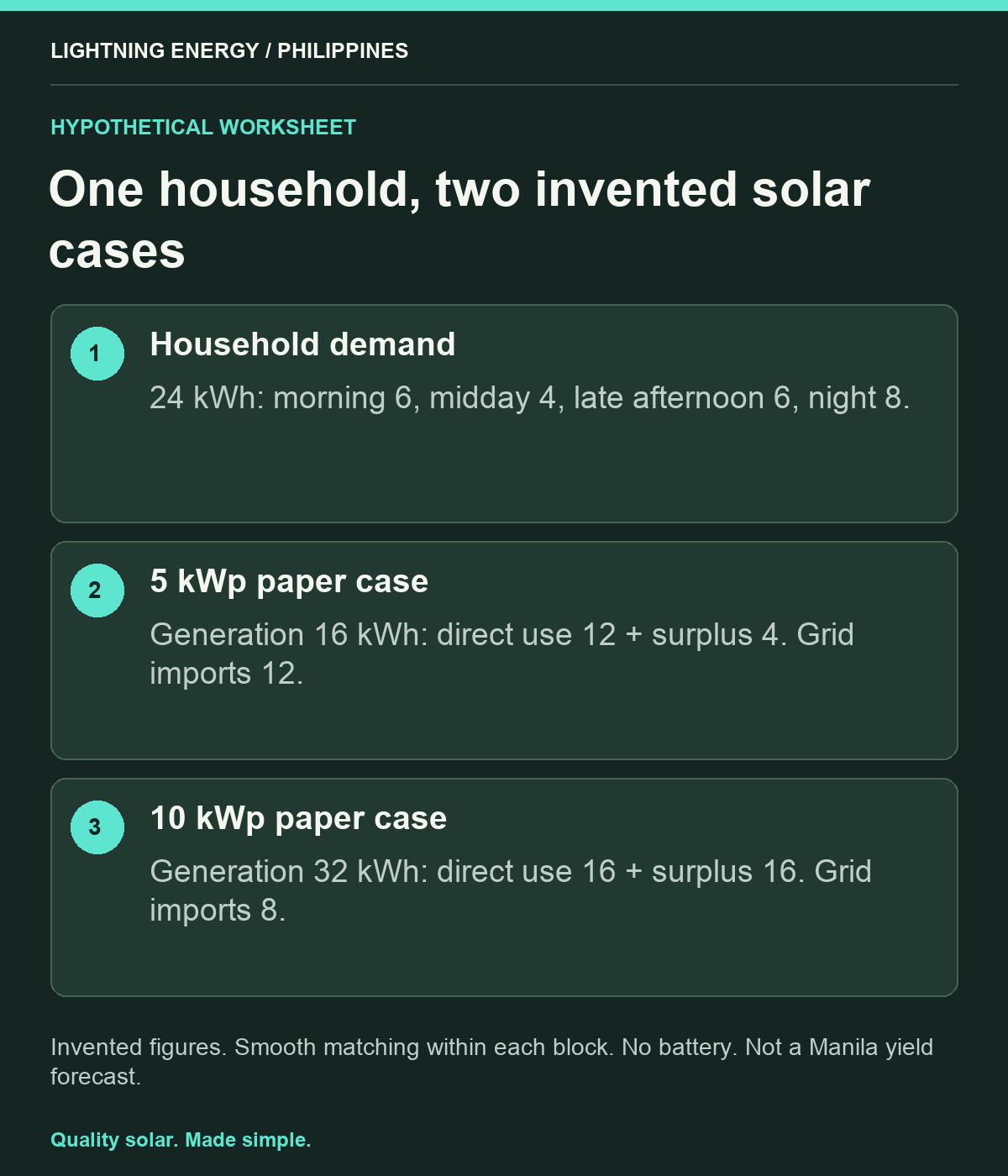
The household uses 24 kWh during our fictional day: 6 kWh in a morning block, 4 kWh around midday, 6 kWh in a late-afternoon block and 8 kWh at night. The same household demand applies to both options. These block labels have no assigned duration and do not imply typical Manila appliance use.
Put the invented production beside the demand
Give the 5 kWp option 4, 8 and 4 kWh of AC generation in the three daylight blocks, totalling 16 kWh. Give the 10 kWp option 8, 16 and 8 kWh, totalling 32 kWh. Doubling these values is a deliberate paper assumption, not a claim that two real roof layouts will have identical yield per panel.
Within each block, assume smooth, coincident production and demand. Direct use is then the smaller of generation and demand; surplus is generation minus direct use. A real interval model can show imports and surplus occurring at different moments within the same block, so taking the smaller block total can overstate direct use. This shortcut is acceptable only inside the stated teaching example.
Balance each option before comparing it
For the 5 kWp option, direct use is 4 + 4 + 4 = 12 kWh. The midday surplus is 4 kWh. Grid imports are 2 kWh in the morning, zero at midday, 2 kWh in late afternoon and 8 kWh at night: 12 kWh altogether. Generation balances at 12 direct + 4 surplus = 16 kWh; demand balances at 12 direct + 12 imported = 24 kWh.
For the 10 kWp option, direct use is 6 + 4 + 6 = 16 kWh. Surplus is 2 + 12 + 2 = 16 kWh, and imports are the 8 kWh used at night. Generation balances at 16 direct + 16 surplus = 32 kWh; demand balances at 16 direct + 8 imported = 24 kWh. These totals are arithmetic checks, not measured performance.
Identify what the extra array actually contributes
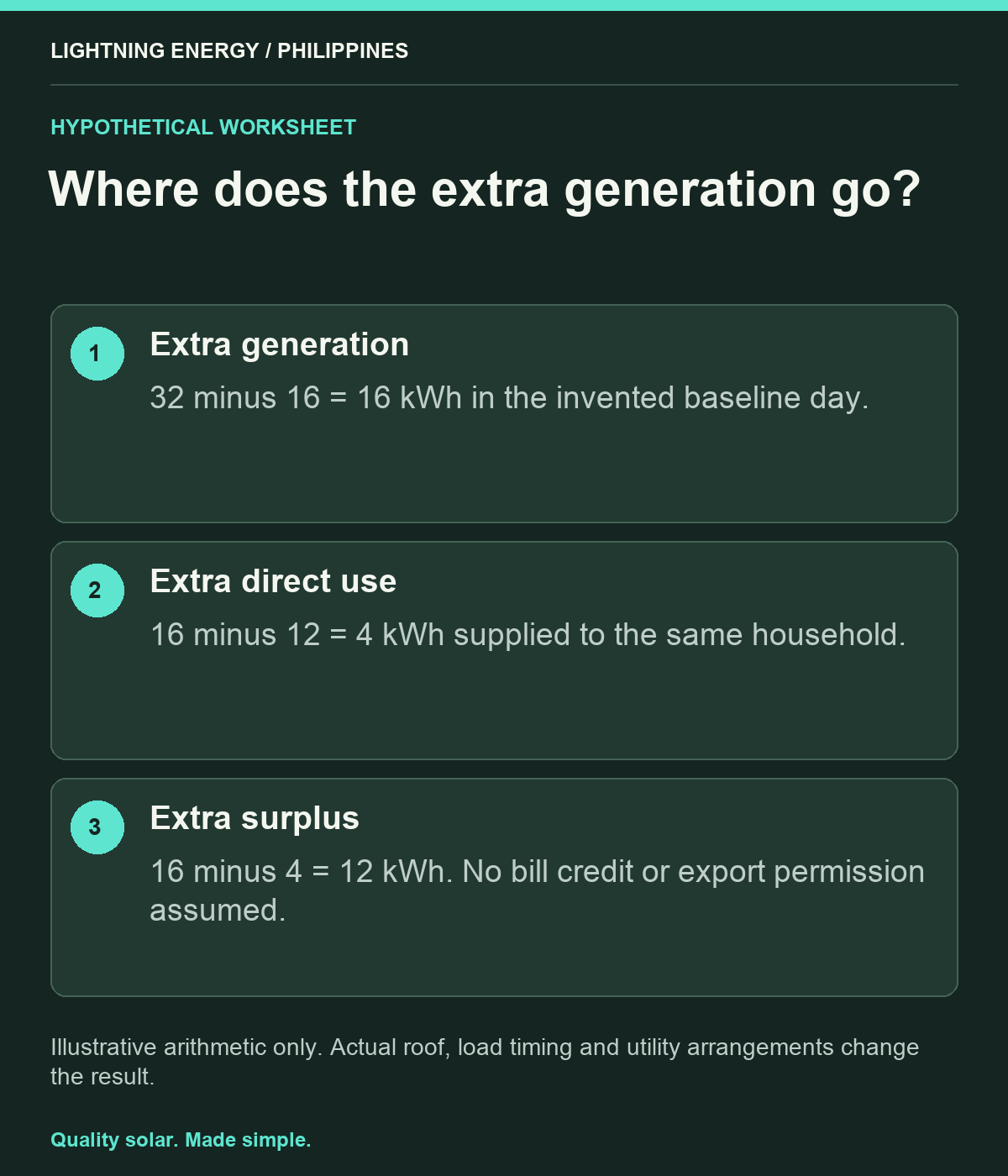
The larger option adds 16 kWh of assumed generation, but only 4 kWh of additional direct household use. The other 12 kWh becomes additional surplus. Imports fall from 12 to 8 kWh, while night imports remain unchanged. The worksheet therefore does not support a claim that doubling array size halves this household’s grid purchases.
“Surplus” is an energy balance, not a guaranteed bill credit. Meralco distinguishes electricity used at home from exported electricity credited under net metering; its export credit uses the applicable generation component rather than the full retail rate. [2] For an approved exporting system, model eligible exports separately. For a constrained or zero-export design, account for curtailment rather than automatically assigning value to all potential surplus.
Try one changed household routine
Now keep the same invented generation but reduce daytime demand to 3, 2 and 3 kWh, while retaining 8 kWh of night demand. Total demand becomes 16 kWh. Both options directly supply all 8 kWh of daytime demand under our smooth-block assumption, and both still import 8 kWh at night.
The smaller option now has 8 kWh of surplus and the larger has 24 kWh. In this second fictional routine, the extra array produces no additional direct-use benefit. This does not make larger systems universally unsuitable: it shows why the same household schedule must appear in both proposals, and why an annual production total alone cannot answer the purchase question.
Replace the assumptions with evidence for your address
The US Department of Energy identifies roof condition, location, orientation, shade and household electricity needs as inputs to an assessment. [1] Ask the installer to replace our invented figures with a location-specific model, a surveyed layout and measured or documented load assumptions. Request seasonal results and an explanation of uncertainty. US incentives and credentials in overseas guidance are not Philippine entitlements.
For a Manila property, add the actual utility arrangement, usable roof areas, service-access constraints and any electrical modifications to each option. Meralco states that net-metering operation and credits depend on its applicable completion requirements, including testing and commissioning. [2] The larger layout must be assessed on its own merits; do not merely double the smaller model’s results.
Take a completed comparison sheet to the quotation meeting
Create matching rows for array rating, inverter rating, modeled generation, direct use, eligible exports, curtailed energy, grid imports and complete installed scope. Leave price and tariff rows blank until you have dated written inputs. Ask which costs change between options and which remain the same. Any financial comparison must preserve those distinctions rather than multiplying all production by one electricity rate.
Send Lightning Energy Philippines your Manila-area address, electricity records and the two sizes you are considering. Request the same load assumptions for both designs and confirm service availability for the property. The useful recommendation is a completed, checkable comparison explaining what the extra equipment contributes, where uncertainty remains and which option fits your actual brief.
Sources & further reading
Sources used for this guide. Policy and product details should be checked for your particular installation.
- US Department of Energy — A Step-by-Step Guide for Consumers Going SolarAccessed 27 September 2026
- Meralco — Net-Metering billing FAQsAccessed 27 September 2026