Product reviews
Deye SUN-12K-SG01LP1-EU Review: A Bigger Hybrid for Philippine Homes?
A research-based look at Deye’s 12kW hybrid: battery matching, essential loads and the questions a serious Philippine quotation should answer.
A large home with several appliances can make a big hybrid inverter sound like an easy choice. The harder question is whether the battery, service connection and protected circuits can support the same ambitions. This Deye review starts with those relationships.
This is a research-based review prepared on 27 September 2026, with no hands-on testing. Lightning Energy Philippines publishes this guide as a solar installer, so it has a commercial interest in installation enquiries. The assessment separates documented features from our judgement about household fit.
The exact product and Philippine listing
Helios Optimum lists the Deye SUN-12K-SG01LP1-EU in its Philippine shop. [1] This records an online offering visible during our research, not confirmed inventory, an endorsement of the seller, or a claim that Lightning Energy stocks the product. Obtain a dated quotation with the complete model code before paying.
The technical reference for this review is Deye — SUN-(12–16)K-SG01LP1-EU user manual, Ver2.2. [2] A similarly named model, a regional revision or an updated generation may have different limits. Require the delivered nameplate and supplied documentation to agree with the quotation.
What the inverter actually contributes
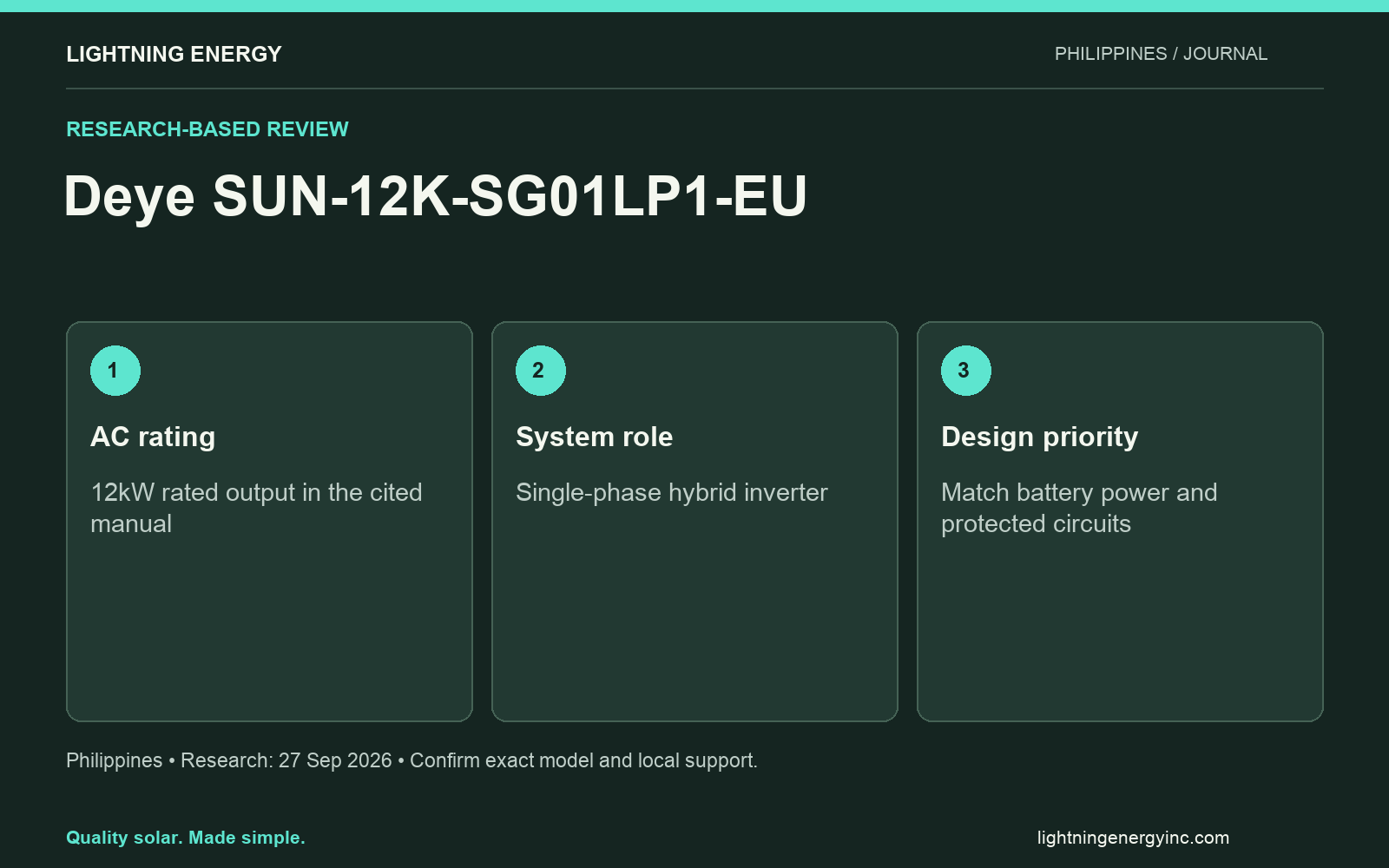
Deye documents a rated 12,000W AC output for this single-phase model and describes grid, battery, solar and generator connections. The manual also includes selectable operating priorities and export-limiting functions. [2] These are useful building blocks for a household that wants to manage several energy sources.
Our assessment is that flexibility is its main attraction. It also creates more commissioning decisions. An installer should explain the normal daytime mode, evening mode and outage mode in plain language, including which source supplies the house when the battery reaches its reserve.
Where the larger rating makes sense
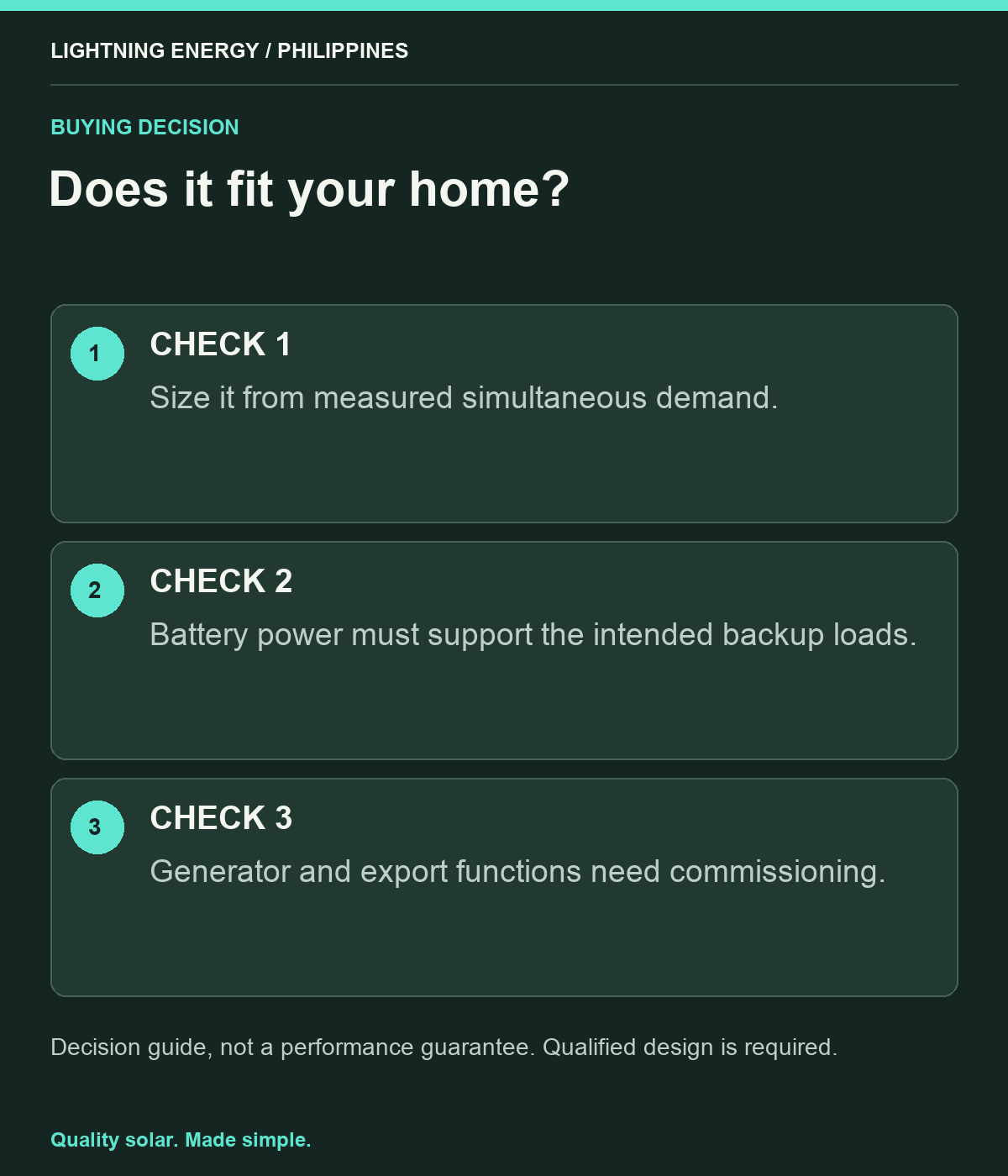
Consider a home in Cavite or Laguna with occupied rooms during the day, a home office and several cooling loads. A larger inverter could be worth assessing if measurements show substantial simultaneous demand. The rating should follow that evidence; a high monthly bill alone does not reveal the peak load.
Ask the designer to separate ordinary use from the loads you would actually protect during an outage. Keeping selected circuits available may require a much more manageable battery and wiring scope than attempting to operate every appliance together.
The battery can be the limiting component
A hybrid inverter does not contain the energy needed for an evening or a brownout. The battery proposal must show both stored energy and allowable continuous power. A large inverter paired with a small or current-limited battery can disappoint even when each component is working correctly.
Request written compatibility for the exact battery, communications protocol and firmware. Ask which battery conditions reduce output, what reserve is retained, and how the installer sized protection and conductors. Do not accept a broad claim that any battery with a familiar nominal voltage will be suitable.
Generator and export functions need a written scope
The manufacturer’s generator and export-control provisions are not evidence that a particular household generator or utility connection is already suitable. [2] Existing equipment should be assessed as part of the proposed system, with the operating logic and permitted power flow recorded.
A buyer with a generator should ask how charging is limited, how automatic starting would work if included, and who will test the transition between sources. A buyer expecting export income should keep utility approval and the applicable metering arrangement separate from the inverter purchase. Never count a software menu as completed interconnection approval.
Our verdict: capable, but justify the scale
This is a reasonable candidate for a substantial, professionally designed residential hybrid installation. It is less persuasive when the essential-load list is modest or the quotation has selected the largest inverter before measuring demand. Spending on unused output capacity can displace money needed for batteries, switchboard work or a better roof design.
Compare a smaller hybrid alternative using the same household schedule and outage objective. Require both proposals to explain their limitations. We would favour the design with a coherent battery and load plan over one that simply highlights the biggest inverter number.
What to put in your quotation request
Before accepting the Deye proposal, request a load schedule that compares normal operation with the protected circuits. Have the installer identify the battery power limit and demonstrate the chosen generator or grid priority if those functions are included. The handover should tell every adult in the home what can run together during a brownout.
Bring Lightning Energy Philippines the existing service and generator details alongside your bills. Ask for a smaller-hybrid comparison if the measured load does not justify this model.
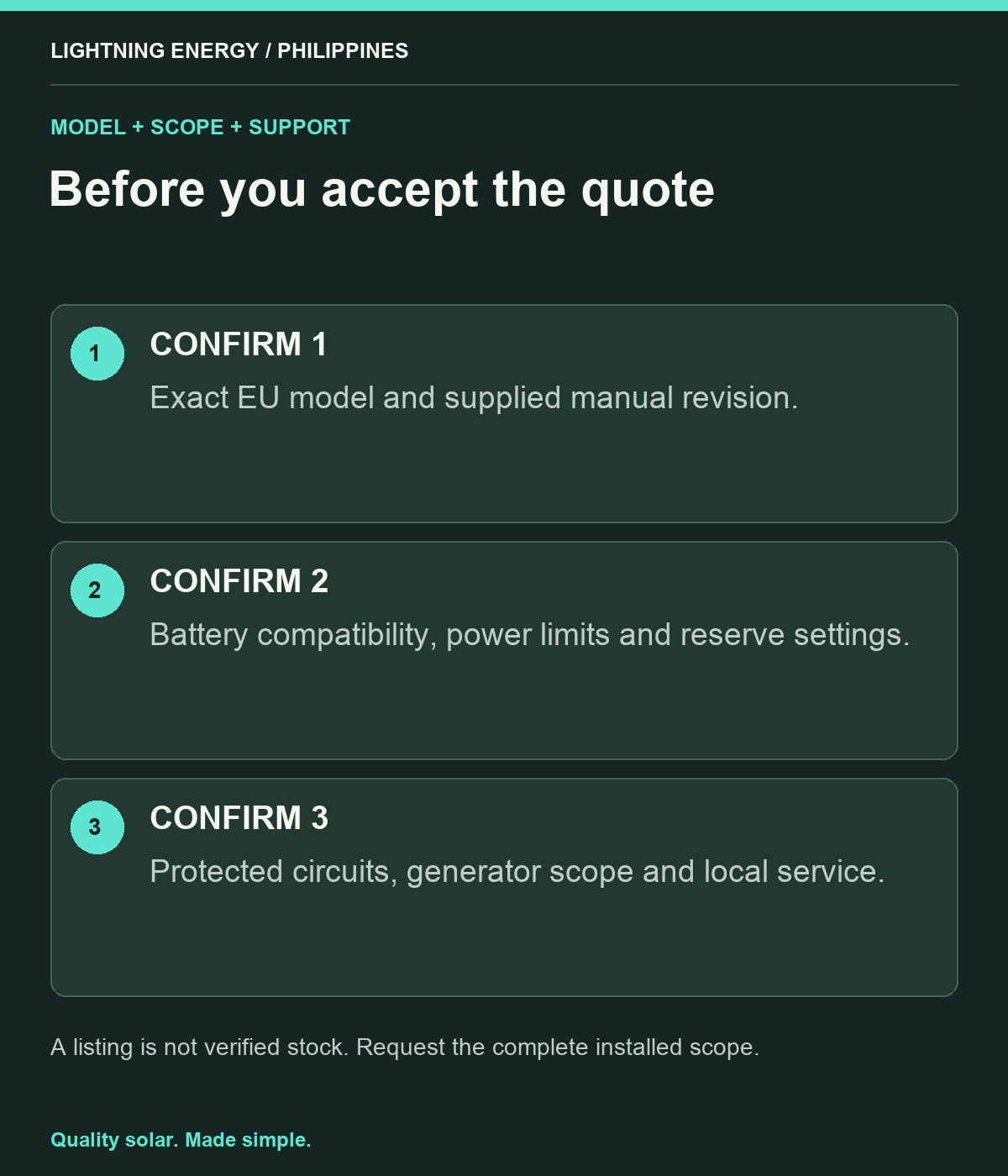
- Exact EU model and supplied manual revision.
- Battery compatibility, power limits and reserve settings.
- Protected circuits, generator scope and local service.
Sources & further reading
Sources used for this guide. Policy and product details should be checked for your particular installation.
- Helios Optimum — Philippine offeringAccessed 27 September 2026; stock not verified
- Deye — SUN-(12–16)K-SG01LP1-EU user manual, Ver2.2Accessed 27 September 2026; verify delivered revision