Product reviews
Dyness DL5.0C Review: Is This Modular Battery Right for Your Philippine Home?
Review the DL5.0C’s storage role, indoor siting and expansion questions before accepting a Philippine solar-battery quote.
For a household starting with essential-load backup, a modular battery can feel more approachable than a large storage cabinet. The Dyness DL5.0C deserves consideration when its capacity, installation space and inverter pairing match the job. It should be assessed as part of a system, not as a universal add-on.
This is a research-based review prepared on 27 September 2026, with no hands-on testing. Lightning Energy Philippines publishes this guide as a solar installer, so it has a commercial interest in installation enquiries. The assessment separates documented features from our judgement about household fit.
The exact product and Philippine listing
Helios Optimum lists the Dyness DYN-MD-DL5.0C battery. [1] This records an online offering visible during our research, not confirmed inventory, an endorsement of the seller, or a claim that Lightning Energy stocks the product. Obtain a dated quotation with the complete model code before paying.
The technical reference for this review is Dyness — DL5.0C datasheet, February 2025. [2] A similarly named model, a regional revision or an updated generation may have different limits. Require the delivered nameplate and supplied documentation to agree with the quotation.
A useful capacity reference, with an important distinction
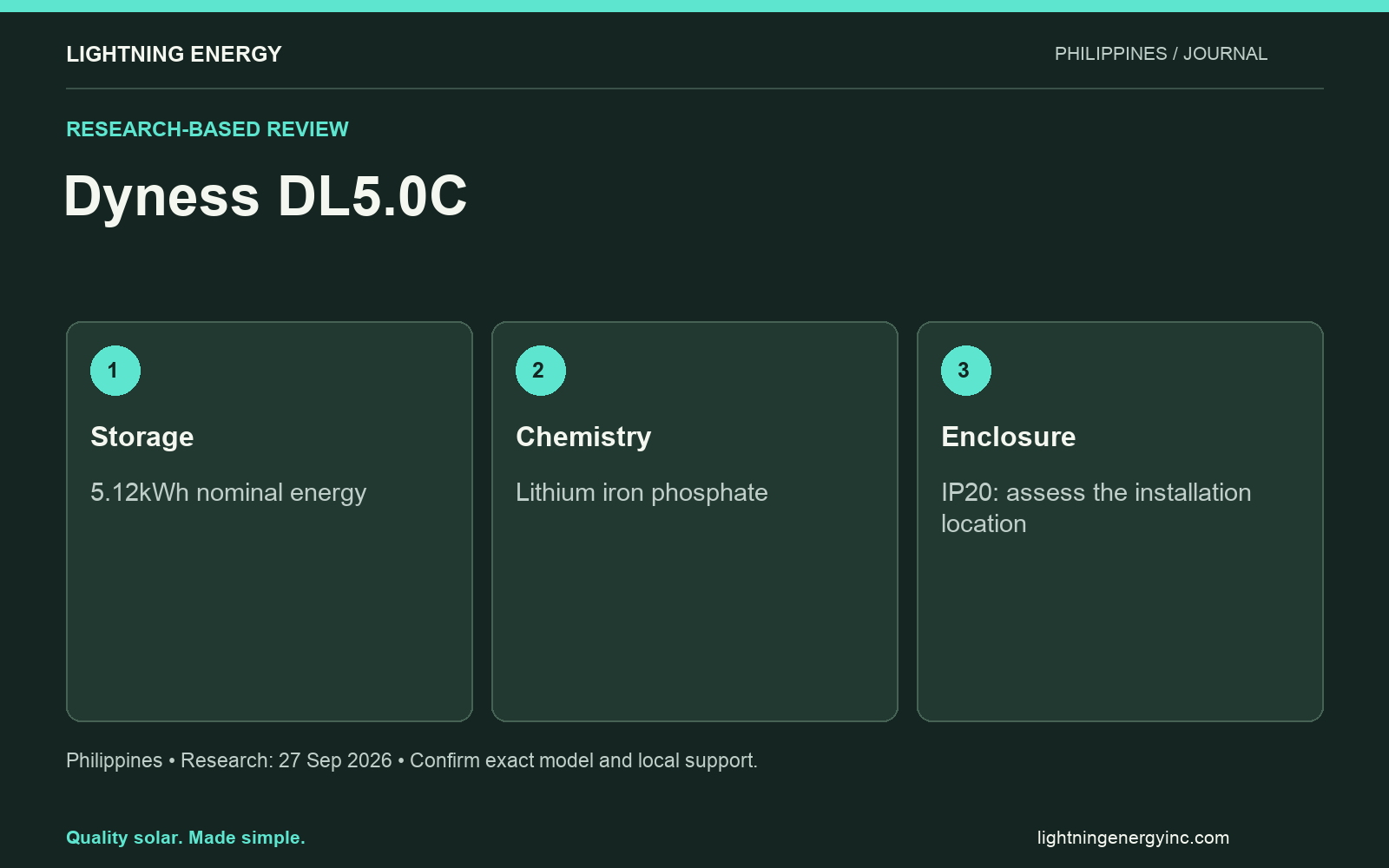
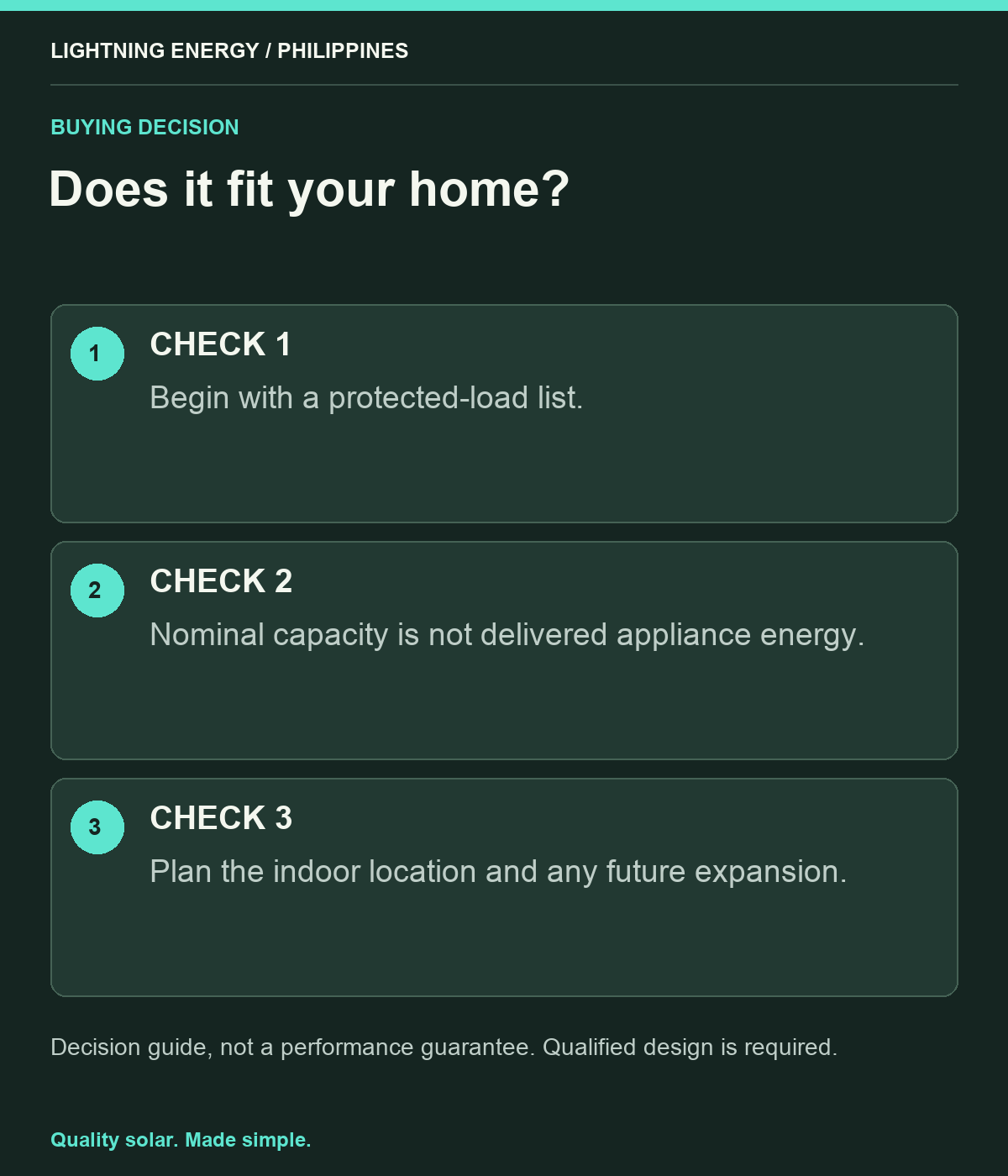
Dyness identifies the DL5.0C as a lithium iron phosphate battery with 5.12kWh nominal energy and an IP20 enclosure. [2] Nominal energy is a reference for the battery, not the energy your appliances will necessarily receive. Reserve settings, conversion losses and the operating conditions affect the useful amount.
Our view is that this capacity class is a sensible starting point for a focused backup conversation. It is not enough information to promise an entire evening of air-conditioning. The protected loads and their actual operating hours must come first.
Start with what should stay on
A family wanting lights, internet and selected refrigeration during a disruption has a different requirement from one wanting normal whole-house operation. Write those priorities down before asking how many modules to buy. Separate appliances that run continuously from those that cycle or start with a brief high demand.
For an evening-shifting project, use the household’s likely surplus solar and evening consumption instead. Buying storage that rarely receives a useful charge can be poor value. Ask for a daily energy-flow estimate and an explanation of what happens during consecutive low-solar days.
Indoor placement is part of the purchase
The documented IP20 rating makes siting a material question. [2] A sheltered-looking wall is not automatically a suitable installation location. Ask the installer to assess water exposure, ventilation, accessibility and the required clearances against the current manual. A qualified professional should choose and document the location.
For a Philippine home with limited utility space, request a marked-up location photo before ordering. Consider how servicing and eventual replacement would happen. A battery that technically fits behind stored household items may be inconvenient to inspect and maintain throughout its life.
Expansion should be designed, not assumed
Modularity is attractive because it offers a possible route to more storage. That route still depends on the manufacturer’s current rules, compatible hardware and the inverter’s limits. Do not interpret an expandable product family as permission to add any later battery without review.
Ask whether the initial rack or mount, battery protection and cable arrangement accommodate the proposed future stage. Record the allowed module combination and who will commission an expansion. Compare the total cost of that staged path with installing the required capacity at the outset, while avoiding a speculative purchase for needs that may never arrive.
Our verdict: focused backup with careful pairing
The DL5.0C is worth shortlisting for a household that wants a measured first step into stationary storage and has an appropriate indoor location. Its limitations are most visible when the buyer expects long operation of heavy loads from a small initial battery bank. A larger bank or a different format may then be more appropriate.
We would choose between offers based on exact inverter compatibility, documented usable energy assumptions and local service arrangements. The seller’s listing contains generic material, so we have not treated its descriptive copy as technical evidence. Ask for the manufacturer documentation attached to your own quote.
What to put in your quotation request
For a DL5.0C quotation, request the proposed module count, mounting arrangement and the inverter compatibility document together. At handover, ask to see how reserve, charging status and any battery alarm are displayed. Keep the serial numbers and commissioned settings with the warranty paperwork, including who pays handling or labour during a claim.
Lightning Energy Philippines can assess a focused essential-load plan from your appliance list and location photos. Ask the team to explain whether this module format is a suitable starting point.
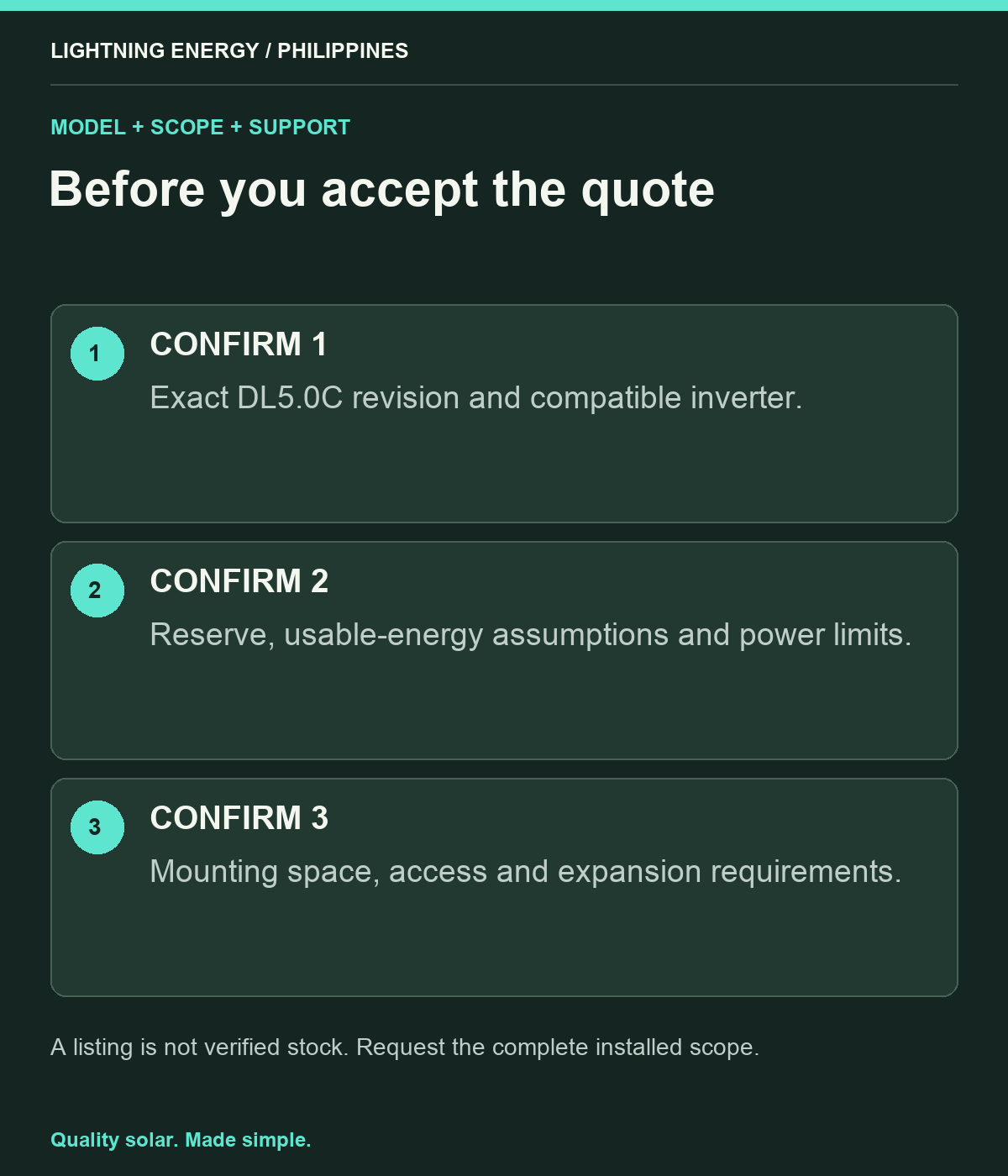
- Exact DL5.0C revision and compatible inverter.
- Reserve, usable-energy assumptions and power limits.
- Mounting space, access and expansion requirements.
Sources & further reading
Sources used for this guide. Policy and product details should be checked for your particular installation.
- Helios Optimum — Philippine offeringAccessed 27 September 2026; stock not verified
- Dyness — DL5.0C datasheet, February 2025Accessed 27 September 2026; verify delivered revision