Product reviews
Dyness PowerBrick Review: The 14.336kWh Battery for Philippine Homes
A review of the 280Ah PowerBrick, including installation location, useful energy and differences from other PowerBrick variants.
A larger battery can make evening use and longer outage coverage easier to discuss, but capacity alone cannot decide the purchase. The 280Ah Dyness PowerBrick is worth examining for a household with substantial storage needs and a suitable installation area. It must not be confused with similarly named variants.
This is a research-based review prepared on 27 September 2026, with no hands-on testing. Lightning Energy Philippines publishes this guide as a solar installer, so it has a commercial interest in installation enquiries. The assessment separates documented features from our judgement about household fit.
The exact product and Philippine listing
Helios Optimum lists the Dyness 280Ah DYN-PW-PBRK battery. [1] This records an online offering visible during our research, not confirmed inventory, an endorsement of the seller, or a claim that Lightning Energy stocks the product. Obtain a dated quotation with the complete model code before paying.
The technical reference for this review is Dyness — PowerBrick low-voltage household storage product specifications. [2] A similarly named model, a regional revision or an updated generation may have different limits. Require the delivered nameplate and supplied documentation to agree with the quotation.
Identify the original PowerBrick clearly
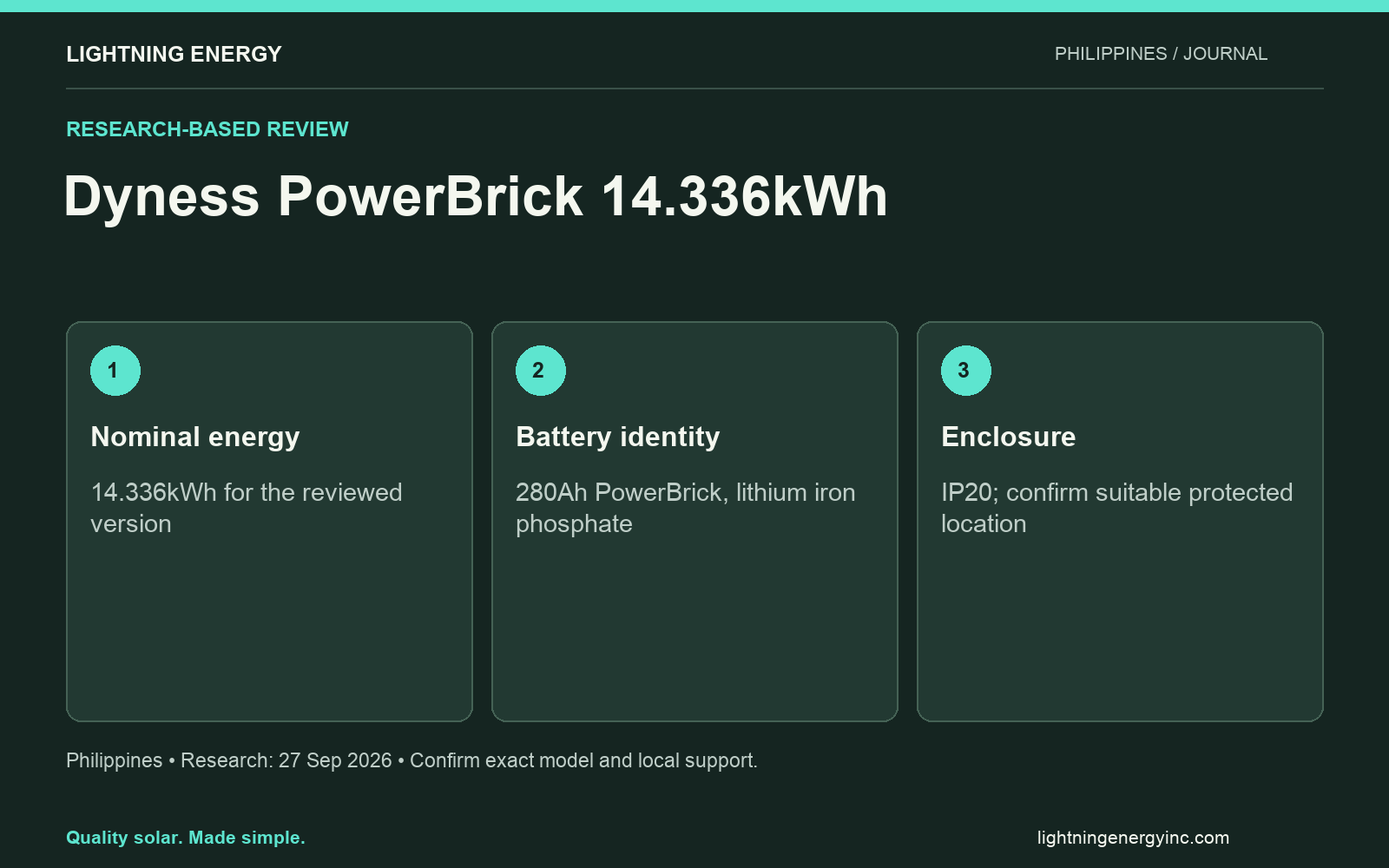
Dyness specifies this PowerBrick as a 14.336kWh, 280Ah lithium iron phosphate battery with an IP20 enclosure. [2] Those identifiers matter because PowerBrick-branded variants can have different capacities and protection ratings. Require the exact model and revision on the quotation rather than accepting the family name alone.
Our review concerns this documented version. It does not transfer specifications from PowerBrick Pro or other later variants. If the supplier proposes a substitute, compare the complete documents again, including installation conditions and current limits, before treating it as an equivalent upgrade.
More energy is useful when the household can use it
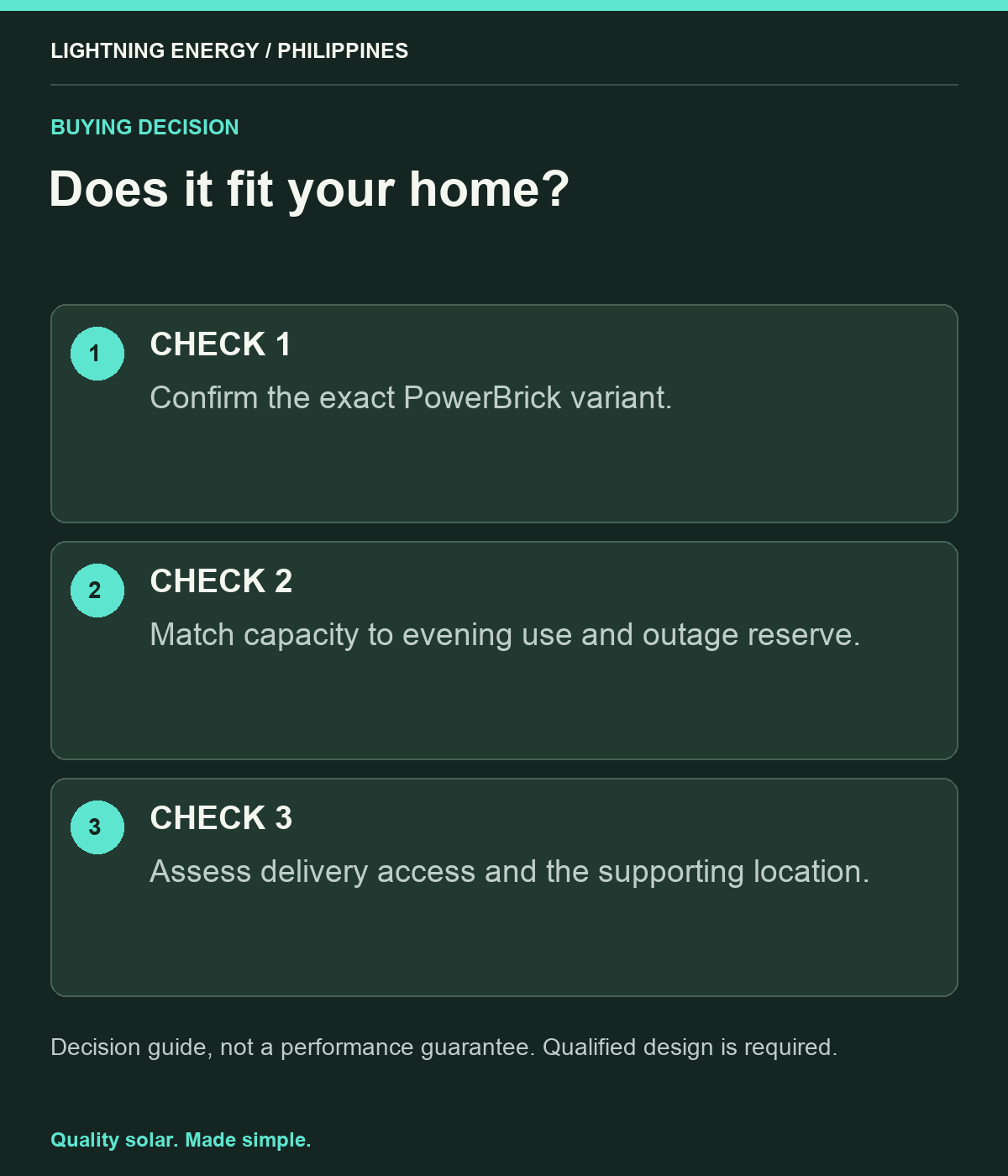
A family with meaningful evening demand may have a stronger reason to consider a larger battery than a household that mostly uses electricity while solar is available. Ask for the expected daily charge and discharge pattern. Capacity that regularly remains unused may add cost without meeting an additional need.
For outage planning, identify the protected appliances and the reserve you want available. Then examine the tradeoff: holding more energy for resilience leaves less available for routine bill reduction. Neither setting is universally best. The household should choose knowingly and be shown how to review the choice.
The location and delivery route need attention
The manufacturer’s IP20 rating makes a properly assessed installation environment essential. Dyness also publishes an approximate weight of 114kg for this version. [2] That has practical implications for delivery access, handling and the supporting surface. Do not leave these details until the equipment arrives.
Ask for a site survey that includes doorways, steps, floor conditions and service access. Where the preferred room has limited ventilation or possible water exposure, discuss a compliant alternative. The right battery may still be the wrong physical format for a particular property.
Energy capacity does not settle the power question
A large stored-energy figure does not establish how many heavy loads can operate together. The battery’s permitted discharge current, inverter output and circuit arrangement must be evaluated as a complete chain. Request the continuous power available under the design conditions, not only a theoretical peak.
The installer should verify communications and firmware compatibility for the exact inverter. If more than one battery is proposed, the manufacturer’s connection and protection requirements should be documented. Avoid accepting a general assurance that a large low-voltage battery will work with every hybrid inverter in the same nominal voltage class.
Our verdict: assess it where storage demand is substantial
The original PowerBrick is worth shortlisting when the household has demonstrated demand for a larger stationary battery and can accommodate its installation requirements. We would hesitate where the larger capacity has been added only to make a package look impressive, or where the quotation blurs the PowerBrick variants.
Compare this single larger battery with an appropriate modular alternative using the same usable-energy and backup assumptions. Include installation, handling and service costs. The better choice is the format that meets the household’s actual operating priorities and can be supported locally, not automatically the largest battery on the shortlist.
What to put in your quotation request
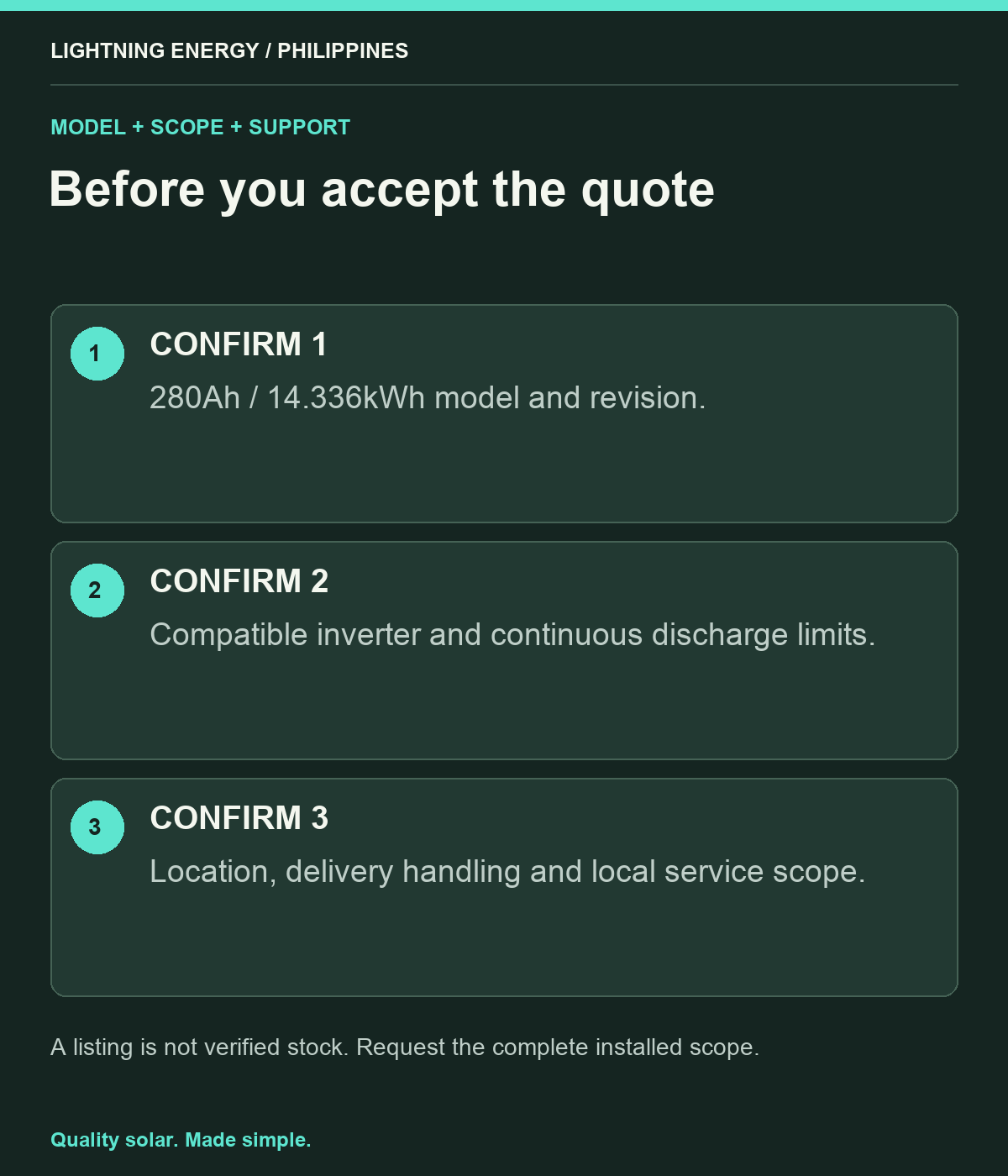
For the 280Ah PowerBrick, confirm the exact battery revision, delivery route and installation position before scheduling. Ask for the paired inverter’s supported continuous power and the chosen reserve policy in writing. The service agreement should explain who handles moving and reconnecting the larger battery if workshop attention is ever needed.
Take your evening-use estimate and installation-space photos to Lightning Energy Philippines. Request a comparison with a modular battery arrangement on equal usable-energy assumptions.
- 280Ah / 14.336kWh model and revision.
- Compatible inverter and continuous discharge limits.
- Location, delivery handling and local service scope.
Sources & further reading
Sources used for this guide. Policy and product details should be checked for your particular installation.
- Helios Optimum — Philippine offeringAccessed 27 September 2026; stock not verified
- Dyness — PowerBrick low-voltage household storage product specificationsAccessed 27 September 2026; verify delivered revision