Product reviews
EcoFlow DELTA 2 Max Review: Portable Solar Backup for Philippine Homes
Review the DELTA 2 Max as a portable backup system, with careful checks for regional voltage, solar input and realistic appliance runtime.
A renter or homeowner who wants to keep selected plug-in devices running may prefer a portable power station to a fixed battery installation. EcoFlow DELTA 2 Max is an option marketed to Philippine buyers. It should be evaluated as a complete portable system with its own limits, not as a miniature version of every whole-house solar setup.
This is a research-based review prepared on 27 September 2026, with no hands-on testing. Lightning Energy Philippines publishes this guide as a solar installer, so it has a commercial interest in installation enquiries. The assessment separates documented features from our judgement about household fit.
The exact product and Philippine listing
EcoFlow Philippines features the DELTA 2 Max solar-generator combination on its local product page. [1] This records an online offering visible during our research, not confirmed inventory, an endorsement of the seller, or a claim that Lightning Energy stocks the product. Obtain a dated quotation with the complete model code before paying.
The technical reference for this review is EcoFlow — DELTA 2 Max manufacturer technical product information. [2] A similarly named model, a regional revision or an updated generation may have different limits. Require the delivered nameplate and supplied documentation to agree with the quotation.
What the portable system contains
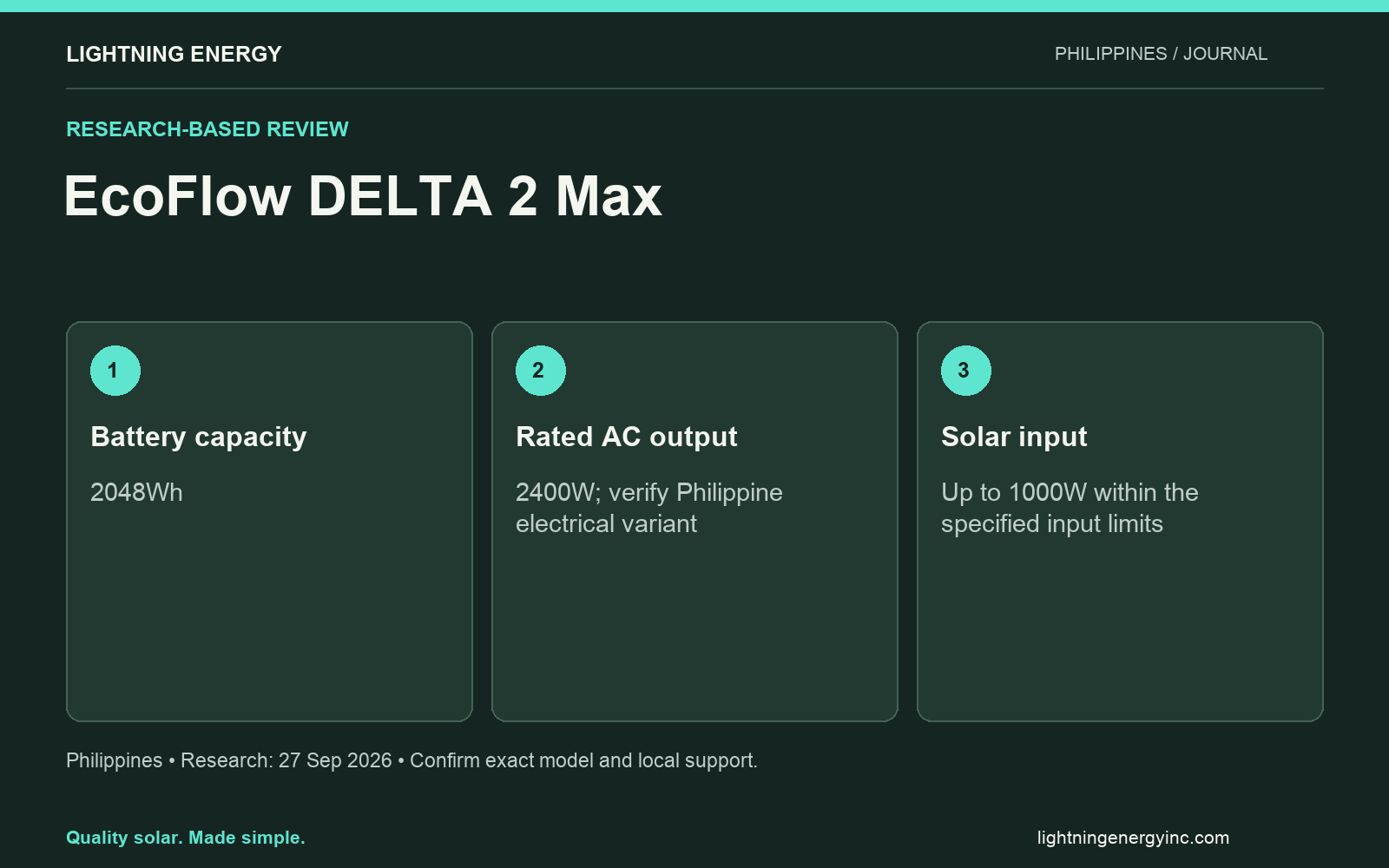
EcoFlow documents DELTA 2 Max with 2048Wh capacity, 2400W rated AC output and up to 1000W solar input across its solar charging arrangement. [2] The battery, inverter and charging functions are packaged together, which can simplify supplying selected compatible plug-in appliances.
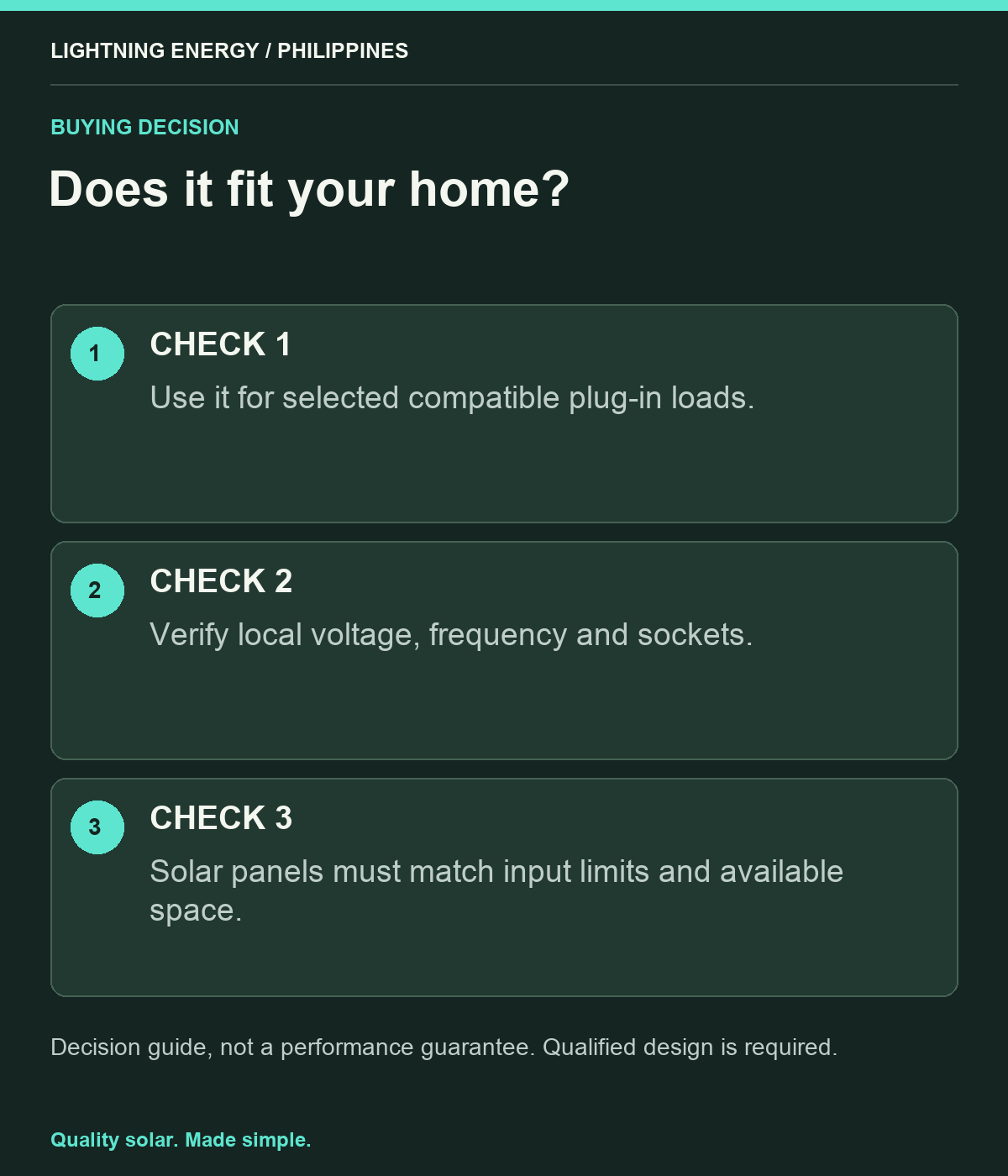
The manufacturer source is a regional page. Confirm the voltage, frequency, sockets and supplied accessories of the Philippine unit before ordering. Do not copy the socket configuration, boost-mode rating or household-wiring examples from a foreign listing. This review uses the core documented model figures and requires local-variant verification.
A practical fit for selected portable loads
A home-office user might prioritise a computer setup, communications equipment and a fan during a short disruption. A family might instead want refrigeration or other selected essentials. Start by measuring the intended loads and checking both running and starting requirements against the exact unit.
The advertised capacity does not equal energy delivered from the AC sockets. Conversion losses, reserve and operating conditions matter. Ask for a runtime estimate based on your own equipment and treat it as an estimate until the combination is tested. An appliance list is more useful than a claim that a product powers most household devices.
Solar charging needs an electrical match and a place to work
The solar-input allowance is an upper input limit, not a promise of continuous charging at that rate. [2] Panel voltage, current, connectors and the approved arrangement must match the portable station’s manual. Avoid purchasing panels solely because their combined wattage appears to equal the headline allowance.
For an apartment or townhouse, consider where panels can be placed safely and whether the area receives useful unobstructed sun. Building rules, secure mounting and cable routing can determine whether a portable solar bundle is practical. A good battery purchase can still be a poor solar purchase if there is nowhere suitable to collect sunlight.
Keep portable use separate from household wiring
Powering suitable devices from the station’s intended outlets is different from connecting it to fixed household circuits. Do not backfeed a wall socket. Any fixed-circuit integration needs an appropriately qualified professional, a compatible design and the required transfer and protection arrangement.
Also distinguish ordinary backup from a dedicated uninterrupted-power requirement. Ask whether the exact devices you rely on tolerate the product’s transfer behaviour and whether an appropriate UPS is needed. This review does not verify medical, critical-process or uninterrupted computing suitability, and a broad marketing label should not settle that question.
Our verdict: convenient when portability is the priority
DELTA 2 Max is worth considering when portability, selected loads and an integrated package matter more than a large permanently installed energy store. It is less attractive when the household’s main objective is extensive daily energy shifting or several heavy loads for long periods; a designed stationary system may deserve comparison.
Check the local warranty route, expansion-battery compatibility and included charging accessories. Compare complete bundles, not a base-unit price against a fixed solar installation. The right choice is the one that matches how you will actually use the equipment and how it will recharge between interruptions.
What to put in your quotation request
Before ordering DELTA 2 Max, ask the Philippine supplier for a photograph or specification of the actual electrical variant and a complete accessory list. Request the applicable local warranty and compatible solar-panel arrangement in writing. Plan a controlled test with your selected appliances while ordinary supply remains available, following the product instructions.
For larger permanent backup needs, ask Lightning Energy Philippines to compare a stationary system with the portable approach rather than assuming the two serve identical loads.
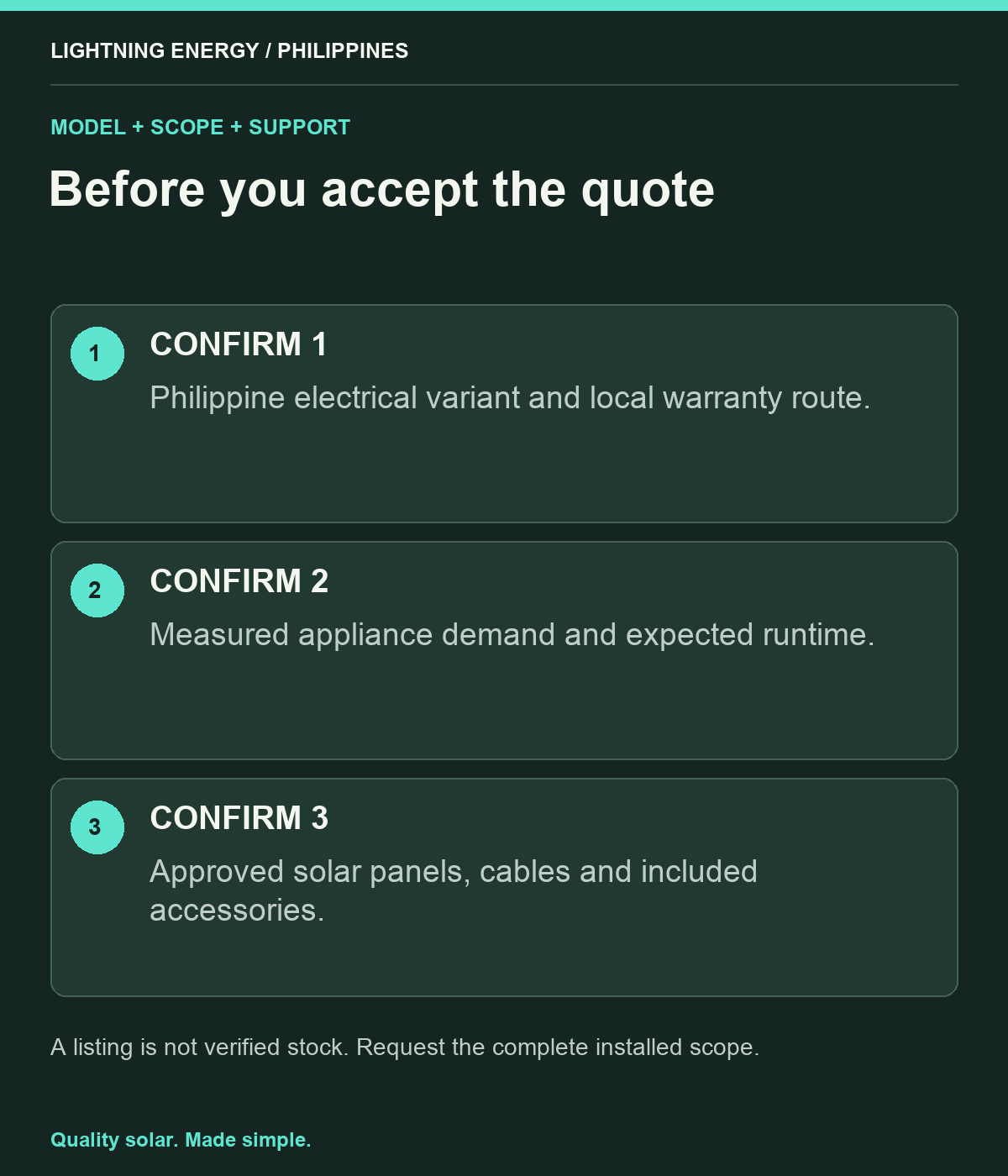
- Philippine electrical variant and local warranty route.
- Measured appliance demand and expected runtime.
- Approved solar panels, cables and included accessories.
Sources & further reading
Sources used for this guide. Policy and product details should be checked for your particular installation.
- EcoFlow Philippines — Solar generators and DELTA 2 Max offeringAccessed 27 September 2026; stock not verified
- EcoFlow — DELTA 2 Max manufacturer technical product informationAccessed 27 September 2026; verify delivered revision