Product reviews
Fox ESS F6000 Review: What Philippine Solar Buyers Should Check
A research-based review of the F6000 grid-tied inverter, with attention to generation differences, battery expectations and local support.
A simple grid-connected system may suit a household that wants useful daytime solar without buying storage immediately. The Fox ESS F6000 is one locally listed option. Review the exact F6000 documents carefully: a familiar family name does not establish that a newer generation’s specifications apply.
This is a research-based review prepared on 27 September 2026, with no hands-on testing. Lightning Energy Philippines publishes this guide as a solar installer, so it has a commercial interest in installation enquiries. The assessment separates documented features from our judgement about household fit.
The exact product and Philippine listing
PHL Solar lists the Fox ESS F6000 Gridtie in its Philippine shop. [1] This records an online offering visible during our research, not confirmed inventory, an endorsement of the seller, or a claim that Lightning Energy stocks the product. Obtain a dated quotation with the complete model code before paying.
The technical reference for this review is Fox ESS — F Series user manual published in the manufacturer download library. [2] A similarly named model, a regional revision or an updated generation may have different limits. Require the delivered nameplate and supplied documentation to agree with the quotation.
The product’s role is clear in its manual
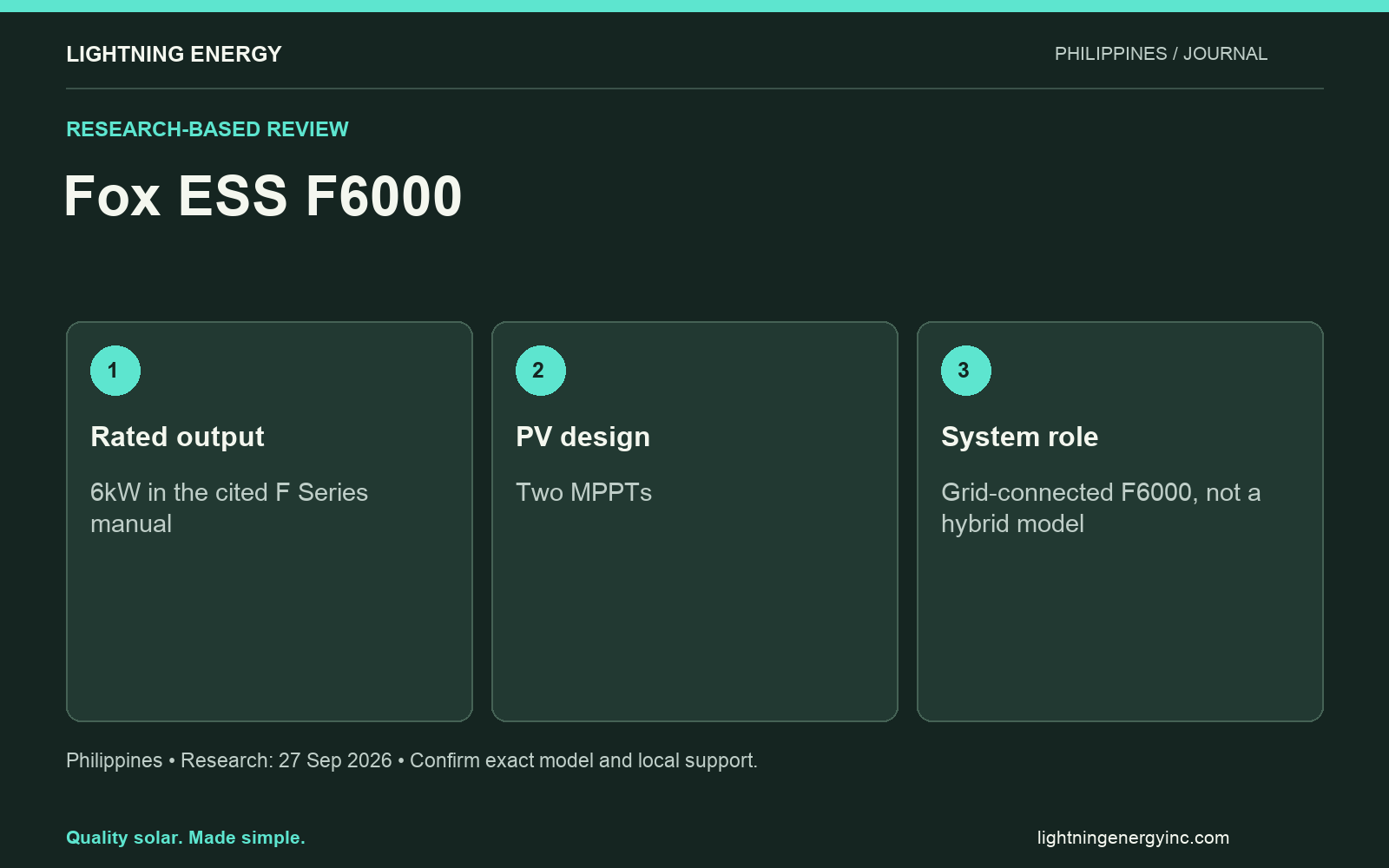
The cited Fox ESS manual includes F6000, with a rated output of 6,000W and two MPPTs. It describes grid-connected equipment and lists anti-islanding protection. [2] This review concerns that F6000 model, not a similarly named G2 or a Fox hybrid platform.
The main buying implication is straightforward: evaluate it as the conversion component of a rooftop-solar installation operating with the grid. If the sales proposal promises battery operation or protected circuits, ask which additional equipment and architecture deliver those functions. They cannot be inferred from the Fox brand alone.
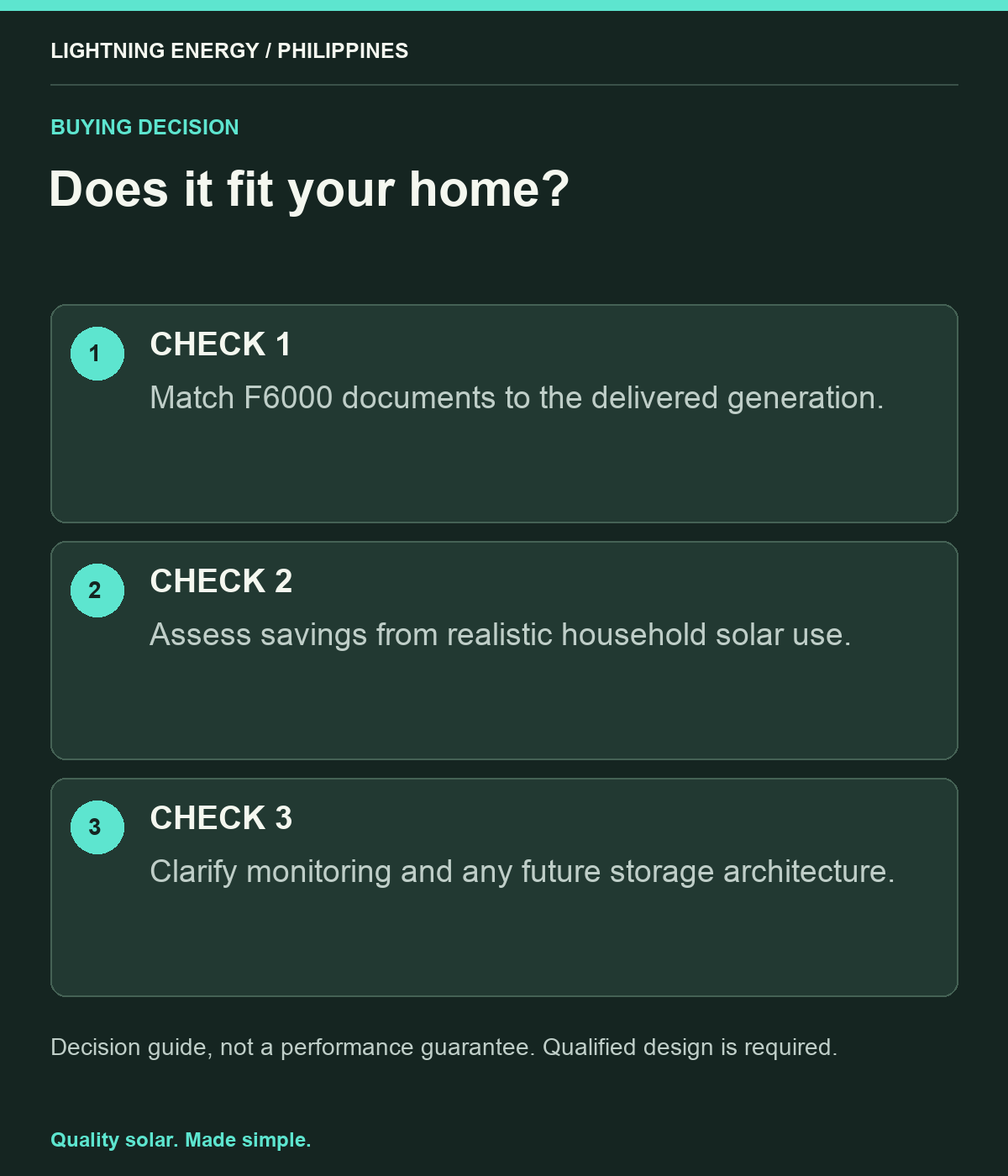
A reasonable starting point for a straightforward roof
For a roof with suitable clear areas, a conventional string inverter can be a practical design choice. The two trackers may allow different electrically suitable panel groups to be managed separately. [2] Ask the installer to show the grouping and explain why it suits the property.
The important evidence is the actual roof assessment. Trees, adjacent buildings and small roof sections can influence the layout more than minor differences between inverter brochures. Make sure the proposal uses the exact panel specifications and includes an electrical check of every planned string.
Judge the benefit through consumption, not peak efficiency
The household’s opportunity depends on how much solar production can be used or appropriately exported under its approved arrangement. A headline conversion-efficiency figure cannot describe the full bill effect. Request a forecast that separates household solar consumption from other energy flows and states the assumptions clearly.
For a working family out during the middle of the day, compare expected savings with a more conservative self-consumption case. For a home office, review the actual daytime schedule rather than assuming every appliance runs continuously. This is original purchase analysis, not a field-tested performance claim for the F6000.
Generation and accessory details can change the comparison
Manufacturer families evolve. The F6000 should be matched to the correct manual, hardware revision and available monitoring accessories. Ask whether communications hardware is included, what connectivity it requires and who owns the monitoring account after handover. A cheap equipment line item can omit items needed for the experience you expect.
Also request the documentation used for the local interconnection and the grid settings proposed by the qualified installer. A certificate for another model or another market should not be assumed to complete Philippine approval. Keep the final records with the system’s commissioning report.
Our verdict: evaluate a complete grid-tied offer
The F6000 is worth considering where the objective is a correctly sized daytime solar installation with a clear local service path. We would be less comfortable with an offer that mixes F6000 and G2 documents or leaves future battery expectations unexplained. The model suffix is a material purchase detail.
Compare it with another exact-model grid-connected inverter using the same array, household assumptions and installed scope. Ask which faults the installer will diagnose locally and how replacements are handled. A transparent commissioning and service package may be more valuable than a small difference in an inverter-only advertised price.
What to put in your quotation request
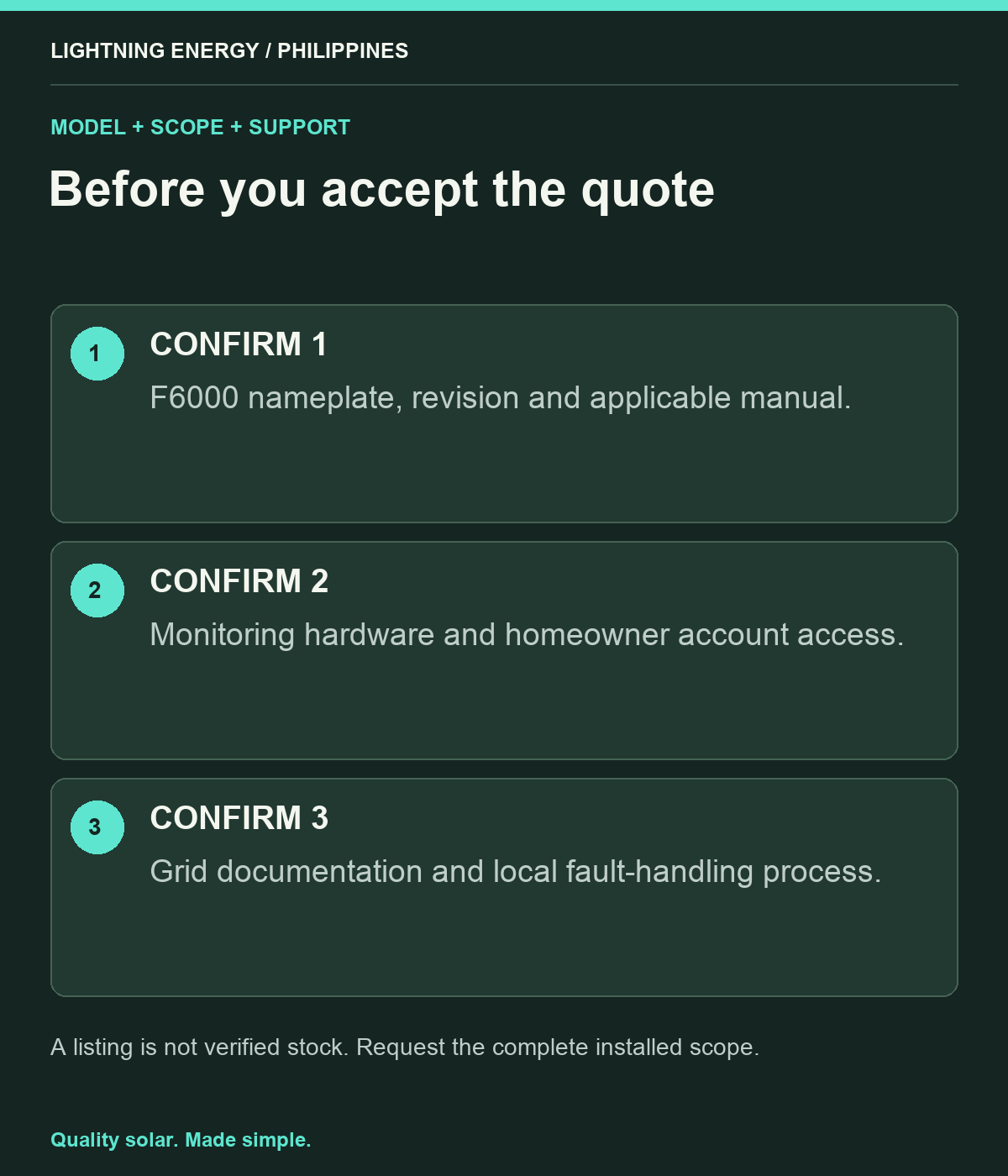
For an F6000 purchase, request the hardware revision and the corresponding manual before the installation date. Confirm whether monitoring communications are included and who retains administrative access. The commissioning record should show the selected array arrangement and the installer responsible for grid settings and local support.
Ask Lightning Energy Philippines to compare the complete Fox offer with another grid-connected option using your daytime consumption, roof conditions and required monitoring features.
- F6000 nameplate, revision and applicable manual.
- Monitoring hardware and homeowner account access.
- Grid documentation and local fault-handling process.
Sources & further reading
Sources used for this guide. Policy and product details should be checked for your particular installation.
- PHL Solar — Philippine offeringAccessed 27 September 2026; stock not verified
- Fox ESS — F Series user manual published in the manufacturer download libraryAccessed 27 September 2026; verify delivered revision