Product reviews
Growatt SPF 5000 ES Review: Off-Grid Priorities for Philippine Buyers
Review this Growatt off-grid inverter’s role, battery design and the important distinction between utility input and permission to export.
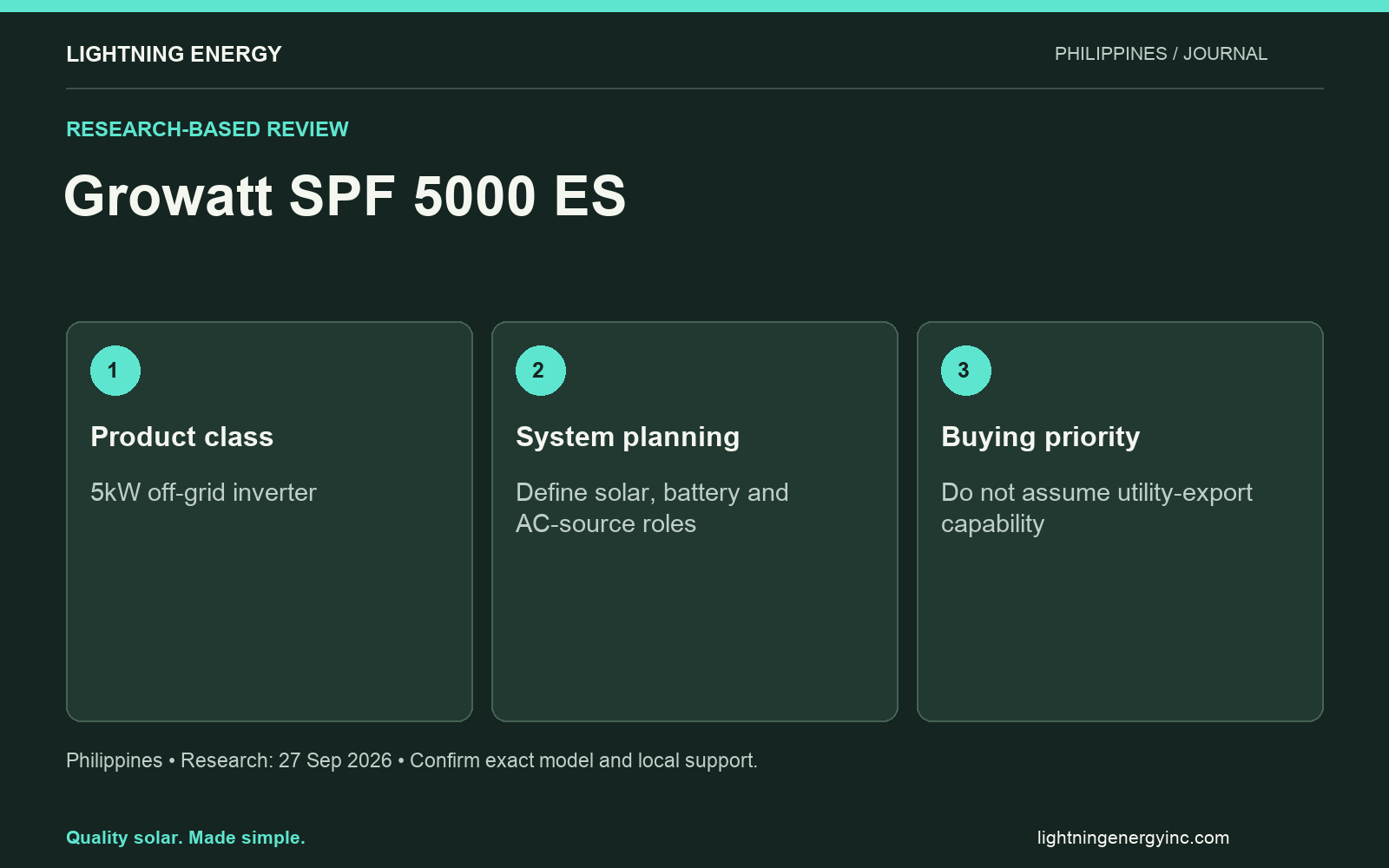
The words “off-grid” and “hybrid” are often used loosely in sales conversations. For the Growatt SPF 5000 ES, begin with the manufacturer’s product category and the job you need done. Supplying selected loads from solar and batteries is a different objective from exporting rooftop generation to the utility.
This is a research-based review prepared on 27 September 2026, with no hands-on testing. Lightning Energy Philippines publishes this guide as a solar installer, so it has a commercial interest in installation enquiries. The assessment separates documented features from our judgement about household fit.
The exact product and Philippine listing
Solar Switch lists the Growatt SPF 5000 ES for Philippine buyers. [1] This records an online offering visible during our research, not confirmed inventory, an endorsement of the seller, or a claim that Lightning Energy stocks the product. Obtain a dated quotation with the complete model code before paying.
The technical reference for this review is Growatt — SPF 3000–5000 ES manufacturer product and document page. [2] A similarly named model, a regional revision or an updated generation may have different limits. Require the delivered nameplate and supplied documentation to agree with the quotation.
Understand the off-grid architecture
Growatt identifies the SPF 3000–5000 ES family as single-phase off-grid inverters, with the SPF 5000 ES occupying the 5kW class. Its product page describes configurable operating modes and support for battery-based systems. [2] This is the architecture to evaluate rather than assuming every inverter carrying “solar” has the same functions.
An AC supply connection can serve a role in an off-grid-style system without making the inverter a utility-export product. Ask the installer to draw the permitted energy flows and explain exactly what happens when solar is insufficient, the battery is low or the utility returns.
A good candidate for a defined protected circuit group
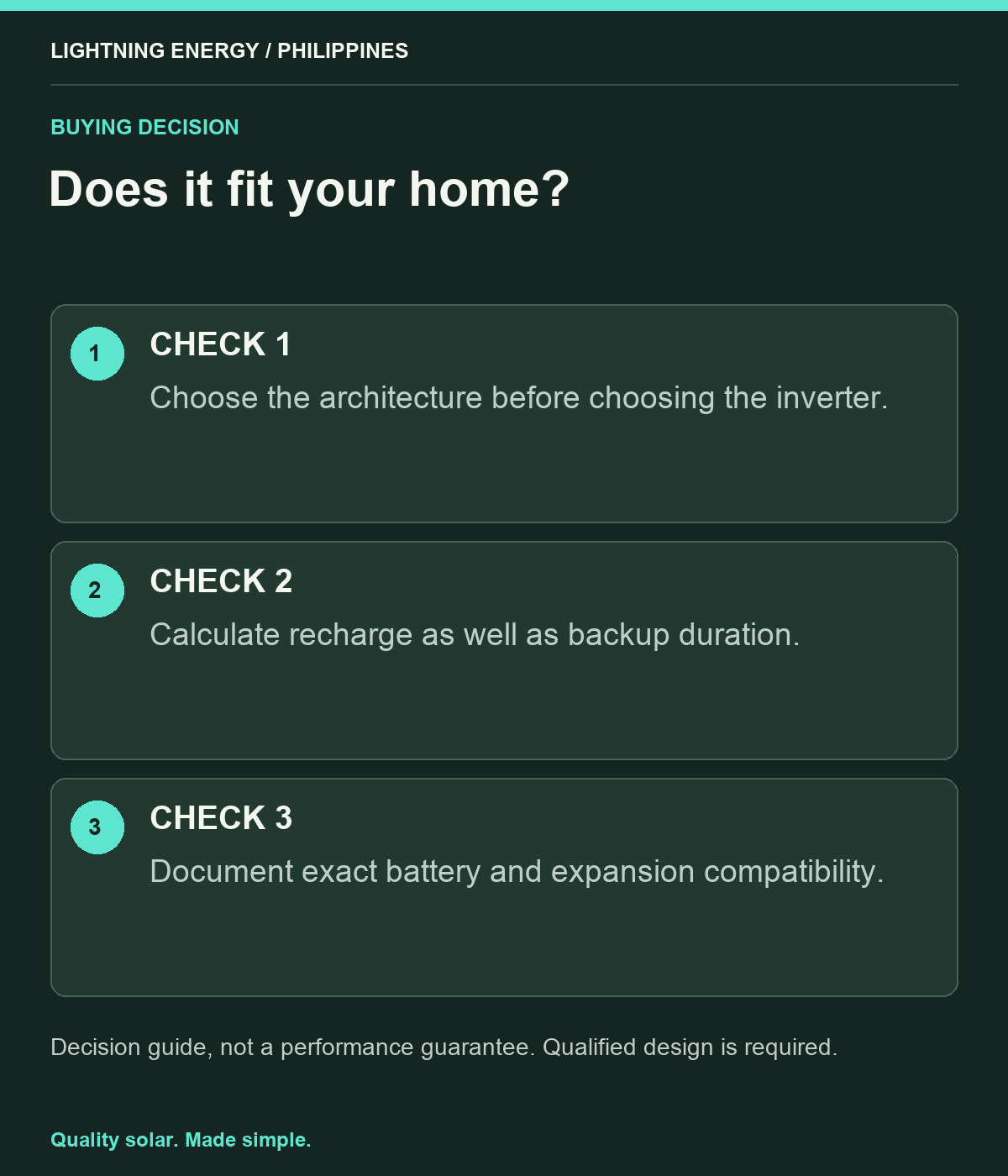
A homeowner wanting selected rooms or essential circuits supplied through a dedicated system may find this approach worth examining. The load list must be realistic. Air-conditioning compressors, pumps and other starting loads need a power assessment as well as an energy calculation.
For a small residence outside a reliable supply area, the daily consumption schedule becomes even more important. Record essential services first, then optional conveniences. That creates a basis for decisions about battery capacity, solar recharge and any alternative charging source, instead of sizing solely around the inverter’s nameplate.
Battery autonomy and recharge belong in the same calculation
It is easy to ask how long a battery can run the house and forget how it will recharge. A design that covers one evening may still struggle after repeated poor-solar days. Request an explanation of the operating reserve and how the household will manage prolonged low generation.
Growatt’s family documentation lists support for several battery types. [2] That is not evidence that an arbitrary lithium battery will communicate correctly or deliver the requested power. Require the installer to verify the exact pairing, settings, cable protection and the conditions under which output will be limited.
Expansion creates more engineering work
The manufacturer describes parallel operation within this family. [2] Treat this as a possible designed configuration, not a do-it-yourself upgrade promise. Adding inverters can affect the battery bank, protection, distribution arrangement and the permitted combinations of hardware or firmware.
If expansion is genuinely planned, request a staged design now. State which later loads you expect and what would have to be replaced. If the future need is only speculative, compare that extra preparation cost against a simpler installation sized for today. Flexibility has value only when its practical requirements are understood.
Our verdict: choose it for the right operating purpose
The SPF 5000 ES is relevant to a deliberately designed off-grid or protected-load project. We would not choose it on a vague promise of both effortless brownout protection and automatic net-metering income. Those expectations require a verified architecture, appropriate equipment and utility arrangements where applicable.
Ask for a witnessed commissioning demonstration covering source changes and a low-battery condition. Have the installer explain what the homeowner should do after an alarm. The best offer will make normal operation understandable and the limitations explicit, rather than treating configuration as something to discover after installation.
What to put in your quotation request
The SPF 5000 ES handover should include a simple source-flow diagram, a protected-circuit list and the battery settings. Ask to see the agreed source changes demonstrated and to receive instructions for low-battery operation. Have the installer explicitly document whether any utility export is part of the approved design; do not infer it from an AC input.
Lightning Energy Philippines can help scope a dedicated-load system when you provide the appliances, desired operating hours and available charging sources.
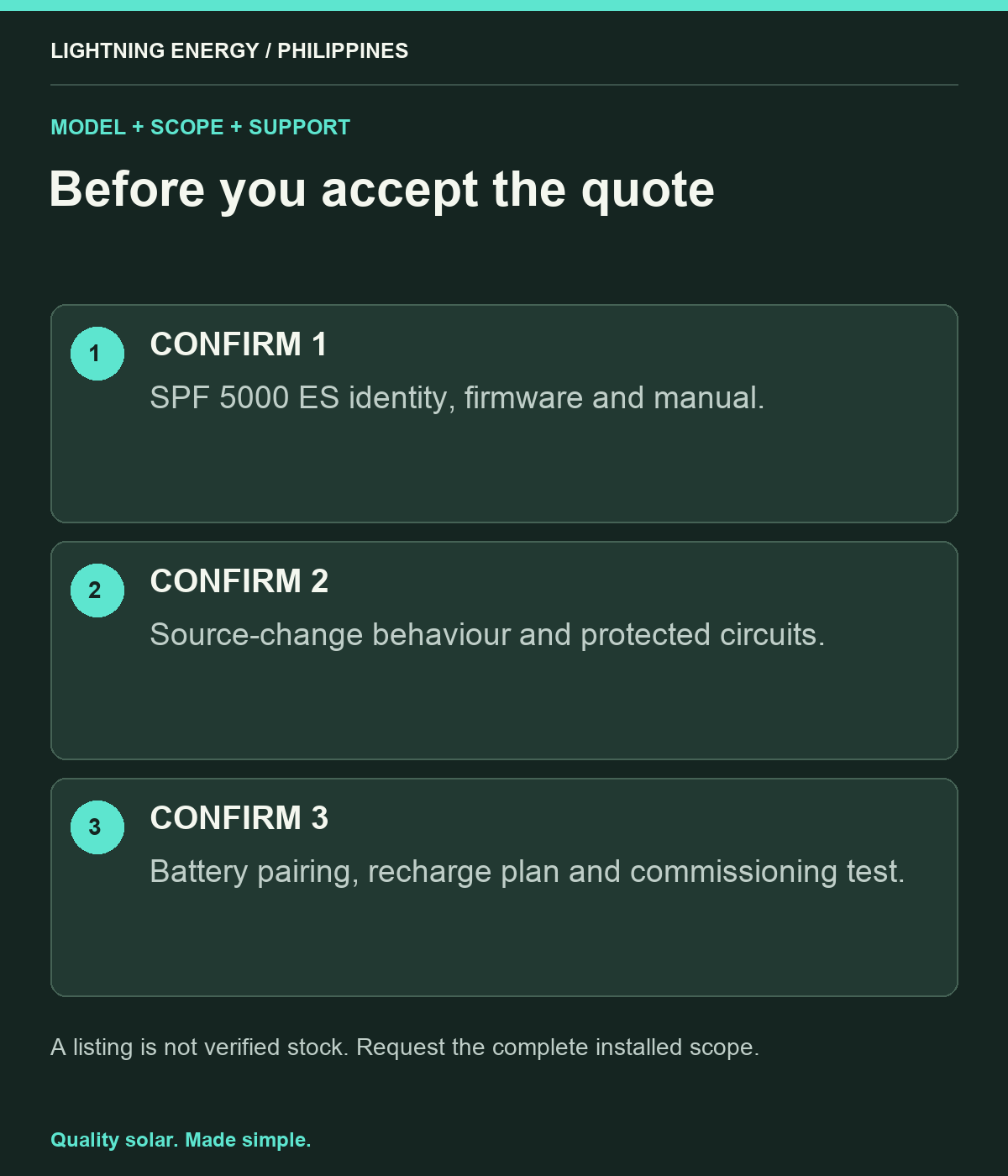
- SPF 5000 ES identity, firmware and manual.
- Source-change behaviour and protected circuits.
- Battery pairing, recharge plan and commissioning test.
Sources & further reading
Sources used for this guide. Policy and product details should be checked for your particular installation.
- Solar Switch — Philippine offeringAccessed 27 September 2026; stock not verified
- Growatt — SPF 3000–5000 ES manufacturer product and document pageAccessed 27 September 2026; verify delivered revision