Product reviews
NUUKO NKM595N-144BDM10 Review: A 595W Panel for Philippine Rooftops
Assess NUUKO’s exact 595W TOPCon panel through roof fit, electrical matching and supplier documentation instead of generic wattage claims.
When a panel quotation offers a competitive headline, the next step is to verify what the model code actually represents. For NUUKO’s NKM595N-144BDM10, the manufacturer publishes an exact table entry. That makes a more useful review possible than comparing a brand name and a wattage with no supporting document.
This is a research-based review prepared on 27 September 2026, with no hands-on testing. Lightning Energy Philippines publishes this guide as a solar installer, so it has a commercial interest in installation enquiries. The assessment separates documented features from our judgement about household fit.
The exact product and Philippine listing
SolarMall PH lists the NUUKO NKM595N-144BDM10 solar panel. [1] This records an online offering visible during our research, not confirmed inventory, an endorsement of the seller, or a claim that Lightning Energy stocks the product. Obtain a dated quotation with the complete model code before paying.
The technical reference for this review is NUUKO Power — NKM575N–595N-144BDM10 technical product table. [2] A similarly named model, a regional revision or an updated generation may have different limits. Require the delivered nameplate and supplied documentation to agree with the quotation.
What the model’s rating actually describes
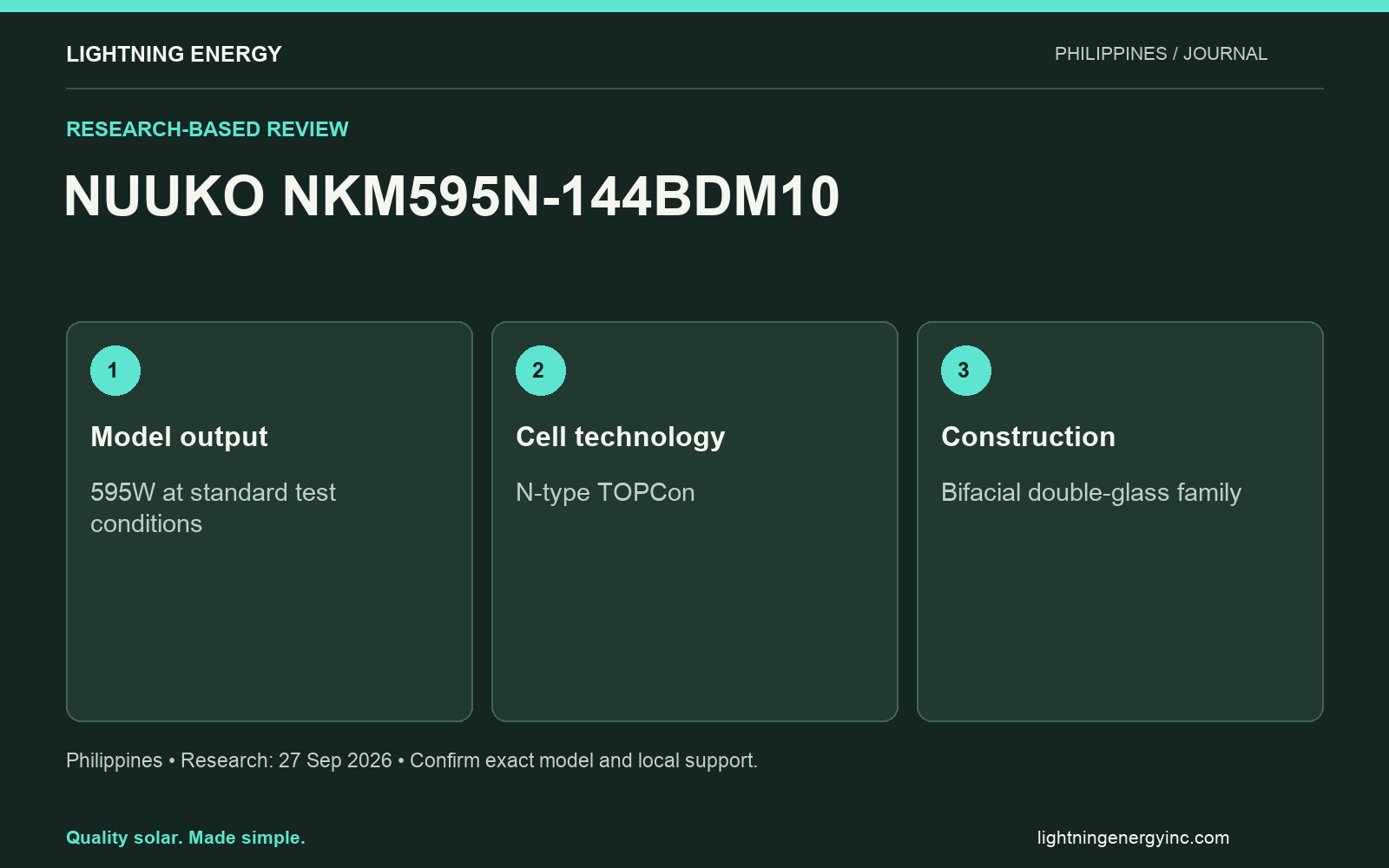
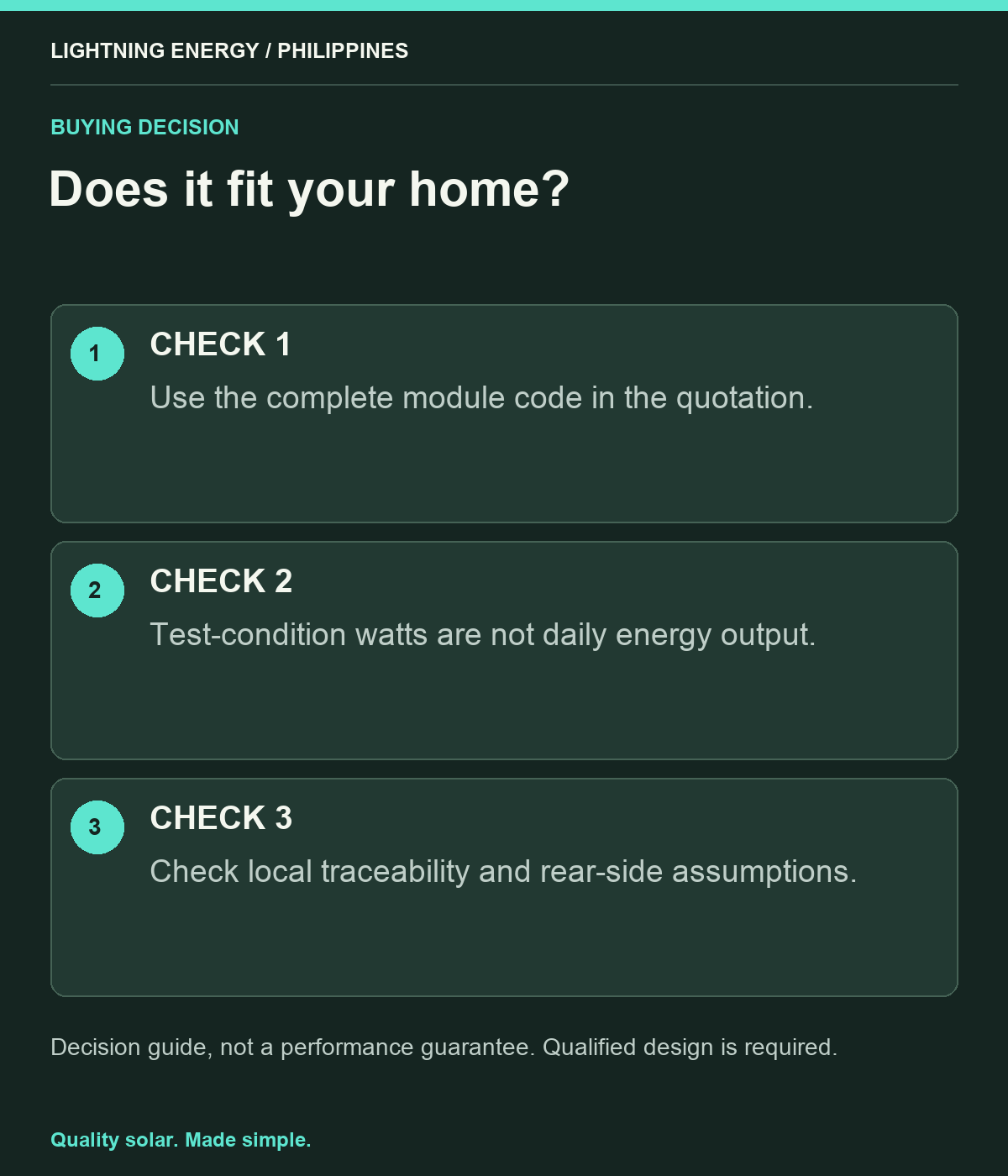
NUUKO identifies this family as N-type TOPCon, bifacial and double-glass. Its table gives the NKM595N-144BDM10 a 595W output under standard test conditions and 445W under the listed nominal-module-operating-temperature test condition. [2] These are different test references, not a promise of a fixed output on your roof.
The distinction is useful for buyers: the largest number on the label is a controlled-condition rating. Actual production changes through the day. A credible installer should model the proposed array at your location instead of multiplying rated watts by every daylight hour.
Why exact electrical matching matters
The manufacturer gives a maximum-power voltage of 43.0V at standard test conditions for the 595W variant. [2] That single number is not enough to select a string length. The designer also needs the other electrical limits, temperature assumptions and the inverter’s allowed operating range.
Ask the quote to show the full module code and the selected inverter model. If either changes, the electrical check must be reviewed. A substitution described as “same watts” may still have different voltage or current characteristics and could affect the original design.
Bifacial glass construction should solve a real problem
The documented bifacial construction can be relevant where the installation provides useful light to the rear. [2] On a residential roof, however, the value of that capability is strongly dependent on the mounting conditions. Request an explanation of any rear-side energy assumption included in the forecast.
Our preference is to compare the proposal with a conservative case that relies on front-side production alone. That prevents an uncertain rear contribution from becoming the reason the financial case appears attractive. Consider mounting and access requirements at the same time, because these are part of the installed project.
The supplier’s paperwork is part of the product
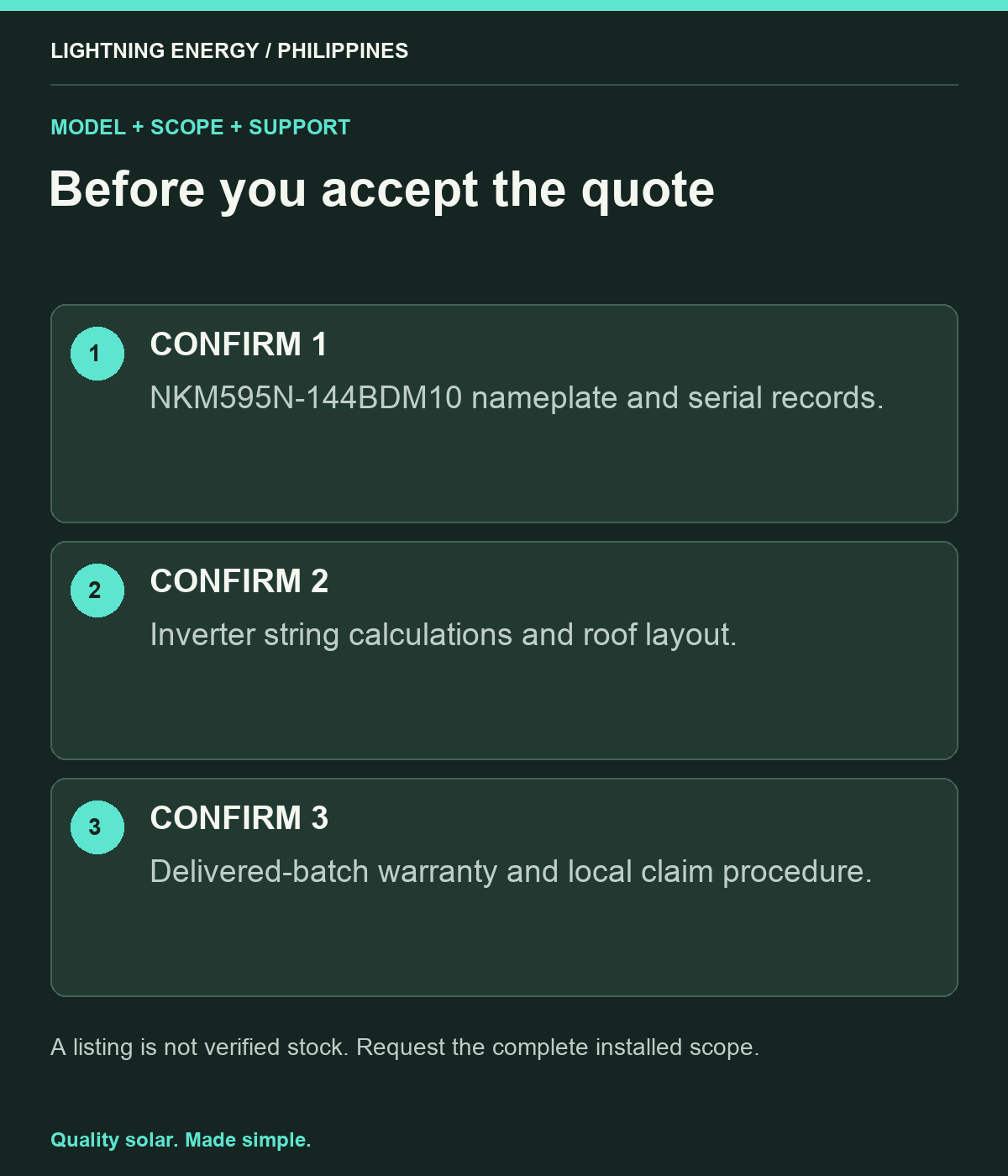
For a homeowner, module traceability and after-sales responsibility can matter as much as a small difference in nameplate output. Ask for serial-number records, the applicable manufacturer warranty document and confirmation of who handles a claim locally. Do not treat a generic brand brochure as proof of coverage for the delivered batch.
Request a written process for damaged modules discovered on delivery or during commissioning. Keep the final layout and equipment list with your installation records. If a replacement is later necessary, those documents help an installer assess electrical and physical compatibility without guessing from a distant roof photograph.
Our verdict: a model to investigate through a complete quote
The NKM595N-144BDM10 is a defined technical product that can be assessed for a Philippine rooftop project. Its suitability depends on the roof layout, structural and mounting design, inverter input limits and credible local support. The manufacturer’s test table is a starting point, not independent evidence of long-term performance in your home.
Compare it with another exact-model panel offer on equal installed scope and production assumptions. We would favour a transparent supplier and coherent design over a small wattage advantage with unclear documentation. Ask Lightning Energy to explain any alternative using the same roof drawing and household needs.
What to put in your quotation request
Before approving the NUUKO array, request an equipment list naming NKM595N-144BDM10 and the exact inverter, plus the string calculations. Keep delivered-module serial records and the warranty claim contact. If the forecast includes rear-side generation, ask the installer to show the corresponding mounting conditions and a conservative alternative estimate.
Lightning Energy Philippines can compare the proposed layout and useful energy with another exact-model panel offer when you share the roof drawing and quotation.
- NKM595N-144BDM10 nameplate and serial records.
- Inverter string calculations and roof layout.
- Delivered-batch warranty and local claim procedure.
Sources & further reading
Sources used for this guide. Policy and product details should be checked for your particular installation.
- SolarMall PH — Philippine offeringAccessed 27 September 2026; stock not verified
- NUUKO Power — NKM575N–595N-144BDM10 technical product tableAccessed 27 September 2026; verify delivered revision