Manila & nearby
Solar and Battery in Antipolo and Rizal: Ask for a Real Site Assessment
Compare solar and battery quotes in Antipolo and Rizal with a focus on shade, roof layout, equipment location and backup priorities.
A solar-and-battery search for Antipolo or another Rizal municipality should lead to an assessment of the actual house. A general map, a neighbour’s result or a large package discount cannot establish the roof’s usable area or the household’s backup requirements.
The most useful early discussion brings together shading, equipment access and your daily electricity routine. The following questions help you obtain a proposal whose assumptions are visible and whose limitations can be checked.
Describe the property without assuming the outcome
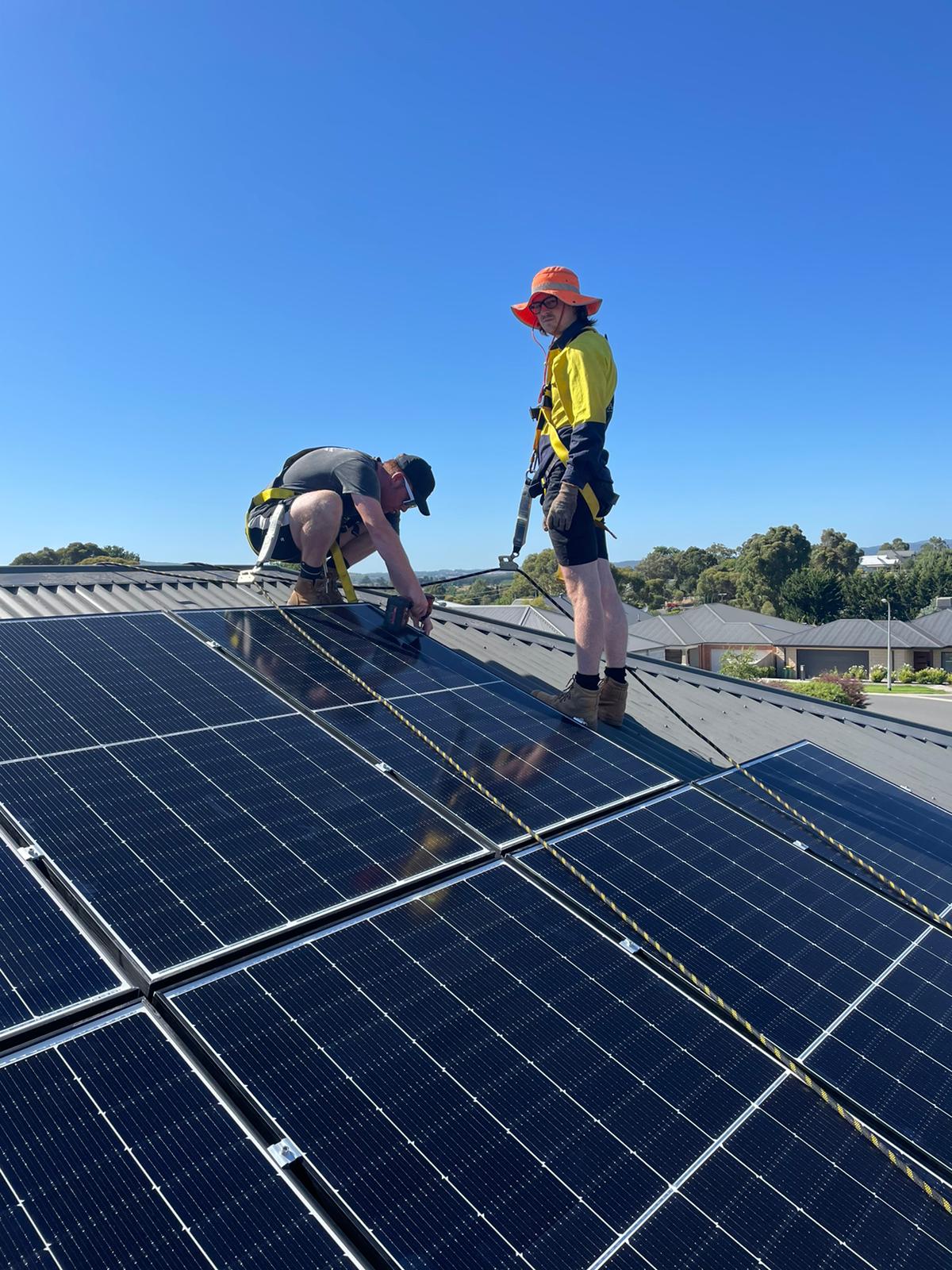
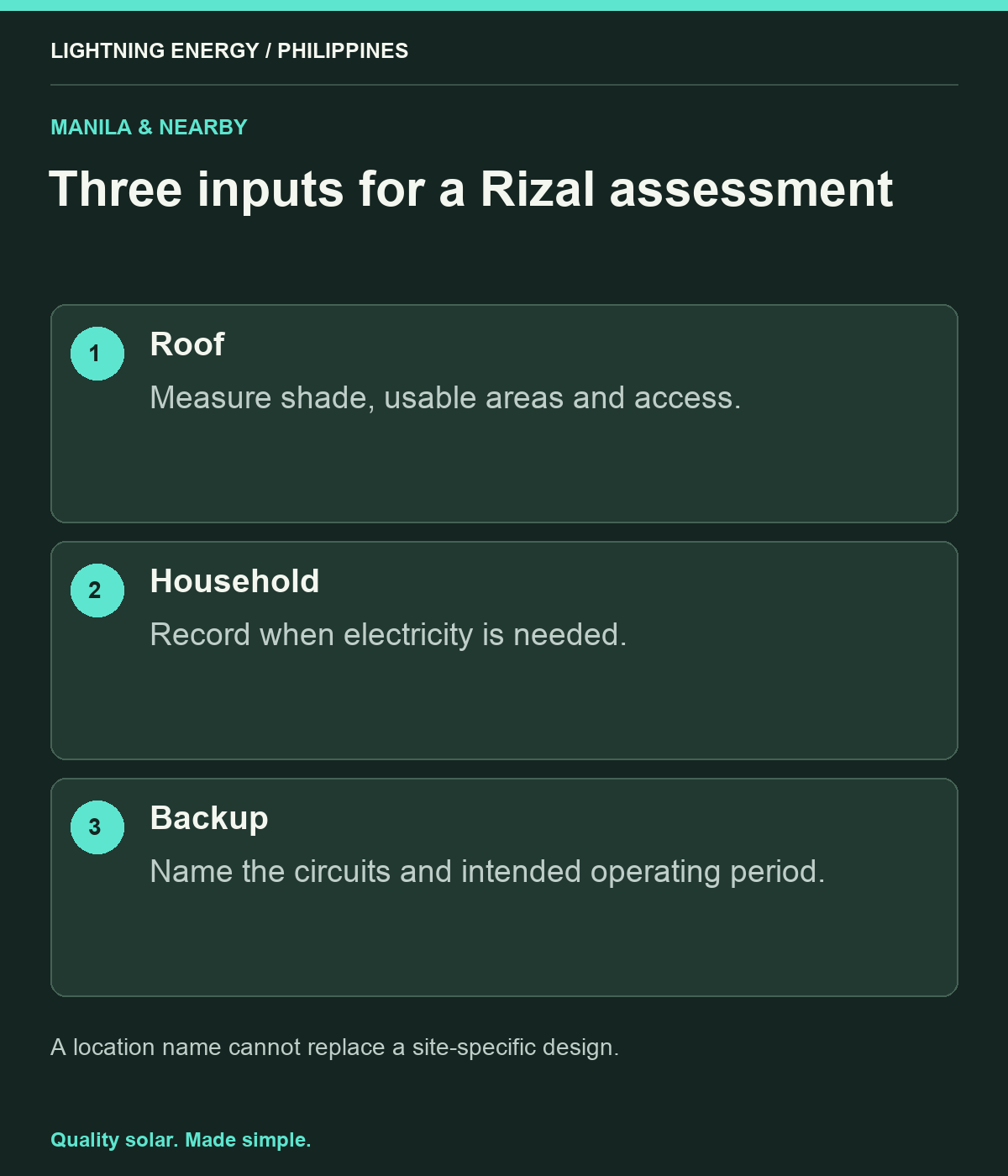
Give the installer the municipality, approximate roof layout and safe photographs showing nearby trees, structures and rooftop equipment. Mention planned building work on your property. Do not climb onto the roof to gather information; the installation team should arrange an appropriate inspection.
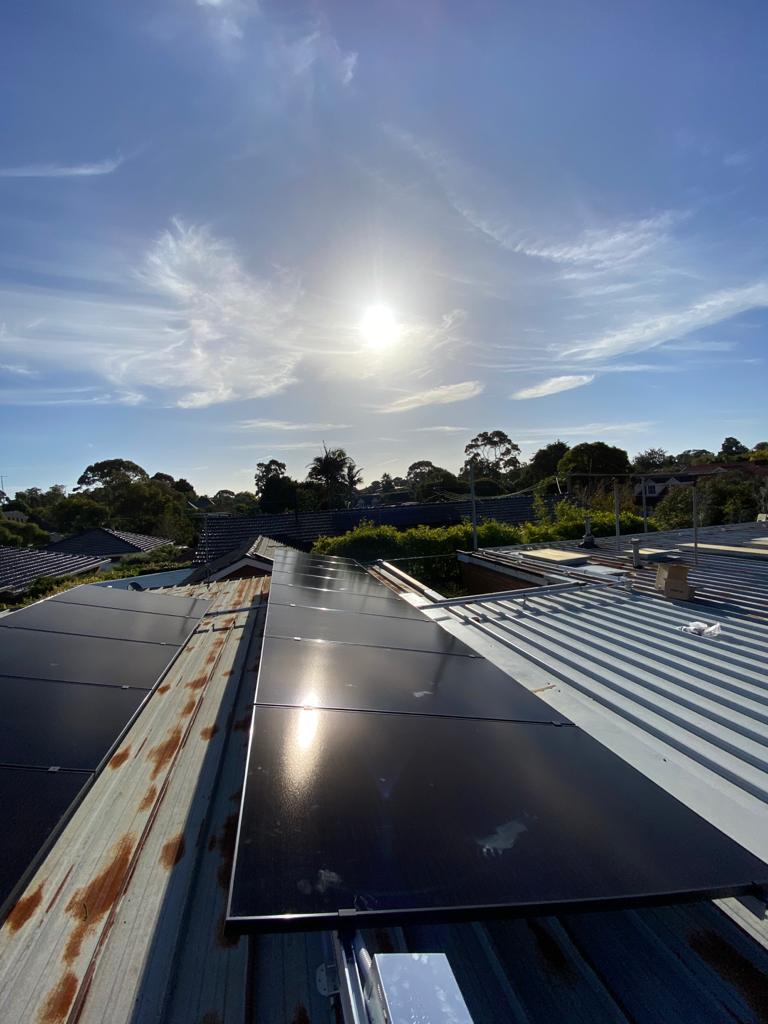
Some properties have complicated surroundings, but location alone does not prove that a roof is shaded or unsuitable. Ask the designer to identify the actual obstructions, when they affect the roof and how those observations enter the generation estimate. Separate confirmed measurements from preliminary desktop assumptions.
Ask for the shade assessment behind the layout
The US Department of Energy identifies shade and other obstructions as factors affecting solar production. [1] For your quotation, ask which roof areas are being used, why they were selected and what output has been assumed from them. A panel count without that explanation is difficult to evaluate.
In a fictional property with a tree shading one roof section late in the afternoon, the designer may compare different layouts or electrical configurations. Ask for the reason behind the chosen approach. Do not assume a particular inverter feature removes every shading loss, or that tree removal is necessary or permitted.
Separate backup priorities from roof capacity
Define the appliances and circuits you want available during an outage before discussing battery capacity. The roof determines part of the generation opportunity; the household’s priorities determine the backup brief. A larger array does not automatically mean every appliance can be supported at once.
As an illustrative planning exercise, list lighting, refrigeration and connectivity as a baseline, then ask the designer to price an additional cooling load separately. This reveals the effect on battery energy, inverter output and circuit work. Use actual appliance data and qualified design rather than a generic runtime advertisement.
Check the equipment location against the property
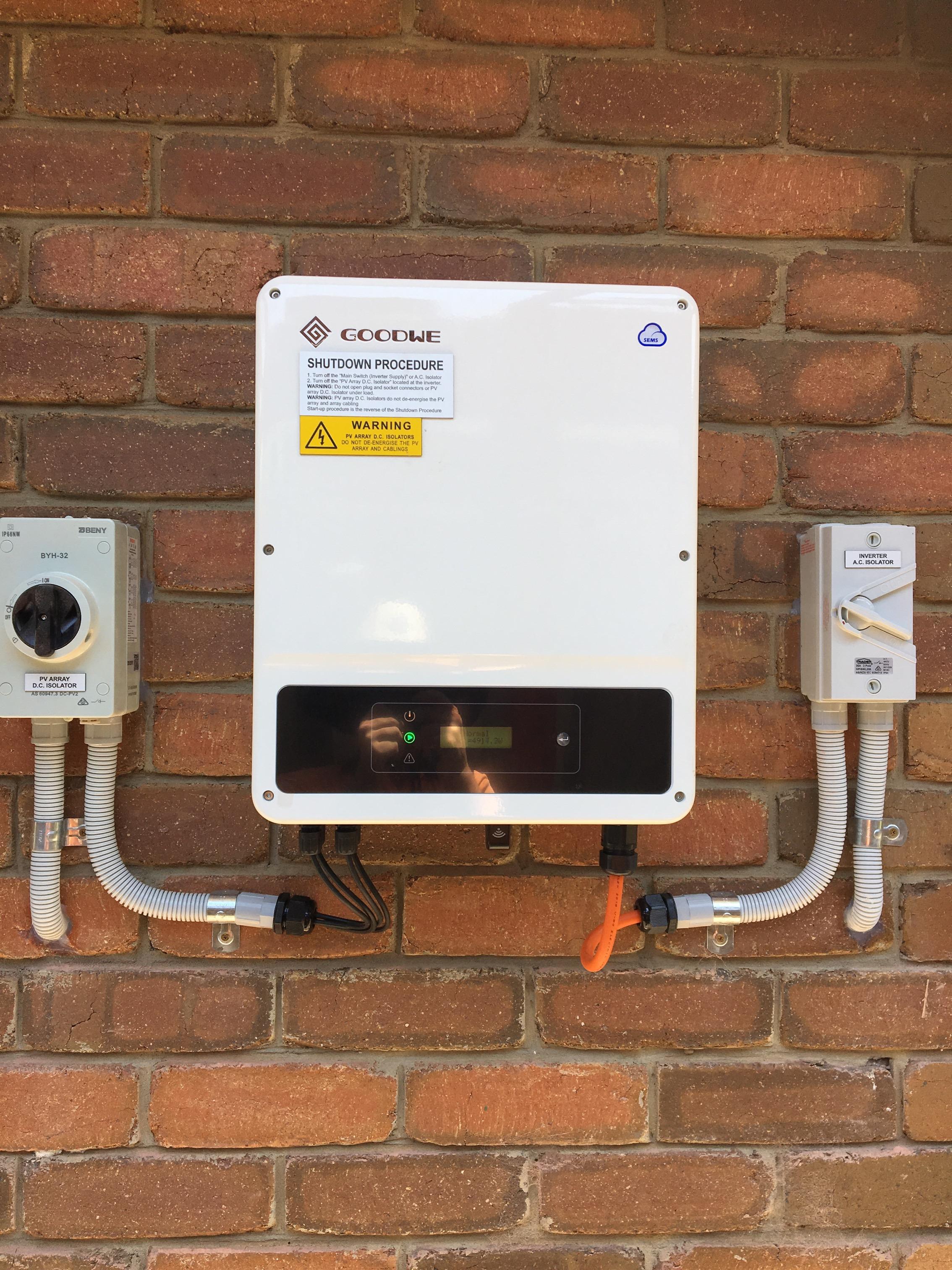
Discuss drainage, access for maintenance and any known water exposure at proposed battery and inverter positions. HazardHunterPH provides location-based hazard screening using agency information. [2] It is a starting point for discussion, not a certificate that a wall or room is safe for electrical equipment.
Ask the designer to reconcile the site findings with the exact product’s installation instructions. Keep escape routes and service access clear. A compact battery cabinet can still require space around it, and an outdoor rating should never be treated as a promise of flood tolerance.
Include travel, delivery and support clearly
Ask how the quotation treats delivery, lifting equipment and future service visits for the specific address. If the property is difficult to access, document the constraint rather than accepting an unexplained regional surcharge. A complete installed figure should show which assumptions could change after the survey.
Agree how faults are reported and who can carry out diagnosis or warranty work. For a household relying on selected backup circuits, ask what support is available if the system must be taken offline. This makes service arrangements part of the purchase decision rather than a question discovered during a fault.
Request a proposal that names its uncertainties
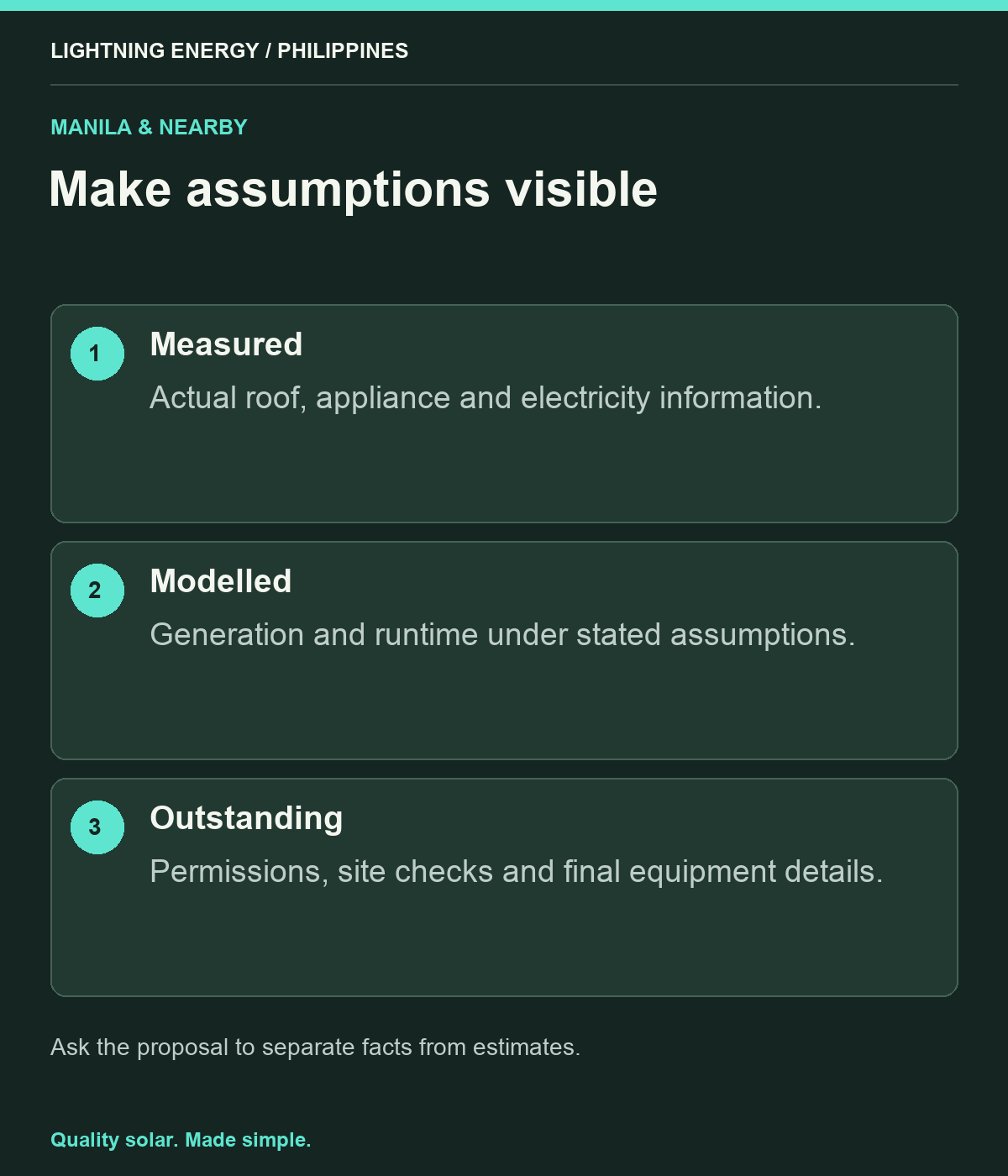
A useful assessment distinguishes measured facts, modelling assumptions and outstanding approvals. Ask for a base-case estimate and an explanation of the factors most likely to change it. Keep the agreed equipment list, backup scope and roof plan together so revisions can be tracked.
Contact Lightning Energy Philippines with your Antipolo or Rizal location, electricity history and the questions your site raises. Confirm service availability and assessment arrangements before committing. The goal is a design that explains the specific roof and household, with a backup plan that remains understandable when conditions are less favourable.
Sources & further reading
Sources used for this guide. Policy and product details should be checked for your particular installation.
- US Department of Energy — Solar Energy and Storage BasicsAccessed 27 September 2026
- GeoRiskPH — HazardHunterPH location assessmentAccessed 27 September 2026