Product reviews
SolaX LD51C Review: A Small Storage Module with Important Power Questions
Review the LD51C’s rated energy, power and installation requirements before including it in a Philippine home battery quotation.
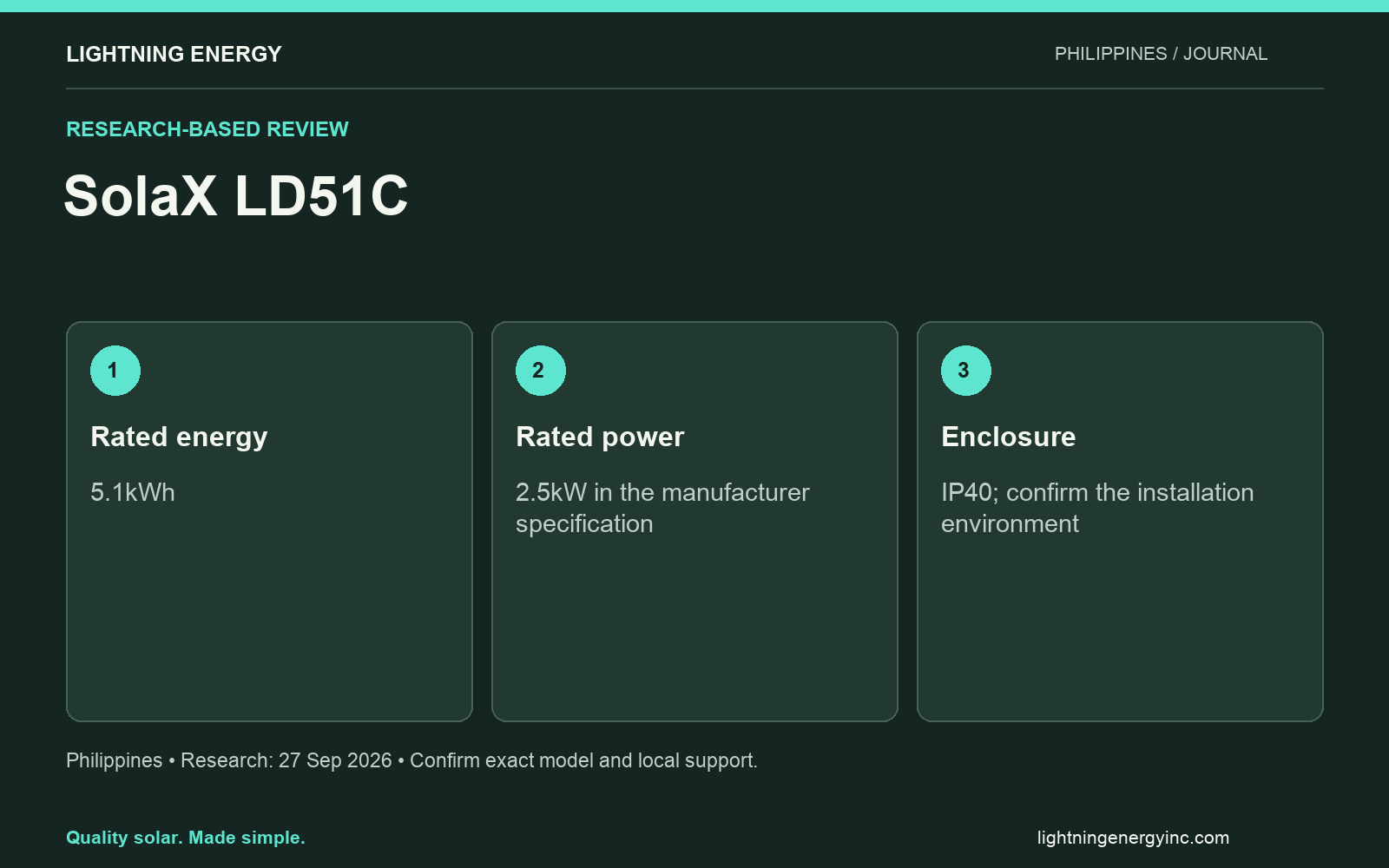
A battery module’s energy rating is only half the buying decision. The SolaX LD51C is a useful example because its manufacturer separately states energy and rated power. A household considering it should decide both how long selected loads must run and how much demand they create at the same time.
This is a research-based review prepared on 27 September 2026, with no hands-on testing. Lightning Energy Philippines publishes this guide as a solar installer, so it has a commercial interest in installation enquiries. The assessment separates documented features from our judgement about household fit.
The exact product and Philippine listing
SolarMall PH lists the SolaX LD51C battery. [1] This records an online offering visible during our research, not confirmed inventory, an endorsement of the seller, or a claim that Lightning Energy stocks the product. Obtain a dated quotation with the complete model code before paying.
The technical reference for this review is SolaX Power — LD51C manufacturer technical specifications. [2] A similarly named model, a regional revision or an updated generation may have different limits. Require the delivered nameplate and supplied documentation to agree with the quotation.
Read energy and power as different specifications
SolaX publishes 5.1kWh rated energy and 2.5kW rated power for the LD51C, with lithium iron phosphate chemistry and IP40 protection. [2] Energy describes the storage amount; power describes a rate of supplying or receiving energy under stated conditions. Neither figure alone supplies a complete runtime promise.
The distinction matters for a household with air-conditioning or pumps. A battery may hold enough energy for an intended period while still being an unsuitable match for simultaneous demand. Ask the designer to show both checks, including the inverter’s restrictions and the battery’s operating conditions.
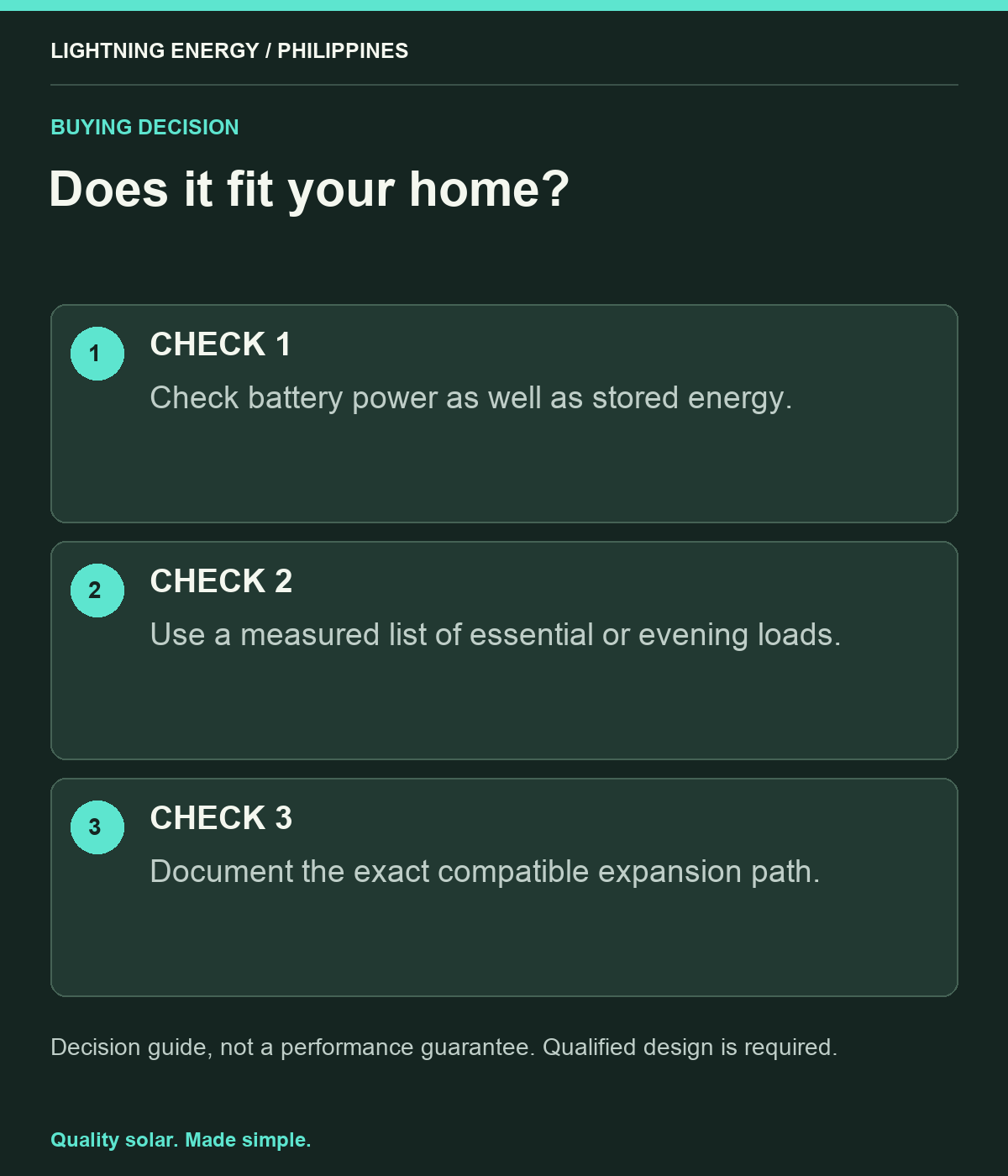
A focused load list makes the product easier to assess
For selected essential circuits, a module in this energy class may be a useful starting point. List the equipment you actually want protected and measure or obtain credible consumption information. Include start-up behaviour where relevant and separate necessary loads from appliances that can wait until normal supply returns.
If the objective is evening self-consumption, request a forecast of available solar surplus and likely battery use. The module should not be chosen simply because it is the smallest item in a package list. A system that repeatedly reaches its reserve too early may not meet the household’s objective even when technically compliant.
Expansion needs a documented combination
SolaX describes parallel expansion for the LD51C family. [2] That is a useful capability to investigate, but the permitted configuration must be confirmed for the exact inverter, battery revision and communications setup. Do not equate physical space for another battery with completed expansion planning.
Ask which additional components and commissioning work a later stage would require. Record any restrictions on mixing ages or revisions from the applicable manufacturer instructions. Compare staged expansion with installing the needed capacity initially, while keeping genuinely uncertain future needs separate from present requirements.
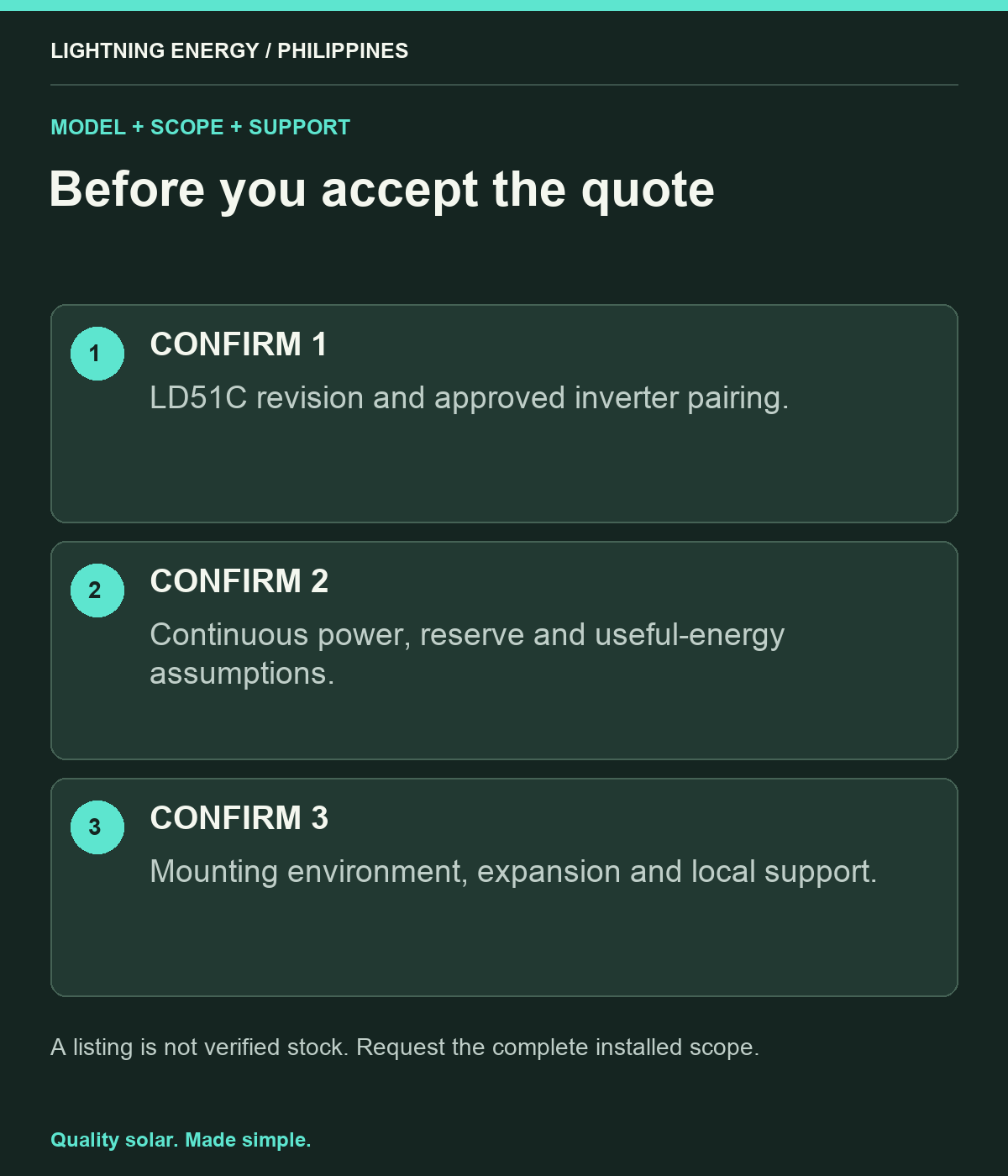
A compact battery still needs an appropriate location
The manufacturer’s IP40 classification should guide a professional review of the installation environment. [2] Do not assume the battery can be exposed to rain because another product from the same brand has a more protective enclosure. Ask for the exact mounting and environmental requirements attached to the quote.
In a home with limited utility space, access for inspection and servicing is especially important. Request a location drawing or marked photograph and check that normal household storage will not obstruct the equipment. The battery should be a maintainable installation, not simply an object that fits an available corner.
Our verdict: useful modular storage when power is checked
The LD51C is a candidate for a carefully scoped Philippine residential storage project, particularly where a modular format suits the available space and expected energy use. Its separate rated-power figure is a reason to demand clear load matching, not to dismiss the product or assume a larger inverter removes the limit.
We would compare complete compatible combinations, including protection and installation, before judging value. Ask the installer to describe the supported load behaviour during an outage and at low battery reserve. That explanation should be specific enough to guide household decisions without relying on a broad “powers the home” slogan.
What to put in your quotation request
The LD51C quotation should state the module quantity and the supported continuous system power, not only the total energy. Ask the installer to identify the limiting component and show how a future module addition would be approved. During handover, review reserve, charging status and the correct response to battery alarms.
Send Lightning Energy Philippines the protected-appliance list and intended battery location. Request a design that explains both stored energy and simultaneous demand.
- LD51C revision and approved inverter pairing.
- Continuous power, reserve and useful-energy assumptions.
- Mounting environment, expansion and local support.
Sources & further reading
Sources used for this guide. Policy and product details should be checked for your particular installation.
- SolarMall PH — Philippine offeringAccessed 27 September 2026; stock not verified
- SolaX Power — LD51C manufacturer technical specificationsAccessed 27 September 2026; verify delivered revision