Bills & savings
The Flexible Business Day: Use Timing as Part of the Solar Plan
Some electricity use can move within real operating limits. Test that flexibility before treating storage as the only option.
A business does not always need to change how much work it does to change when it uses electricity. Some tasks have a genuine scheduling window; others are fixed by customers, safety or production. Understanding that distinction can improve a solar assessment.
For Philippine businesses, flexibility begins as an operational question. It is not an invitation to assume access to a foreign demand-response payment or to move essential work merely for an attractive graph. Start with tasks the team can realistically schedule and record the limits that protect the business.
Separate fixed tasks from movable ones
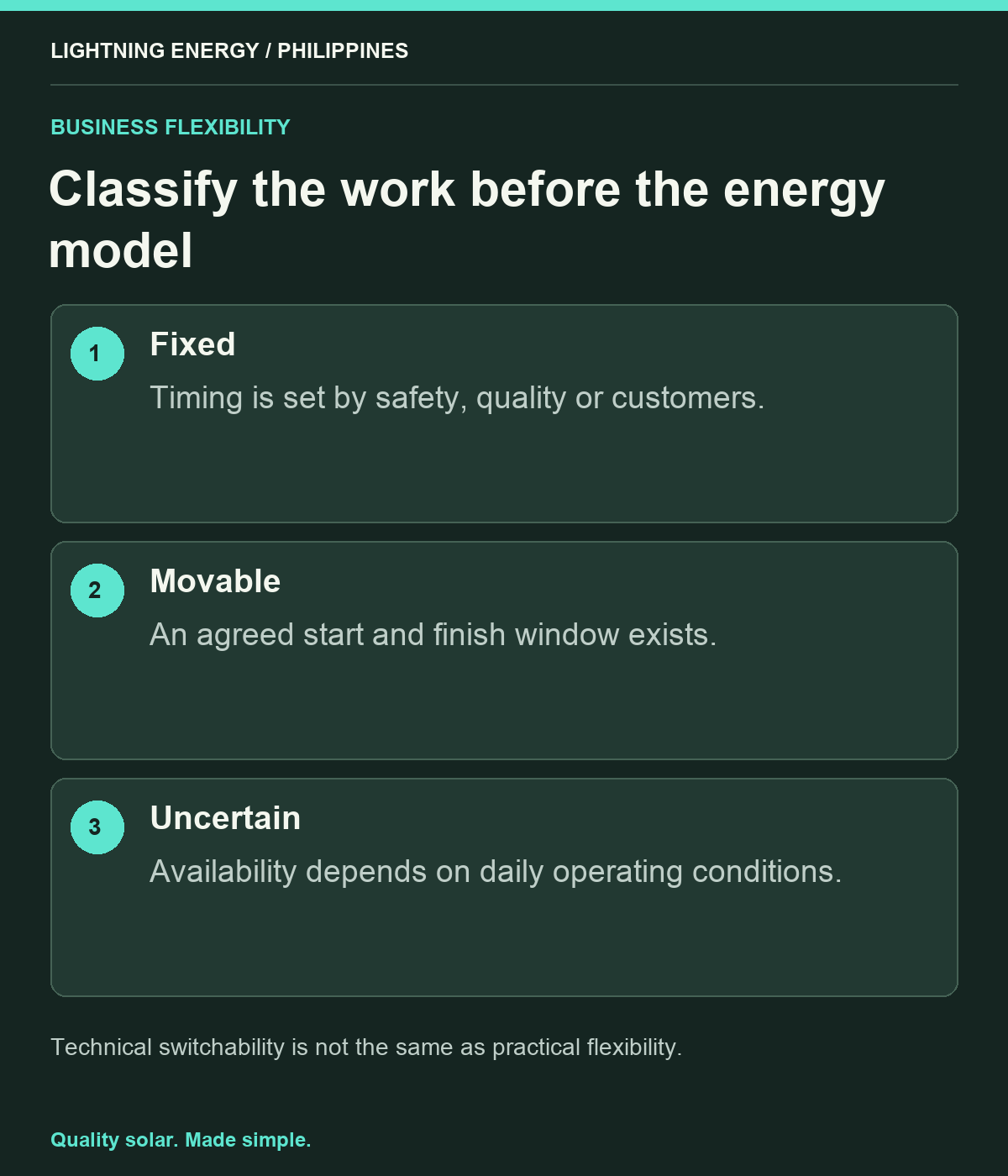
Make a list with the operations team. Mark tasks that must happen at a particular time, tasks that can move within a window and tasks whose timing is uncertain. The IEA describes demand response as shifting or reducing electricity use in response to system or market signals. [1] A site's internal scheduling exercise is simpler and need not involve a market programme. Its first purpose is to reveal practical options that can be tested against solar availability and the actual electricity tariff.
Set constraints before looking for benefits
For each movable task, record the earliest start, latest finish, responsible person and conditions that require an override. Keep product quality, employee welfare and required services outside the optimisation experiment. A hypothetical workshop might schedule a non-urgent process during an available daytime window, but another workshop may need the same machine immediately when a customer arrives. Neither is wrong. The project should reflect the business's real freedom, rather than assigning flexibility because a device can technically be switched.
Learn from Singapore without importing its programme
Singapore's EMA announced demand-side flexibility initiatives involving resources such as charging stations in 2025. [2] The relevant lesson is that participation requires a defined framework, controls and operating agreement. That announcement does not create Philippine eligibility or revenue. If a supplier proposes external payments, ask for the applicable local programme, qualification rules and contract. Until those are verified, keep the investment case grounded in the site's own consumption and explicitly evidenced billing arrangements.
Compare simple scheduling with automation
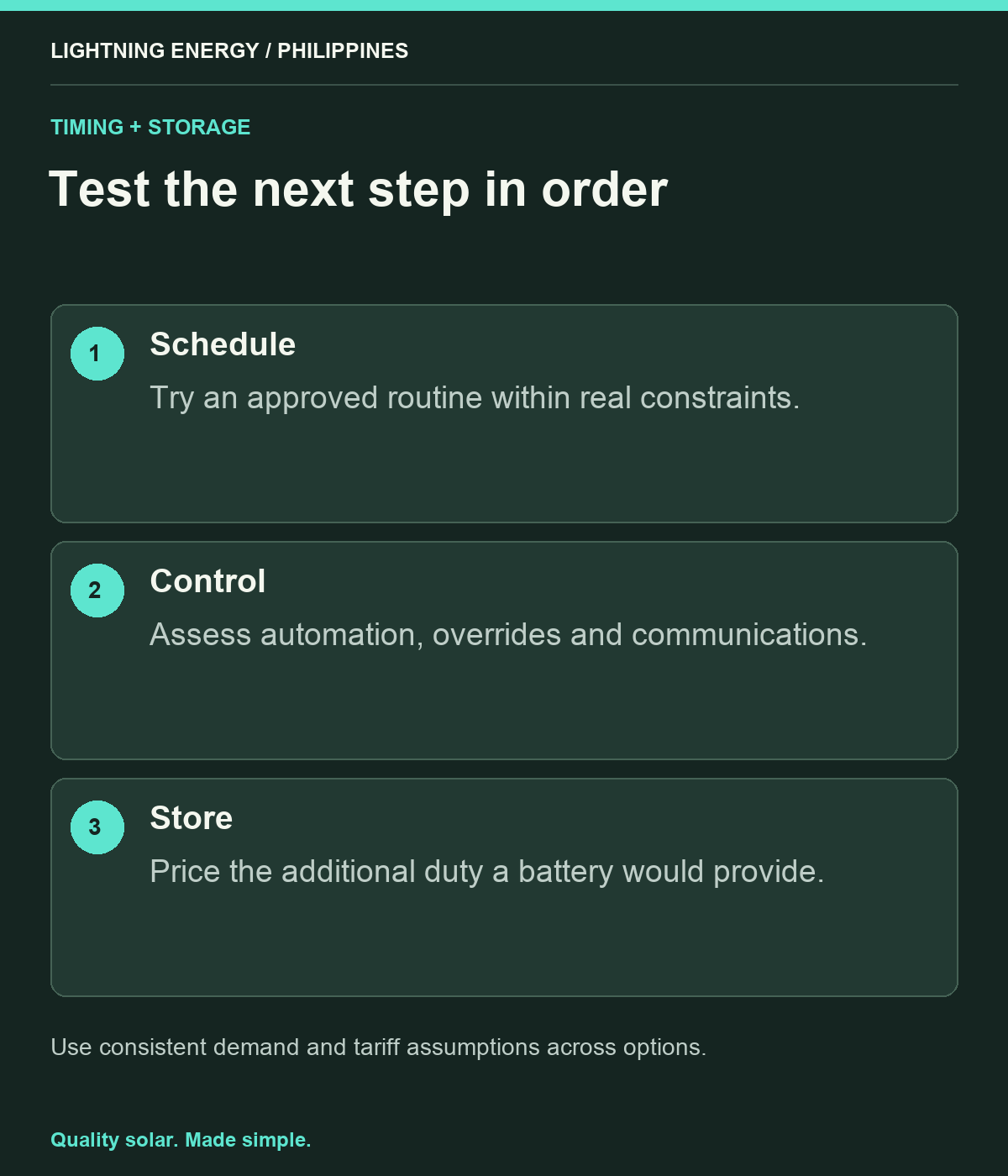
Try an approved, documented operating change where it is practical, then measure the result. If staff cannot maintain the schedule reliably, evaluate whether suitable controls would help. Consider override rights, communications failure and the training required. An automated system still needs clear priorities. It should not silently postpone work that the business considers urgent. The useful question is whether coordination can be dependable within the operating limits, not whether a dashboard can produce a perfectly smooth theoretical demand curve.
Assess the battery after the operating options
Storage may add useful flexibility, but first identify what remains after realistic scheduling has been considered. Ask the designer to compare the options using the same demand data and tariff assumptions. Keep reserve requirements and backup priorities explicit if a battery has more than one intended role. Do not count the same shifted electricity twice. A project may combine scheduling and storage, but the proposal should show the additional service and cost of each step so the owner can make a clear decision.
Track effects on the business as well as the meter
Review completion times, staff effort and any service disruption alongside electricity outcomes. A small bill improvement may not be worthwhile if it creates costly operational friction. Conversely, a simple routine that staff find easy can be valuable even without sophisticated equipment. Use an agreed review period and preserve the observations. The evidence should explain what changed, under what conditions and whether the practice remained workable during a busy week, rather than report only the most favourable day.
Bring the operations team into procurement
Share the task windows, constraints and measured results with Lightning Energy during the solar assessment. Ask for a model that respects them. The outcome should describe the business's ordinary operation and any deliberate changes required to achieve the proposed benefit. Flexibility becomes useful when it is specific, repeatable and acceptable to the people doing the work. It should leave the business with more control over electricity decisions, not a new obligation to rearrange essential services around an unrealistic schedule.
Sources & further reading
Sources used for this guide. Policy and product details should be checked for your particular installation.
- IEA: Electricity 2026, Flexibility2026; accessed 27 September 2026
- EMA: Flexible Electricity Demand Initiatives27 October 2025; accessed 27 September 2026