Bills & savings
Working from Home Changes the Solar Conversation
A home office can shift electricity use into daylight hours. Build a proposal around the real work routine and continuity needs.
Working from home changes when a house is occupied. A room that once stayed empty may now host calls, screens, lighting and cooling through the afternoon. For a Philippine household considering solar, that change deserves attention because the timing of consumption matters as much as the monthly total.
It also introduces a separate concern: keeping work going when electricity is interrupted. Daytime savings and reliable calls are related to different parts of the system. A useful assessment considers both without turning a small office into an excuse for an unnecessarily large installation.
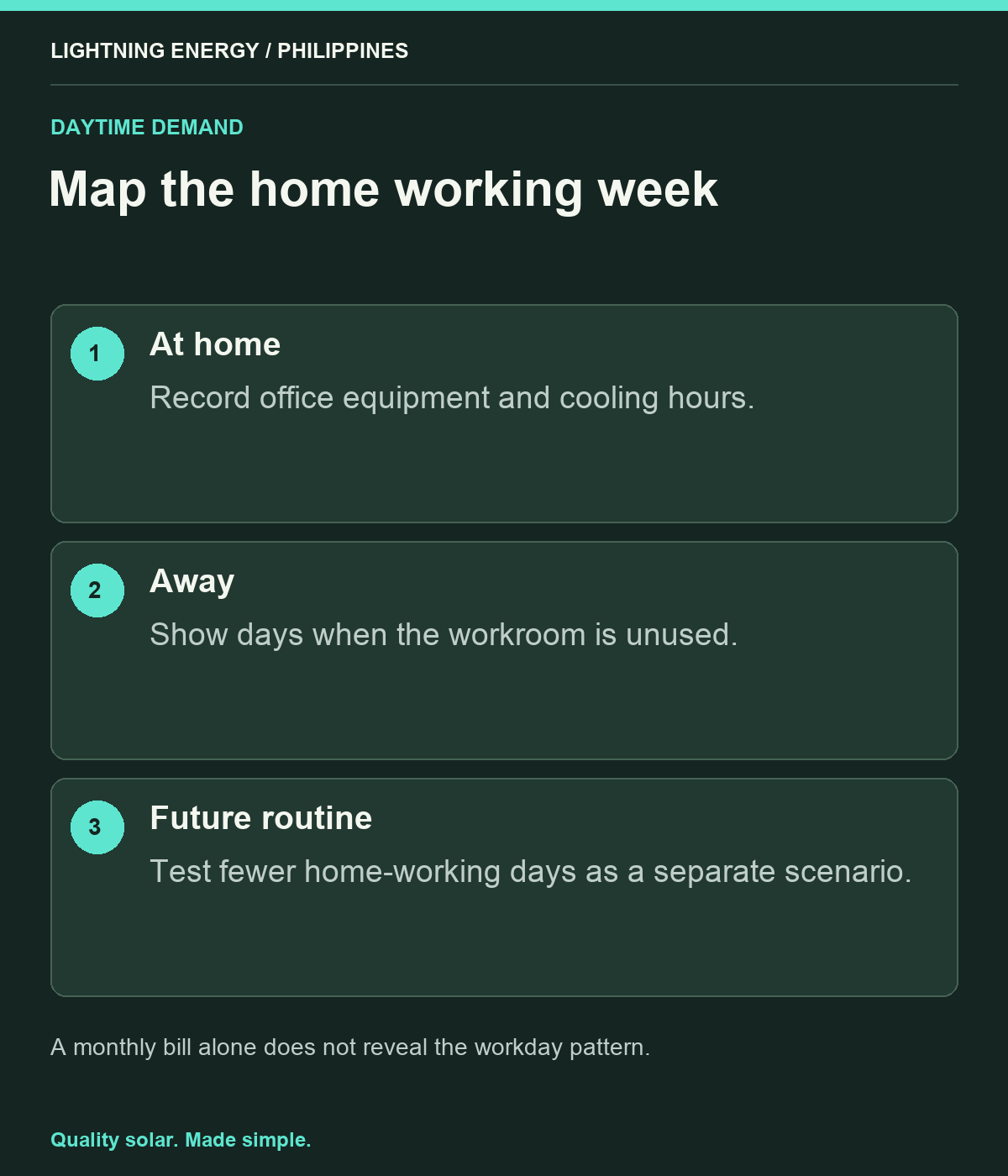
Describe the working week honestly
List which days someone works at home and which days the room is unused. Include school holidays, travel and any expected return to an office. IEA identifies cooling as a major contributor to Southeast Asian electricity-demand growth. [1] For this household, the relevant question is more specific: how many hours does the actual workroom use cooling? Ask the assessor to separate that observed pattern from assumptions about every bedroom or living space being occupied all day.
Identify the load that supports the work
Record the computer, screens, router, network equipment and any other devices needed for the job. Note whether the work depends on a home server, printer or specialised equipment. Use measured consumption where practical and manufacturer information where necessary. A laptop on a call and a desktop performing heavy processing may not have the same needs. Keep a clear boundary between what is essential to finish work and what is simply convenient to run during an interruption.
Give the battery a realistic task
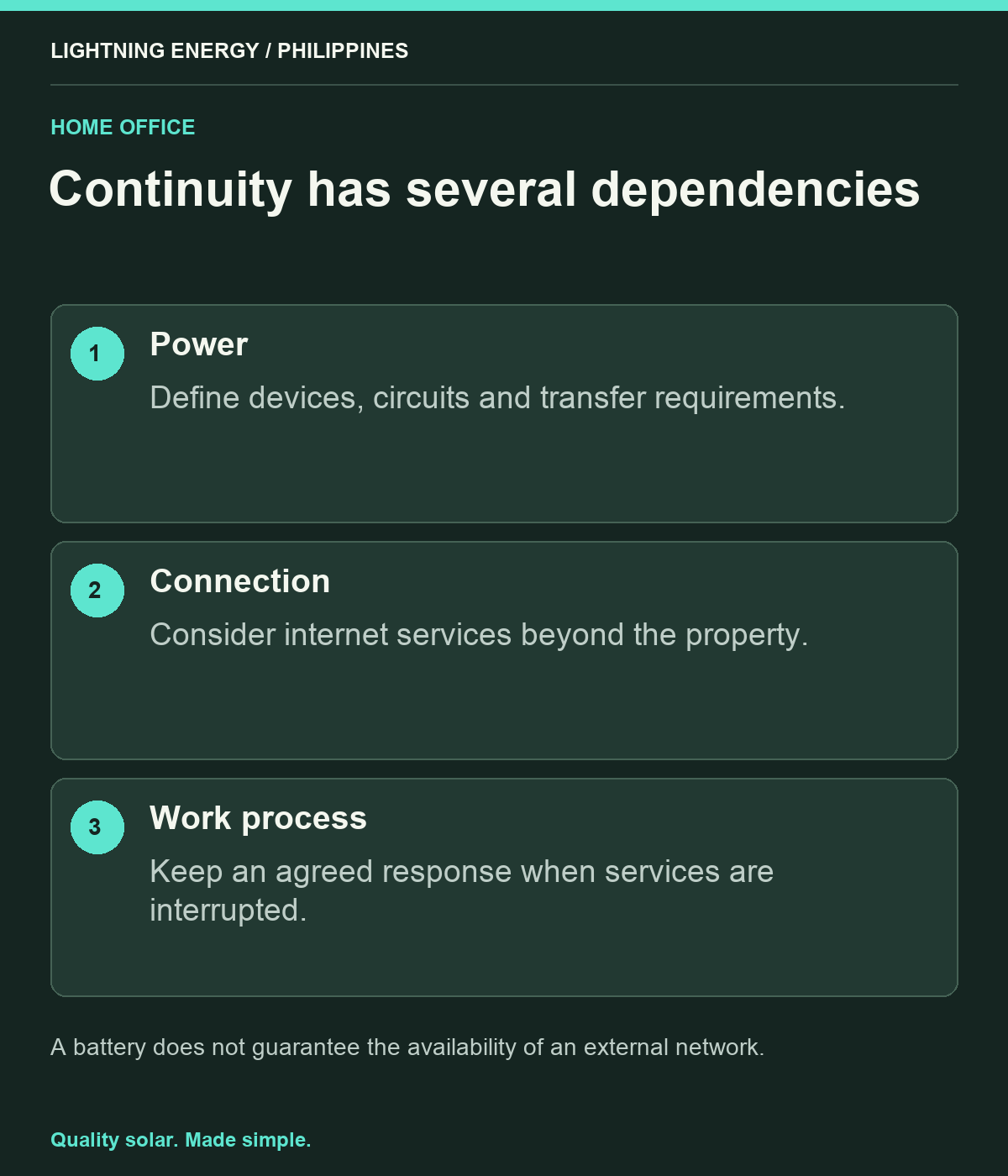
The US Department of Energy explains that storage can shift electricity use across time, with conversion losses. [2] A home-office battery assessment should therefore show the energy available for the proposed duty, rather than treating stored electricity as free or unlimited. Ask the designer about supported circuits, transfer behaviour and compatibility with any existing UPS. Specify the desired continuity outcome. A device that must never restart may require a different arrangement from an appliance that can tolerate a brief interruption.
Include the connection beyond the house
Keeping a router powered does not guarantee that the internet provider's network remains available. Make a separate work-continuity plan for communications and any data that must remain accessible. This is an operating observation, not a forecast of network reliability. An illustrative remote worker might maintain an approved alternative connection and a process for notifying colleagues. Solar and storage can address part of the home electricity problem; the complete work plan should identify dependencies outside the property's control.
Compare today with a different work pattern
Request an assessment for the current schedule and another for reduced daytime occupancy. Keep tariff and export assumptions visible in both. This helps a household judge whether the purchase remains comfortable if employment arrangements change. Avoid counting an intended future workroom as a guaranteed load before it exists. If expansion is likely, ask how the electrical design could accommodate it and which later upgrades would need a fresh assessment rather than assuming every component is automatically expandable.
Make monitoring useful without becoming a hobby
A short monthly review can compare generation and household consumption with changes in workdays, weather or appliances. Keep those notes with the electricity bills. If something looks unusual, share the date and observed pattern with the installer rather than changing unfamiliar control settings. Agree who holds account access and how support is requested. The aim is a system that supports the household quietly, not one that requires a remote worker to become a part-time energy manager.
Bring the timetable to the solar visit
Collect recent bills, the work schedule and a list of devices whose continuity matters. Explain whether the roof or electrical system is due for work. Lightning Energy can then discuss ordinary daytime use and a separately defined backup option. A well-matched home-office installation starts with the way the household actually lives and works. That practical detail is more valuable than a promise that every family with a desk should buy the same solar-and-battery package.
Sources & further reading
Sources used for this guide. Policy and product details should be checked for your particular installation.
- IEA: Southeast Asia Energy Outlook 2024, executive summary2024; accessed 27 September 2026
- US Department of Energy: Solar Energy and Storage BasicsAccessed 27 September 2026