Solar for business
Buying Solar or Buying Its Electricity: A Business Decision Map
Compare ownership and third-party offers by following payments, responsibilities and exit terms through the project.
A Philippine business may be offered an outright solar purchase, a financed purchase or an arrangement in which another party owns the system and supplies electricity. These options can distribute costs and responsibilities differently even when the panels look similar.
The useful comparison is broader than the first payment. Follow the money, the service obligations and the decisions the business retains over time. This article provides a commercial review framework; it does not establish the availability, legality or suitability of a particular contract for your site.
Identify the arrangement before comparing prices
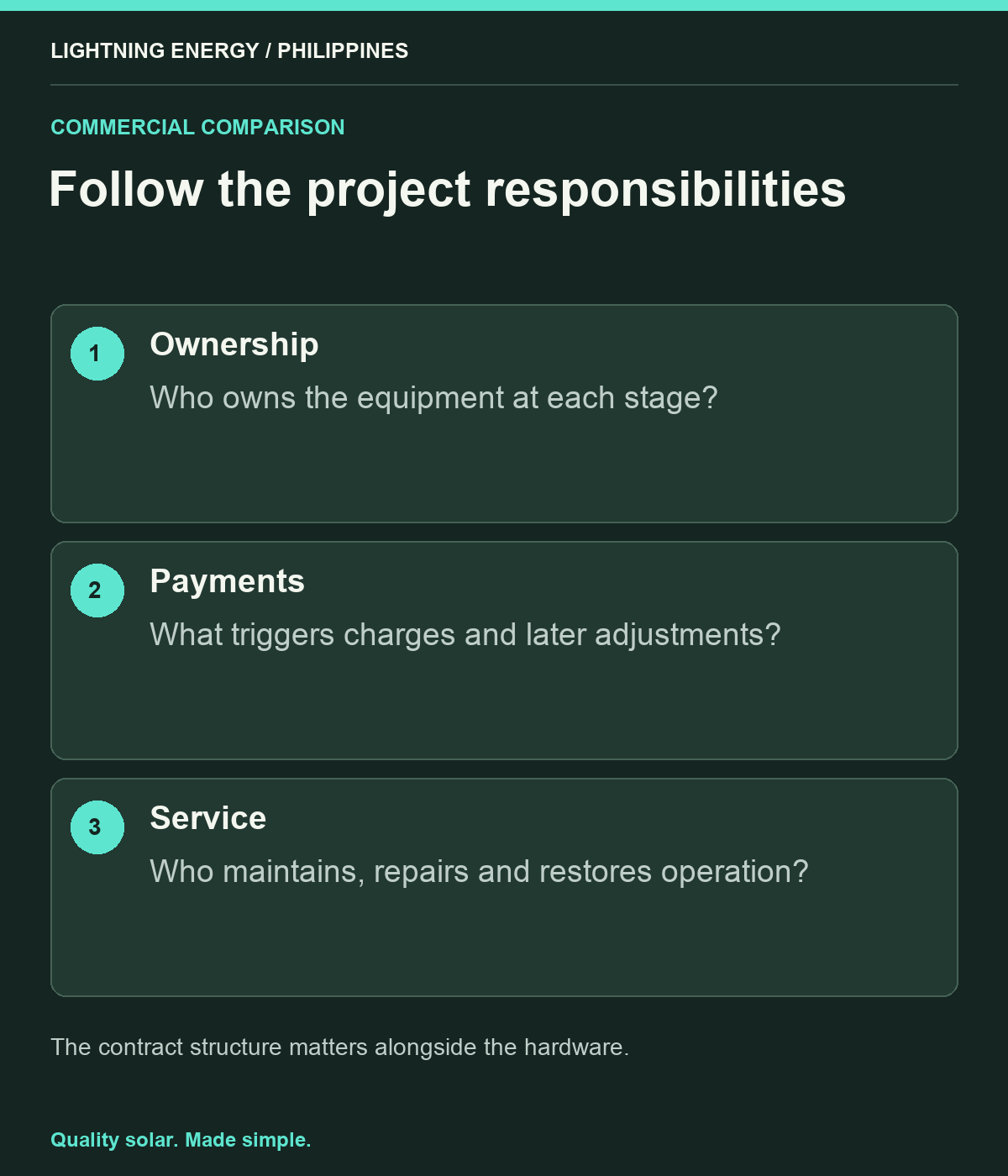
Ask each bidder to describe exactly what the customer is buying. Is the business acquiring equipment, borrowing to acquire it, leasing it or paying for electricity under a third-party arrangement? ADB's Philippine Buskowitz project documents a commercial-rooftop investment portfolio. [1] Its existence does not make every proposed contract equivalent. Record the actual owner, electricity customer, financier if relevant and service provider so that the people reviewing the offer understand their respective roles.
Put all payment rules on the same timeline
For an ownership proposal, include the installed price and the costs the owner keeps. For a third-party offer, identify the payment basis, adjustments, minimum obligations and any transfer terms stated in the contract. Have qualified advisers examine the actual wording. Do not compare a flat equipment price with only the first month of an electricity arrangement. Build a timeline long enough to expose later obligations, then mark assumptions that depend on renewals, tariffs or future business activity.
Keep performance assumptions consistent
Give all bidders the same electricity records, operating calendar and site information. Ask them to show which energy is expected to be used on site and how any approved export is treated. The ADB rooftop handbook includes financing as one part of project development. [2] Our comparison approach is to hold the physical assumptions steady while evaluating different commercial structures. If one offer assumes higher demand or better production, the difference must be visible before its payment model can be judged fairly.
Follow maintenance and repair responsibilities
An owner may value direct control but must know which services are included and which require future payment. A third-party arrangement may assign maintenance elsewhere, yet the response standards and exclusions still matter. Distinguish a warranty claim from a commitment to restore service within a particular time. Ask who arranges roof access, pays for removal during building work and keeps the system's records. Responsibility should be traceable to a named contractual party rather than an informal sales assurance.
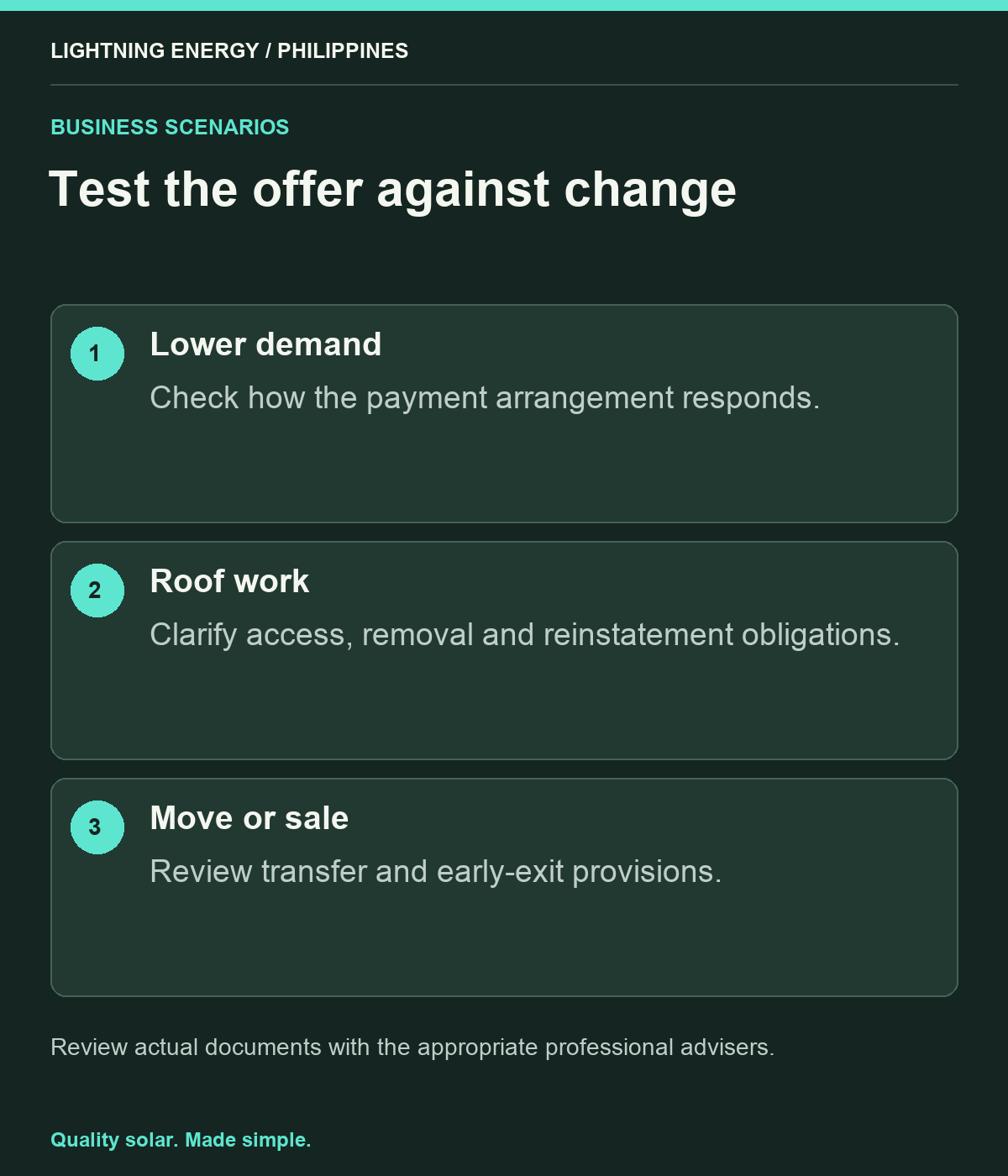
Test a change in the business
Use a hypothetical scenario in which the premises operate fewer days, change tenant or need a roof replacement. Ask how each proposal responds under its actual terms. An agreement that is comfortable during today's busy operations may behave differently after a move or expansion. Record the costs and permissions involved in transfer, early termination or alteration. These are matters for specific contract review, not universal features of all leases or power-purchase agreements.
Compare uncertainty as well as the base case
Ask the finance team to examine less favourable production and consumption scenarios without treating them as forecasts. Keep financing costs, service allowances and tax assumptions explicit and obtain appropriate advice on the latter. A lower initial outlay can be valuable, but it should not conceal a commitment the business does not understand. Likewise, ownership should not be presented as automatically superior when capital has other productive uses. The decision depends on the operation, the written offer and the owner's priorities.
Request a one-page responsibility schedule
Before choosing a route, ask for a summary covering asset ownership, payments, maintenance, roof works, data access and exit arrangements, supported by the full documents. Lightning Energy can help explain an installation scope and the evidence behind its energy model. The relevant commercial and legal advisers should assess any financing or third-party contract. A sound decision leaves the business able to explain not only why solar is useful, but who must do what when the building, demand or equipment changes.
Sources & further reading
Sources used for this guide. Policy and product details should be checked for your particular installation.
- ADB: Buskowitz Rooftop Solar ProjectAccessed 27 September 2026
- ADB: Handbook for Rooftop Solar Development in AsiaDecember 2014; accessed 27 September 2026