Solar for business
Island Resorts: Plan Solar Around the Whole Guest Experience
A resort solar-and-storage brief should include occupancy, water, kitchens, staff areas and the logistics of keeping equipment serviced.
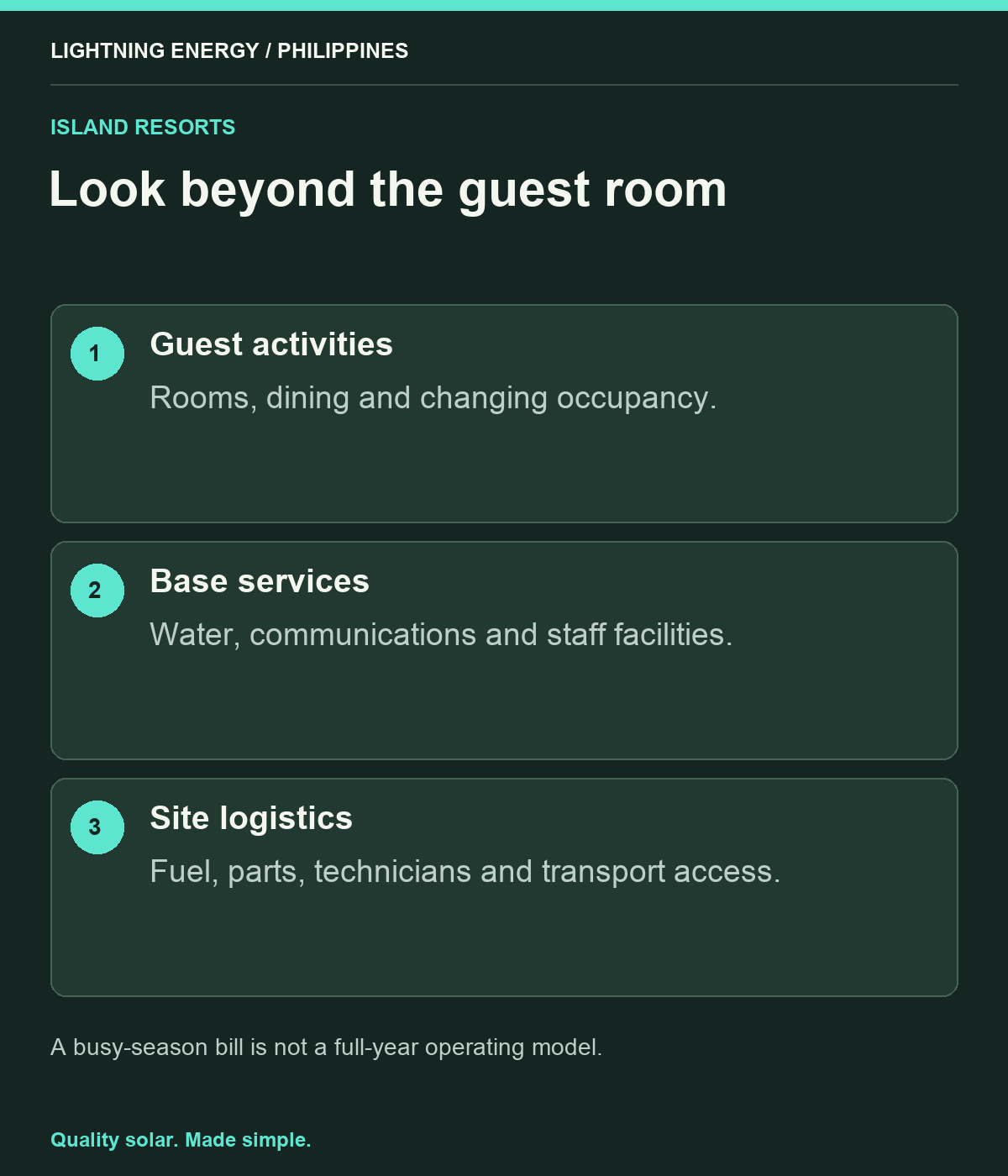
For an island resort, electricity supports much more than the guest room. Kitchens, water systems, communications, staff facilities and maintenance activities all shape the energy day. Seasonal occupancy can change that pattern, while transport affects how fuel, parts and technicians reach the property.
A solar-and-storage project should therefore be assessed as an operating system for the resort, not simply as a roof installation. Start with current energy records and the services guests and staff rely on, then evaluate how new equipment would work alongside the existing supply arrangement.
Build an occupancy-aware energy picture
Compare busy and quiet periods, and separate guest-related demand from services that continue regardless of occupancy. Record restaurant hours, laundry activity, water pumping and staff accommodation where relevant. A single peak-season bill is not a full-year model. Use an illustrative low-occupancy week to ask which loads remain and whether the proposed generation would still be useful. Keep future room expansion or electric equipment purchases as explicit scenarios until the business has committed to them.
Learn from island systems without copying their scale
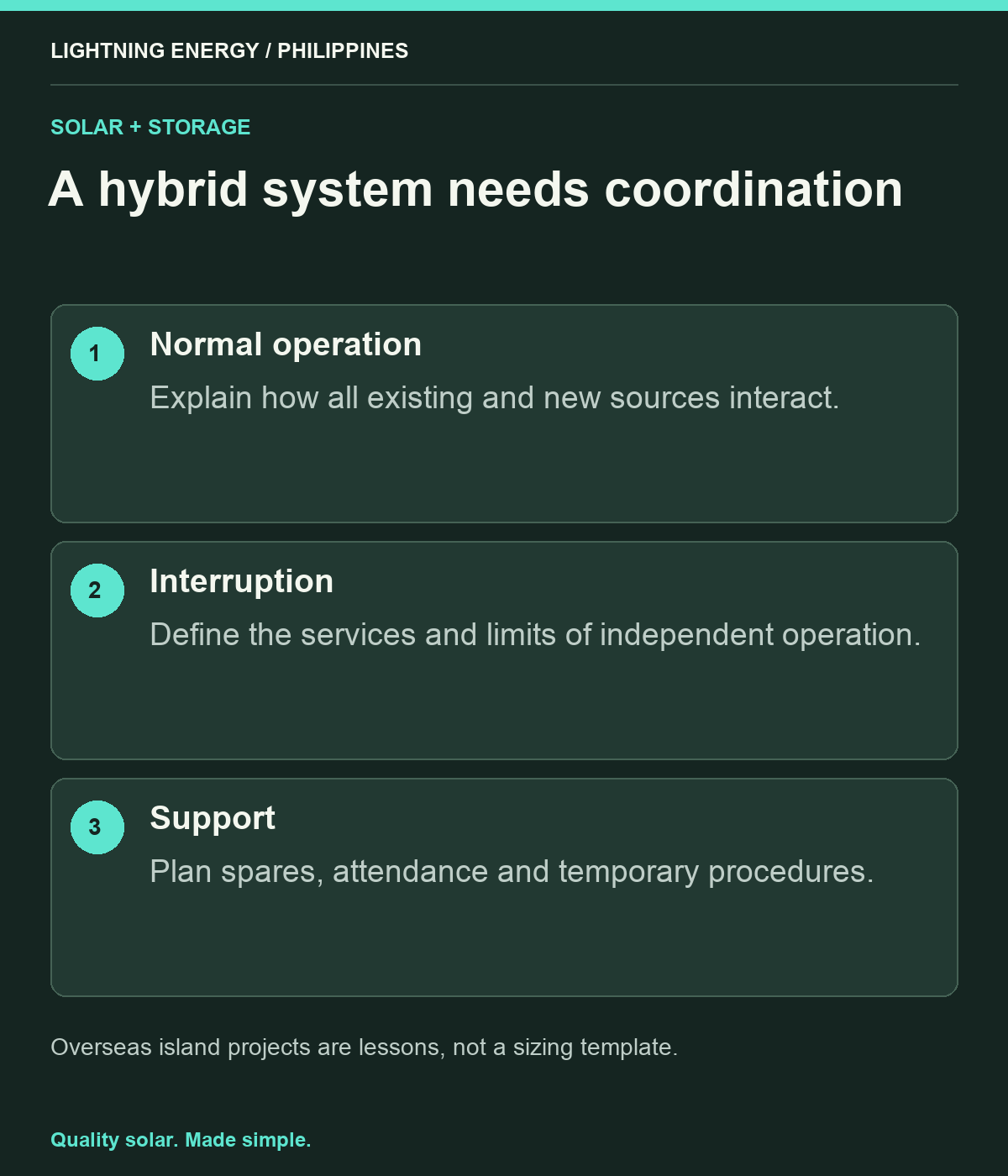
ADB's Maldives experience describes hybrid mini-grids combining generation, batteries and management systems. [1] The useful lesson is coordination, not a standard equipment ratio for every island. A Philippine resort has its own demand, electrical network, operating obligations and weather exposure. Ask the designer to assess how solar, storage and any existing generator would interact. Do not assume that adding a battery makes an existing supply system compatible or that a overseas mini-grid result predicts the resort's economics.
Define the experience during an interruption
Decide which services the resort intends to maintain and which can be limited under its approved operating plan. The US Department of Energy describes microgrids as systems that can coordinate local resources and, when designed for it, operate independently. [2] That capability must be assessed and commissioned. A guest-area continuity promise should identify the actual scope, including any power or duration limits, rather than rely on a broad claim that the resort is now fully solar powered.
Include water and logistics in the discussion
Ask the relevant specialists to map electricity dependencies in water supply and treatment, without changing required service or safety standards to fit solar output. Include the timing of deliveries and access to the site. A remote location may make a readily serviceable arrangement more valuable than an impressive specification with uncertain support. Record how replacement parts would arrive, who can attend and what temporary operating procedures are available while equipment is being assessed or repaired.
Keep hospitality promises evidence-based
If the resort wants to communicate its solar project to guests, choose statements that the records support. Installed capacity, measured generation over a stated period and a defined share of site electricity are different claims. Avoid implying uninterrupted renewable supply from annual generation alone. If environmental claims depend on ownership of energy attributes, obtain appropriate advice. The marketing team should use the same verified information as the facilities team, with a clear date and boundary for any published figure.
Assess lifecycle costs in the island context
Request a breakdown covering installation access, commissioning, routine service and likely replacement responsibilities. Compare scenarios for occupancy and existing fuel or electricity costs rather than using a single optimistic forecast. Keep the business's resilience objective visible even where it is not expressed as a bill saving. An owner can then see which expenditure supports lower ordinary consumption and which buys a defined operational capability. That makes the investment easier to manage when tourism conditions change.
Bring operations into the first site assessment
Prepare energy records, occupancy history, equipment lists and transport constraints. Include the resort manager and maintenance lead in the discussion with Lightning Energy and the relevant designers. The result should explain the system's normal operation, its response to interruption and the support plan behind it. Solar works best for an island resort when it is designed around the full guest and staff experience, including the unglamorous services that keep the property functioning every day.
Sources & further reading
Sources used for this guide. Policy and product details should be checked for your particular installation.
- ADB: Maldives’ Experience Deploying Hybrid Renewable EnergyAugust 2024; accessed 27 September 2026
- US Department of Energy: Distributed Energy Resources and Microgrids BasicsAccessed 27 September 2026