Solar for business
Campus Laboratories and Solar: Keep the Research Schedule Visible
Laboratories need an energy plan that distinguishes ordinary daytime activity from equipment that requires protected continuity.
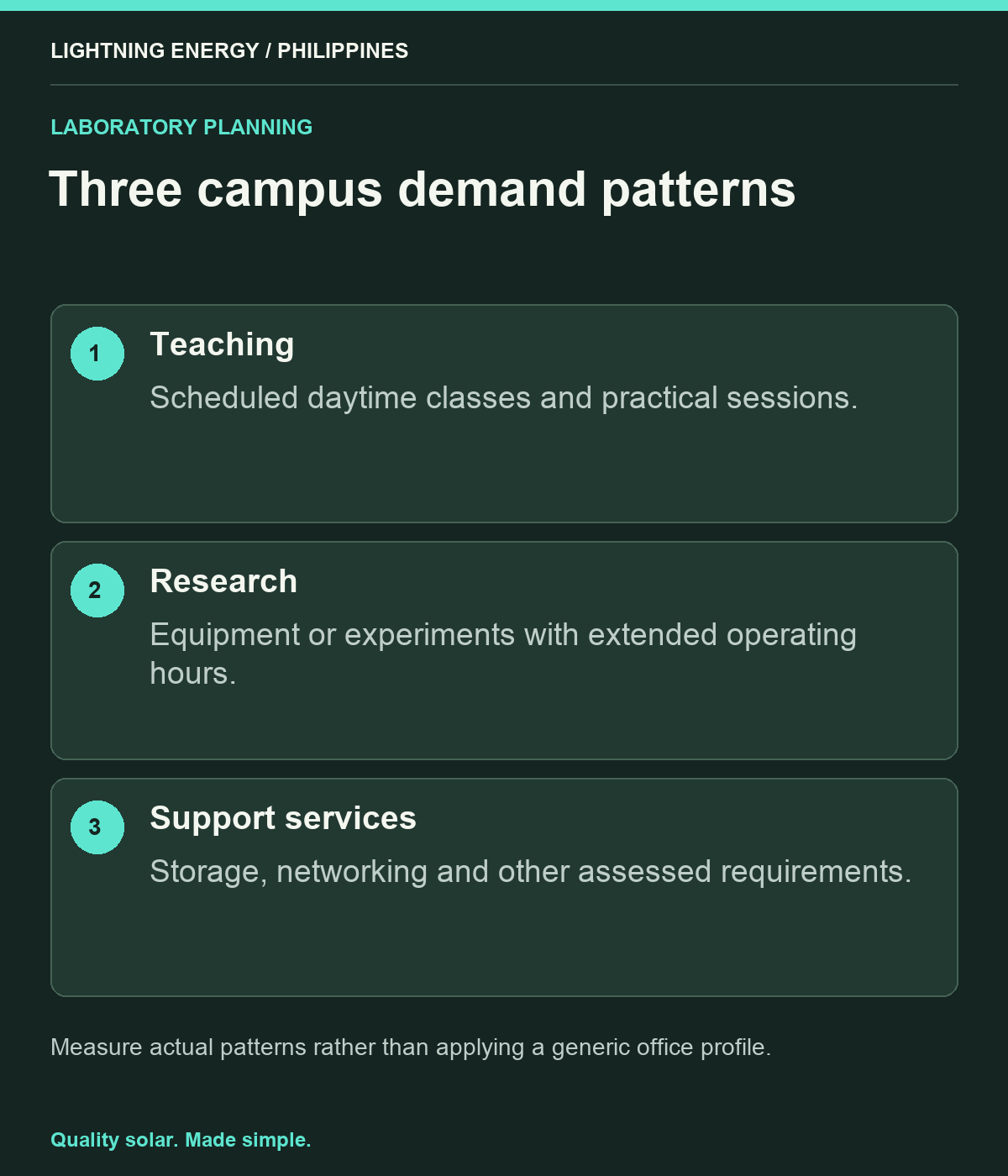
A university campus may seem to have a predictable daytime schedule, but laboratory demand can continue long after lectures finish. Research equipment, storage and controlled environments may serve work that cannot simply pause for a cloudy afternoon or an electrical interruption.
For Philippine institutions, the right solar conversation brings researchers, facilities staff and procurement together. The objective is to identify useful daytime generation while preserving the requirements of the work. A standard office load profile is a poor substitute for an equipment register and a realistic laboratory calendar.
Map activities at the room level
List teaching laboratories, research spaces, offices and supporting facilities separately. Record ordinary hours, overnight activities and periods when experiments or equipment require continuity. The WHO-led Energizing Health report describes methods for characterising facility energy needs. [1] Although a university laboratory is a different setting, the transferable planning principle is to begin with services and equipment. Any specialised laboratory requirements must be established by the institution's responsible professionals, rather than borrowed from a generic solar design.
Identify equipment requirements precisely
Gather model numbers, operating instructions and the relevant power-quality or continuity specifications for critical equipment. Ask the laboratory team to identify what a restart or interruption would mean operationally. This is not a request to guess a financial value for every experiment. It is a way to distinguish routine electricity demand from services requiring dedicated protection. Keep that assessment separate from a supplier's proposed solar capacity so that the protection requirement is not adjusted merely to fit a convenient package.
Use solar modelling for the appropriate question
Assess how rooftop generation aligns with measured campus consumption through normal teaching, research and holiday periods. Account for meters and electrical boundaries across buildings. If a future laboratory expansion is planned, model it as a separate scenario with its own evidence. An illustrative campus might have daytime teaching demand and overnight research demand in the same building. The annual total hides that distinction, while the time profile makes clear which portion solar could serve directly and which requires other supply arrangements.
Evaluate storage by duty, not appearance
The US Department of Energy distinguishes a storage system's power capability from its energy capacity. [2] Ask the designer to state the proposed battery duty and explain how it interacts with existing UPS, generator or other protected systems. Do not assume a large battery cabinet can satisfy specialised continuity requirements. The complete electrical arrangement, transfer behaviour and operating limits need review. A storage proposal for bill management may be entirely different from one intended to support carefully specified laboratory services.
Coordinate installation with research commitments
Bring the research calendar into construction planning. Identify approved shutdown windows, access restrictions and any activities that require additional coordination. Facilities staff should have a clear process for notifying laboratory users and recording acceptance of planned interruptions. Equipment deliveries and roof access must also fit campus operations. A procurement schedule that ignores these constraints can create avoidable disruption even if the solar design itself is sound. Ask contractors to include the coordination work in their programme.
Make data available without exposing controls
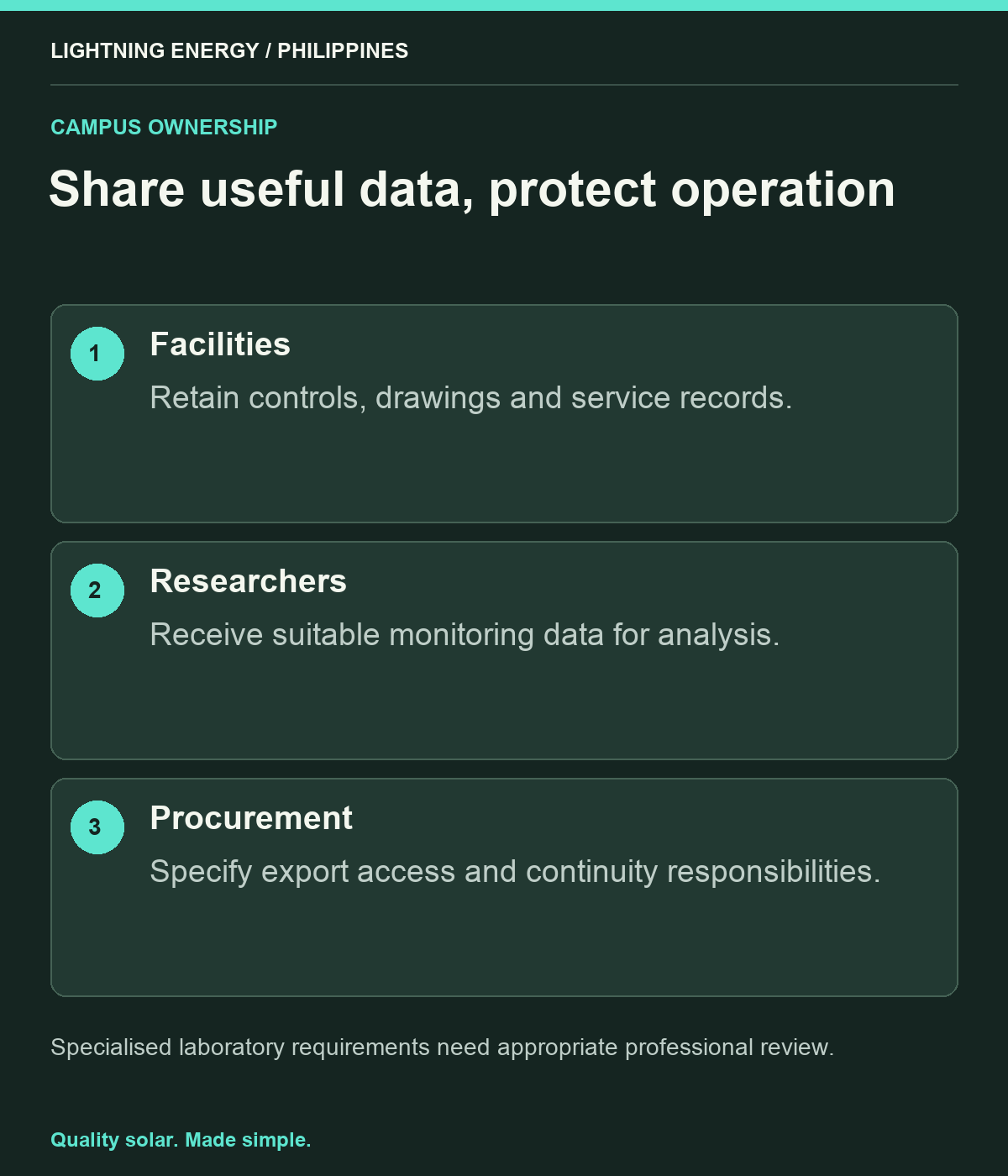
Researchers may want generation data for teaching or analysis. Plan an appropriate way to share monitoring outputs while keeping operational controls restricted to authorised personnel. Label datasets with time periods and relevant limitations. A class can learn from actual variation without treating a short sample as an annual performance guarantee. Clarify data ownership and export access during procurement so that the institution is not dependent on screenshots from one person's account when students or staff change.
Build a handover that survives staff turnover
Keep drawings, equipment records, commissioning results and support contacts in the institution's facilities system. Assign an owner for periodic review and a route for laboratory teams to report changes in demand. Lightning Energy can assess solar opportunities with that shared brief, while specialised continuity decisions remain with the appropriate professionals. A successful campus project respects the work already happening in the building and provides an energy asset whose limits and responsibilities remain clear to the next research group.
Sources & further reading
Sources used for this guide. Policy and product details should be checked for your particular installation.
- WHO, World Bank, IRENA and SEforALL: Energizing Health14 January 2023; accessed 27 September 2026
- US Department of Energy: Solar Energy and Storage BasicsAccessed 27 September 2026