Across Asia
Japan’s Perovskite Push: Separate Technology Promise from a Purchase Decision
Lightweight solar developments are worth following. A Philippine purchase still needs evidence for the exact product and installation.
Solar technology announcements can make an ordinary roof owner wonder whether today’s equipment will soon be obsolete. Japan’s work on perovskite solar cells is an interesting example: it opens a conversation about surfaces that conventional installations may not suit.
The sensible response is neither to dismiss the development nor to treat a research headline as a finished local offer. Put the announcement on one track and the requirements of a real Philippine project on another, then compare the evidence that connects them.
Understand the specific opportunity
Japan’s 2025 energy white paper describes lightweight, flexible perovskite cells as a route to surfaces with limited load-bearing capacity. [1] That potential is more specific than a claim that every existing solar installation should be replaced. Start with the building constraint you actually have. If conventional equipment is being considered for a sound, suitable roof, the decision differs from a project exploring a curved facade or a structure that requires a specialised lightweight solution.
Read demonstrations as demonstrations
NEDO’s December 2025 account describes field trials and continuing work on durability and manufacturing scale. [2] A demonstration can be valuable evidence without answering every buyer question. Record what was tested, the location, duration and product version, then identify which points remain unknown for your project. Avoid converting a laboratory result, a manufacturer’s development target or an accelerated test into an unconditional claim about decades of service on a Philippine building. Those statements describe different kinds of evidence.
Ask for an identifiable product
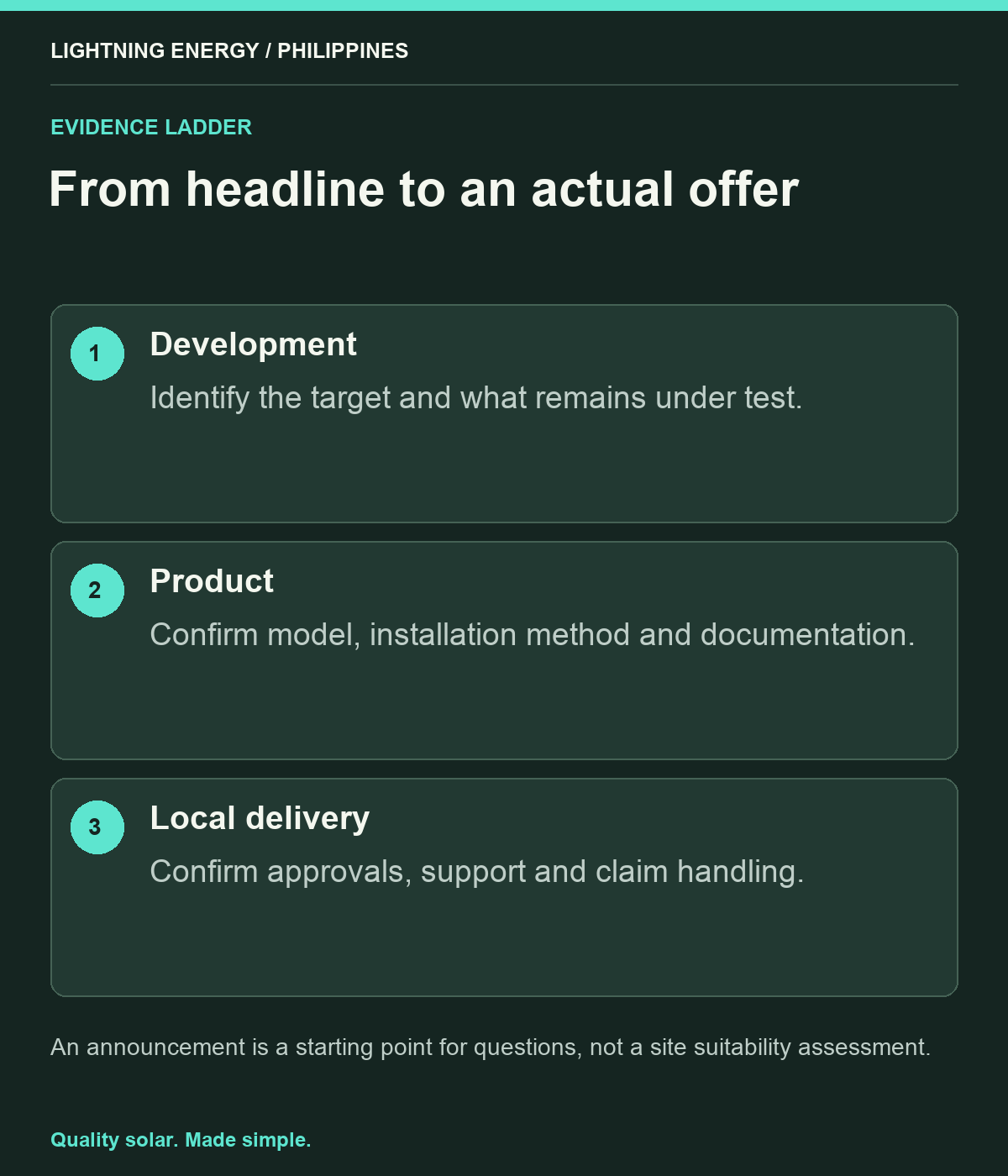
An actionable proposal needs a manufacturer, model, specification, installation method and documented support arrangement. A presentation about an entire technology family is not enough to define what will arrive on site. Ask the supplier to distinguish products currently offered from future versions under development. Have the design team review the exact assembly rather than a generic material description. If the proposed product changes during procurement, require a documented review of the replacement before accepting it as equivalent.
Compare the whole building job
A lightweight component does not remove the need to coordinate roof condition, access, interfaces, electrical work and future replacement. Ask the architect and installer to explain which existing materials remain, which are changed and who is responsible for each joint or penetration. For a hypothetical commercial facade, the cost of reaching an upper section for repair belongs in the discussion. Compare complete installed options that perform the same building function, rather than placing unlike module prices beside one another.
Give warranty questions a local address
Find out who accepts a claim in the Philippines, what documents they require and which costs the agreement covers. Separate a product warranty from promises about output, installation workmanship and building weatherproofing. If a distributor changes, identify the route the owner can still use. These questions apply to established products as well as emerging ones. They are especially useful when a proposal relies heavily on a technology roadmap, because the buyer needs an enforceable offer for the product purchased today.
Make waiting an explicit option
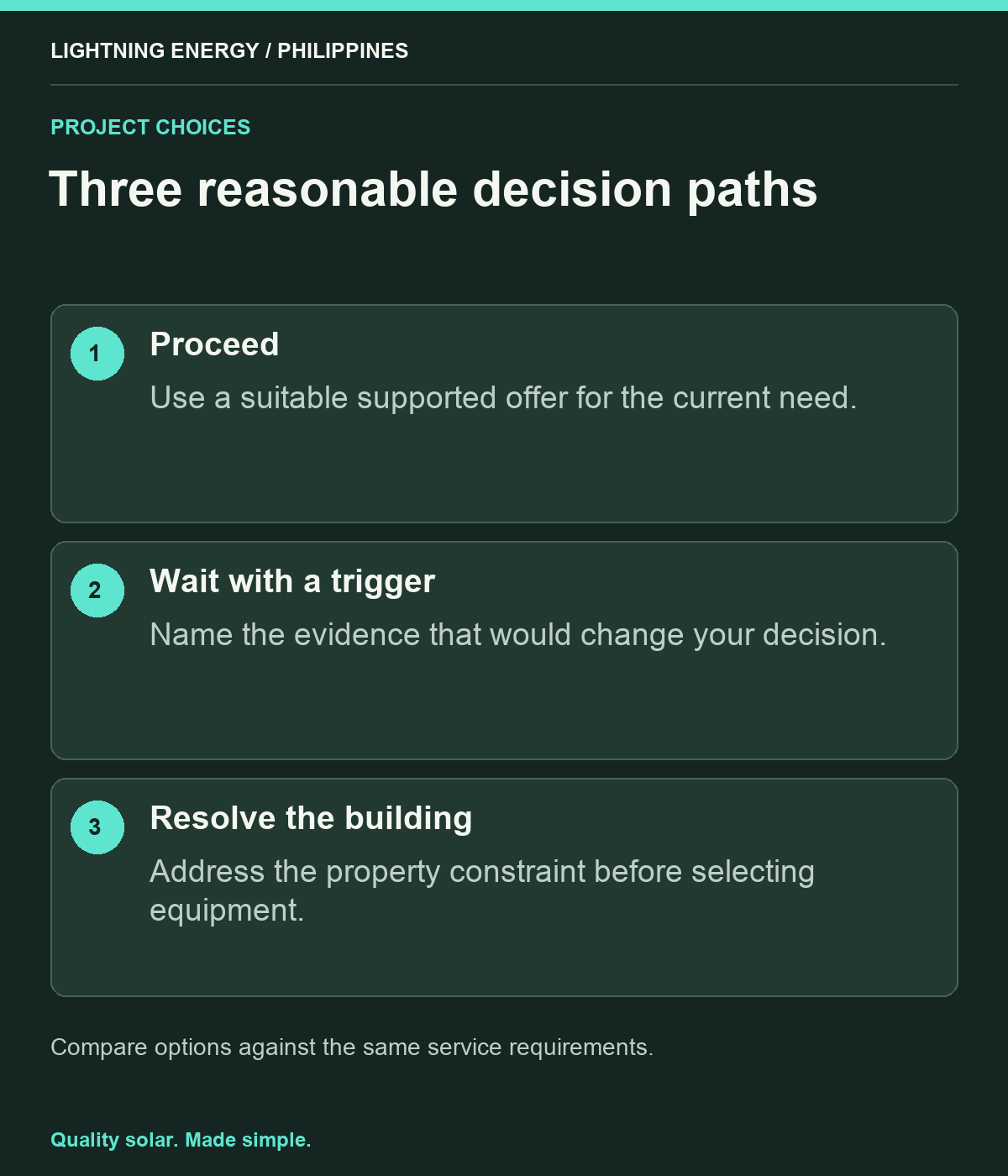
A household does not need to predict the winning technology to make a considered decision. Compare proceeding with a suitable supported system, waiting for defined evidence, or resolving a building issue before either option. Name what would trigger a review: an independently assessed product, an applicable approval, a local service agreement or a completed building survey. This turns waiting into a deliberate choice. It also prevents an endless cycle in which every new headline postpones a decision without improving the information available.
Bring the discussion back to your property
Keep a short technology watchlist alongside the current project brief. The watchlist can capture promising developments; the brief should capture the service needed, constraints, budget boundaries and evidence required before purchase. Lightning Energy Philippines can discuss available system options against that brief. No emerging technology should be assumed suitable from its name alone. A clear explanation of what is available and supported locally is more useful than declaring either old or new equipment the automatic winner.
Sources & further reading
Sources used for this guide. Policy and product details should be checked for your particular installation.
- Japan METI: Energy White Paper 2025, next-generation energy technologies2025; accessed 27 September 2026
- NEDO: Film-Type Perovskite Solar Cells Move Toward Practical Deployment5 December 2025; accessed 27 September 2026