Across Asia
Japan’s Second-Life Battery Trials: Reuse Needs a New Quality Record
Repurposed EV batteries can have new applications, but an old battery is not automatically a finished home-storage system.
Reusing an electric-vehicle battery sounds like a straightforward way to give valuable equipment another working life. Japan’s experience shows why the interesting part is not simply finding a used battery. It is the process that makes a new application assessable and supportable.
For Philippine buyers, this is a procurement lesson rather than a conversion guide. A second-life storage proposal should arrive as a defined system with a responsible supplier, suitable documentation and a clear explanation of its intended use.
Read the trial as a bounded example
Nissan’s November 2021 account describes trials of repurposed vehicle batteries at Japanese railway crossings, including operational testing before deployment. [1] The example does not establish suitability for a Philippine house, nor does it provide evidence that every retired battery has the same condition. Keep the application, date and testing boundary attached to the story. A carefully developed trial can demonstrate a route worth investigating without becoming permission to connect unrelated used equipment to a building.
Look for the assessment process
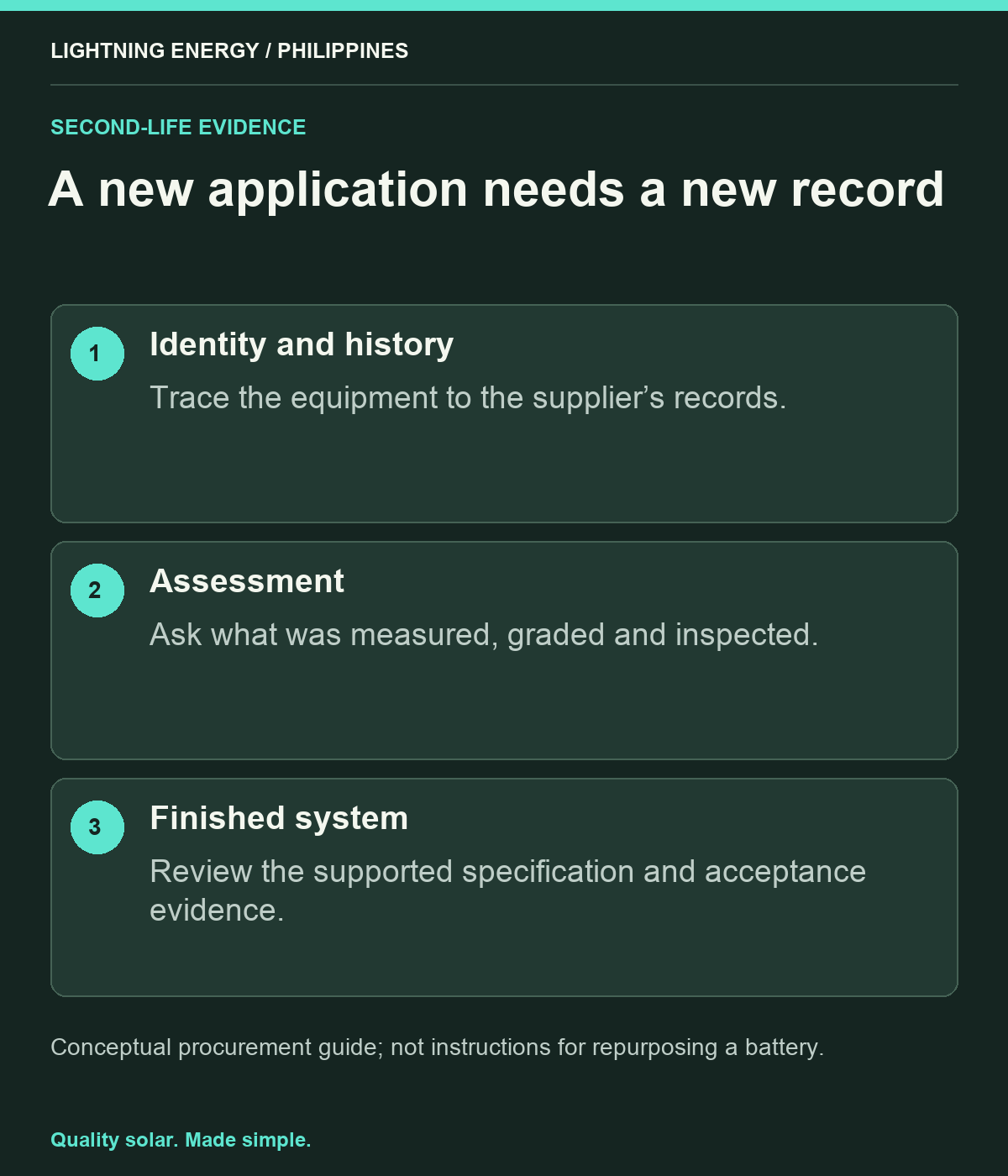
Nissan’s 2025 technical review describes measurement, grading and inspection within its battery-reuse process. [2] The practical buyer question is what comparable evidence accompanies the system being offered. Ask who evaluated it, which product identity the records apply to and what the assessment actually covers. A general statement that a battery still holds charge is not a complete product record. The owner should be able to trace the proposed system to the supplier’s documented quality and acceptance process.
Separate history from present specification
Request the specification for the finished storage system rather than relying on the original vehicle’s brochure. Clarify how the seller describes usable capacity, power capability, operating limits and warranty terms for this application. Ask the installer to review that information alongside the rest of the design. Previous service is part of the history, but the purchase contract needs to say what is being supplied now. Any uncertain or unavailable information should remain visible in the decision rather than being replaced by an optimistic assumption.
Identify who owns the integration
A storage offer needs a party responsible for the complete arrangement, including the interfaces with other equipment and the intended installation. Ask which combinations are supported and who approves a change. The owner should not have to resolve compatibility by collecting reassuring statements from unrelated sellers. For an illustrative commercial project, make one responsible team explain the system boundary, the evidence supporting it and the procedure for addressing a problem. This is a specialist engineering and procurement task, not a do-it-yourself assembly exercise.
Compare equivalent services
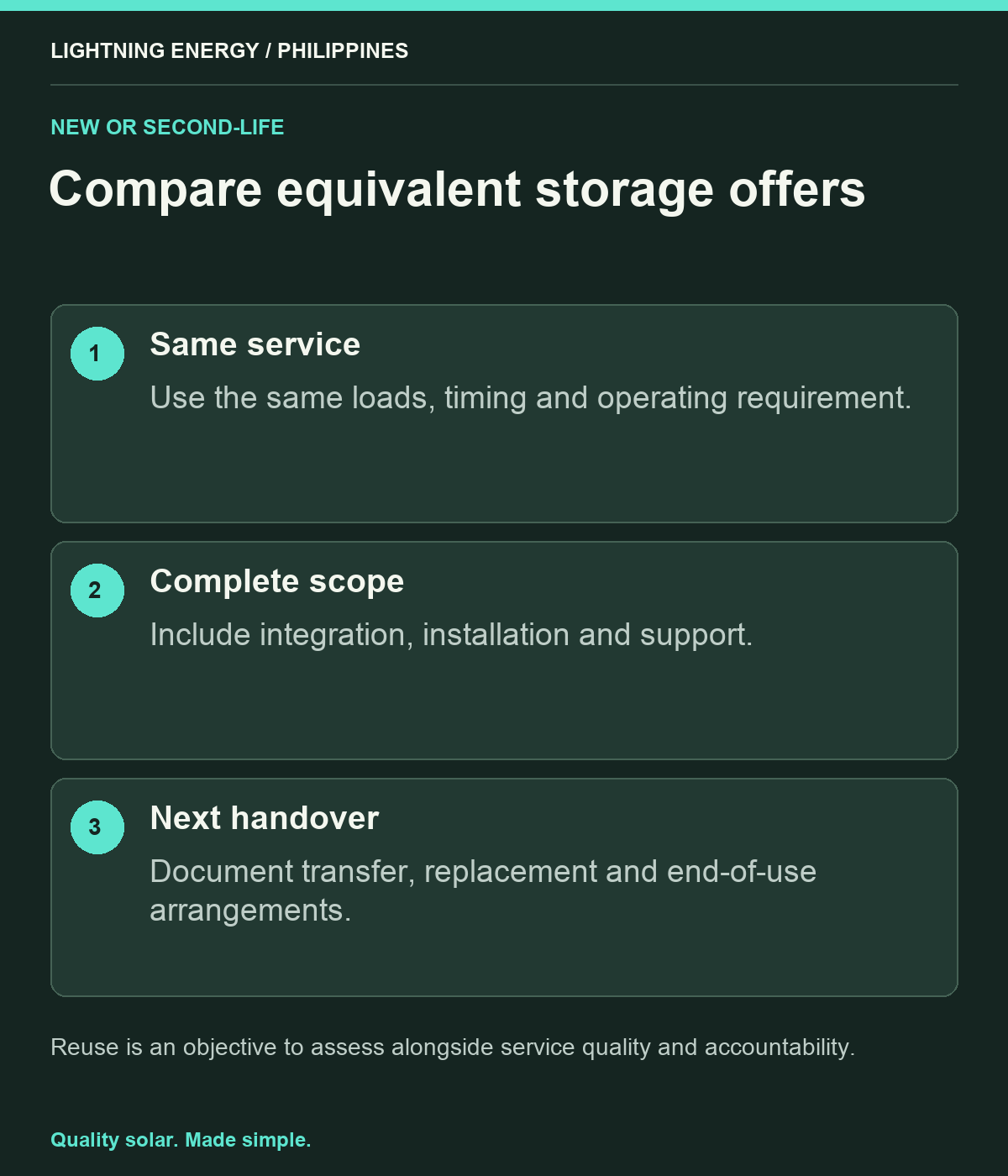
Set a new-system proposal and a second-life proposal against the same requirements, then list differences in documentation, service arrangements, installation scope and warranty. Avoid comparing a loose used battery price with the installed cost of a complete supported system. If environmental reuse is an important objective, state it openly while still checking the required service. A buyer can value reuse without assuming that it guarantees the lowest cost, the longest remaining life or the best fit for every property.
Plan the next handover as well
Ask what happens when the system changes owner, reaches the end of its supported use or needs a replacement component. Name the route for professional removal and appropriate end-of-use handling in the agreement. Retain the system identity, commissioning records and supplier contacts so that later decisions do not depend on someone remembering where the equipment came from. A credible reuse project should leave the next owner or technician with more clarity, not a collection of components with an uncertain history.
Let evidence carry the sustainability story
The most convincing second-life story explains the quality process and the service delivered, rather than treating reuse itself as proof of suitability. Lightning Energy Philippines can discuss the requirements of a supported storage proposal and the information a designer would need to assess it. Japan’s examples are useful because they encourage better questions. Any local offer still needs its own evidence, applicable approvals and accountable delivery team before it can be judged against other options for a Philippine property.
Sources & further reading
Sources used for this guide. Policy and product details should be checked for your particular installation.
- Nissan: Used EV Batteries at Japanese Railway Crossings2021; accessed 27 September 2026
- Nissan Technical Review 91: Commercializing Used EV Battery Reuse2025; accessed 27 September 2026