Across Asia
Nepal’s Solar-and-Hydro Pairing: Complementarity Needs Local Evidence
Nepal offers a useful way to think about combining resources, but Philippine projects need their own seasonal evidence.
Different energy sources can be useful partners without being perfect substitutes. Nepal’s solar-and-hydro experience offers Philippine readers a practical reminder: the relationship between technologies depends on the place, the season and the infrastructure connecting them.
For a business considering solar alongside an existing energy arrangement, the useful question is not whether another country made a combination work. It is which gaps the proposed addition would actually fill at this particular site.
Read the project in its own setting
The World Bank’s 2023 Nepal completion report describes solar development alongside a hydropower-based system and identifies dry-season complementarity in that setting. [1] That is a dated project rationale, not proof that Philippine sunshine and water availability follow the same pattern. Start a local discussion with the actual resources available. A Cebu facility, a Luzon industrial estate and a small island operation should not inherit one seasonal assumption simply because each has access to renewable electricity.
Compare calendars before annual totals
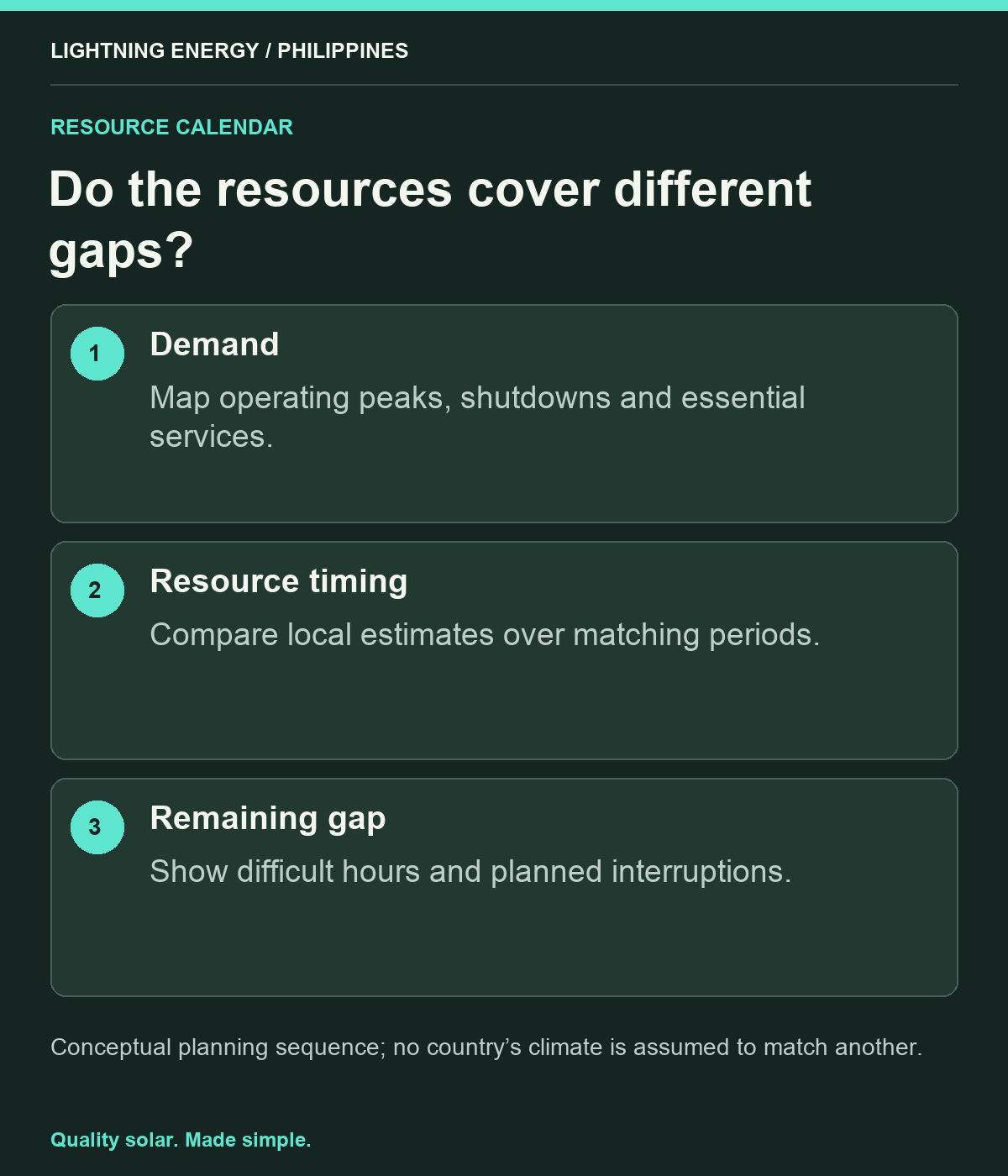
Create an operating calendar showing the business’s busiest periods, planned shutdowns and the months when existing supply is least dependable. Ask the project team to place resource estimates beside it, with the data period and uncertainty clearly stated. Two sources can produce attractive annual totals while leaving the same difficult hours uncovered. Conversely, a modest addition may be useful if it addresses a well-defined operating gap. The calendar gives the designer something specific to test before equipment is selected.
Treat shared infrastructure as a design question
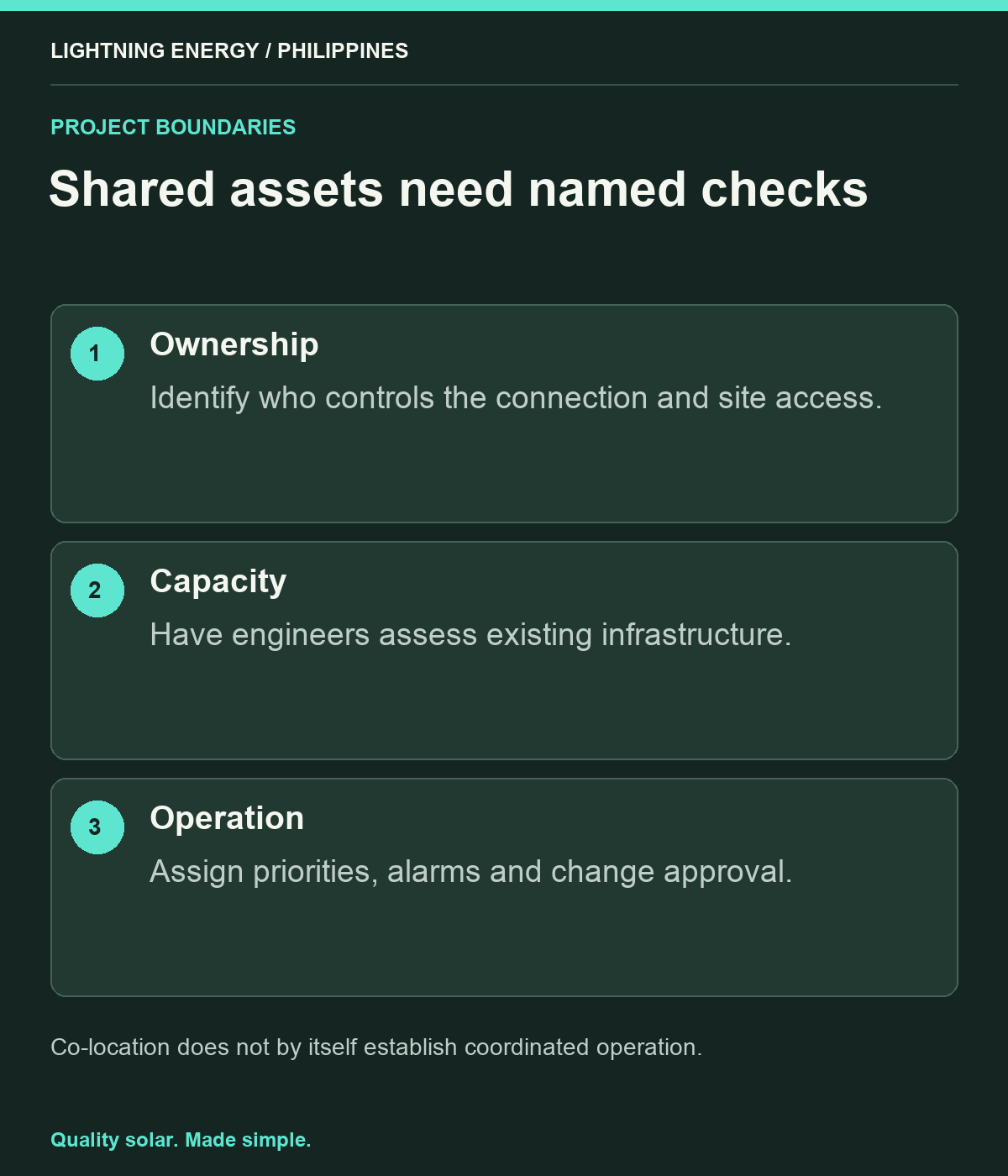
An existing connection, access road or electrical room may look like an obvious saving. Record each proposed shared asset and the permission, condition assessment and capacity check it requires. An owner’s familiarity with equipment is not a substitute for an engineering review. For an illustrative estate considering a common solar installation, establish who owns the connection and who can approve changes before using shared infrastructure as a financial benefit. Include any required upgrades in the comparison from the beginning.
Separate physical pairing from coordinated operation
The IEA’s Thailand hybrid study considers how combining technologies interacts with system flexibility and operating arrangements. [2] For a Philippine owner, make the intended relationship explicit: are the assets merely on the same property, or will someone coordinate their operation? Ask who sets priorities, receives alarms and authorises changes. A project that depends on active coordination needs a practical operating agreement. Co-location alone should not be presented as a guarantee of lower costs or continuous supply.
Keep the difficult days in the model
Ask for representative low-output periods, maintenance interruptions and changes in business demand to be included in the assessment. These are scenarios to investigate, not predictions that a particular failure will occur. For example, an owner could ask how the proposed arrangement performs when a planned production expansion coincides with one source being unavailable. Show the response and remaining limitations in plain language. A model becomes more useful when it explains the service boundary as clearly as the expected annual generation.
Learn from delivery as well as technology
A published development project should be read as a whole, including evaluation findings, rather than reduced to a success headline. Nepal’s completion report also records implementation difficulties and a moderately unsatisfactory overall outcome. [1] A Philippine procurement team can respond by defining decision dates, approval responsibilities and evidence required before ordering. The lesson is not that projects should be avoided. It is that the timetable and the equipment proposal both need scrutiny, with unresolved dependencies visible to the people funding the work.
Turn the comparison into a local brief
Prepare a one-page brief naming the service gap, available resources, operating calendar, existing assets and decisions still required. Give it to the designer before discussing a preferred technology combination. Lightning Energy Philippines can use that starting point to discuss a site assessment and the evidence needed for a proposal. Regional examples are most useful when they improve local questions. They should never replace local measurements, engineering, applicable approvals or a clear explanation of what the finished system is expected to do.
Sources & further reading
Sources used for this guide. Policy and product details should be checked for your particular installation.
- World Bank: Nepal Grid Solar and Energy Efficiency completion report2023; accessed 27 September 2026
- IEA: How Hybrid PV Technologies Can Contribute to the Decarbonisation of Thailand’s Power System23 November 2022; accessed 27 September 2026