Solar for business
School Rooftops: Solar Planning Starts with the Calendar
Term time, holidays and community use give school solar projects a distinct rhythm. Here is a practical planning approach.
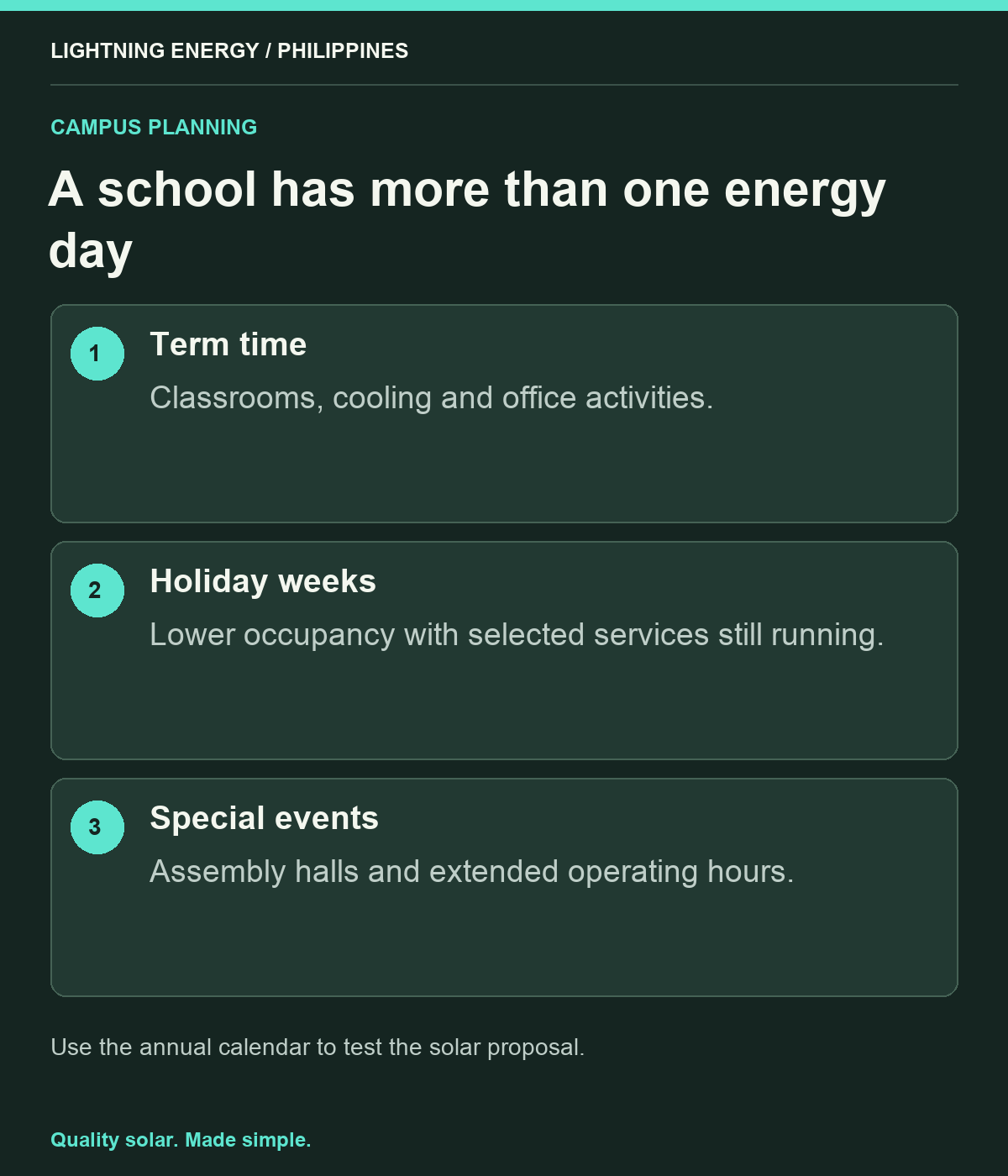
A school roof can look like an obvious place for solar, but a full classroom and an empty campus are two different energy situations. A proposal based only on a busy weekday can miss weekends, holidays, examinations and events. The school calendar belongs beside the electricity bills from the first meeting.
For Philippine school administrators, the most useful project brief links electricity to educational activities. Savings, learning opportunities and continuity during an interruption can all matter, but each needs its own evidence and responsibilities. None should be assumed simply because panels fit on the roof.
Compare term time with quieter weeks
Build a calendar that shows ordinary classes, shortened days, holidays, maintenance closures and external bookings. Add the rooms that remain occupied during breaks, such as the administration office. IEA's Southeast Asia outlook identifies cooling as an important driver of electricity demand. [1] That regional observation does not establish this school's load. It is a reason to measure which cooling equipment operates, in which spaces and at which times before deciding system size.
Give each building a role
A campus may have classrooms, laboratories, a library, a kitchen and an assembly hall on different electrical arrangements. Ask the assessor to map roofs and meters together. Identify buildings likely to be renovated or expanded. A large assembly roof may be attractive, yet the nearest daytime load may sit elsewhere. Record those practical questions early so that cable routes, permissions and access are priced instead of appearing as surprises after a committee approves the budget.
Treat resilience as a separate design brief
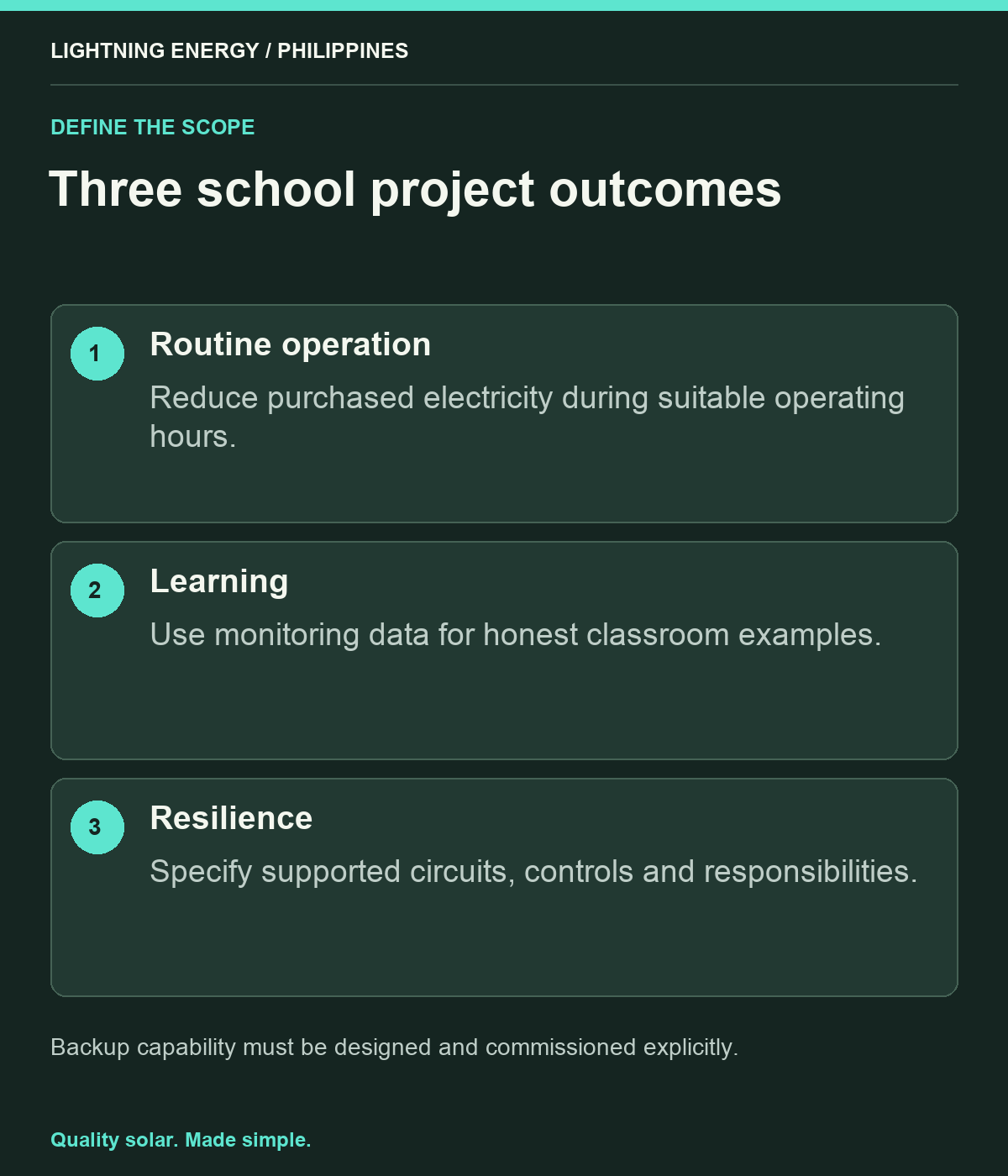
The US Department of Energy explains that solar with suitable storage and controls can support critical community facilities. [2] This is a technical concept, not a guarantee that any school installation supplies power during an outage. Decide whether the objective is office continuity, emergency lighting or a designated community use. Have the appropriate professionals define circuits, transfer behaviour and operating limits. Ordinary grid-connected generation and an emergency-ready facility are different project scopes.
Use the installation as a learning resource
A monitoring display can make the project visible to students without inviting them onto roofs or into electrical equipment. Consider showing daily generation alongside weather observations, with explanations of units and uncertainty. An original classroom exercise could compare a cloudy school day with a sunny holiday and ask why generation and campus consumption differ. Avoid presenting one unusually good day as the typical result for the year. Educational value comes from honest data and careful questions.
Plan construction around the school community
Prepare access arrangements for workers, equipment deliveries and any electrical shutdowns. Ask how classrooms, walkways and emergency routes will remain usable during the work. School staff should know the schedule before installation begins. If the project is phased across buildings, make the handover and responsibility boundaries clear. A quiet holiday installation window may be convenient, but the commissioning plan should still test the system against the intended operating conditions rather than an empty campus alone.
Budget for the years after the ribbon cutting
Identify who owns the monitoring login, who receives fault notifications and which budget pays for professional maintenance. Record warranties and the process for obtaining service when school leadership changes. Compare proposals using a full year of expected activity, including periods of low consumption. If a financing offer relies on a particular export credit, verify that assumption with the applicable utility arrangement. A demonstration project becomes a durable asset when recurring responsibilities are as clear as the launch event.
Make the next meeting concrete
Bring the annual calendar, electricity records, a campus map and planned building work to the solar assessment. Ask for an ordinary-operation option and, if needed, a clearly defined resilience option. The governing body can then see which benefits each expenditure buys. The decision should leave teachers free to teach and administrators able to explain performance with evidence. Solar belongs in the school's long-term facilities plan, alongside the roof, electrical system and learning spaces that make the campus work.
Sources & further reading
Sources used for this guide. Policy and product details should be checked for your particular installation.
- IEA: Southeast Asia Energy Outlook 2024, executive summary2024; accessed 27 September 2026
- US Department of Energy: Solar and Resilience BasicsAccessed 27 September 2026