Solar for business
Solar at the Delivery Depot: Start with Vehicle Dwell Time
A depot solar-and-charging plan works from routes, parking windows and electrical capacity—not just the number of vehicles.
An electric delivery fleet can create a strong reason to examine depot electricity, but the vehicles may spend the sunniest hours on the road. A roof full of panels does not by itself align solar production with charging. The operational timetable needs to lead the project.
For Philippine businesses evaluating vehicles and solar together, use a staged plan. First understand routes and depot activity, then assess charging, solar and storage as connected but distinct investments. This avoids buying equipment around an idealised day that the delivery team cannot actually operate.
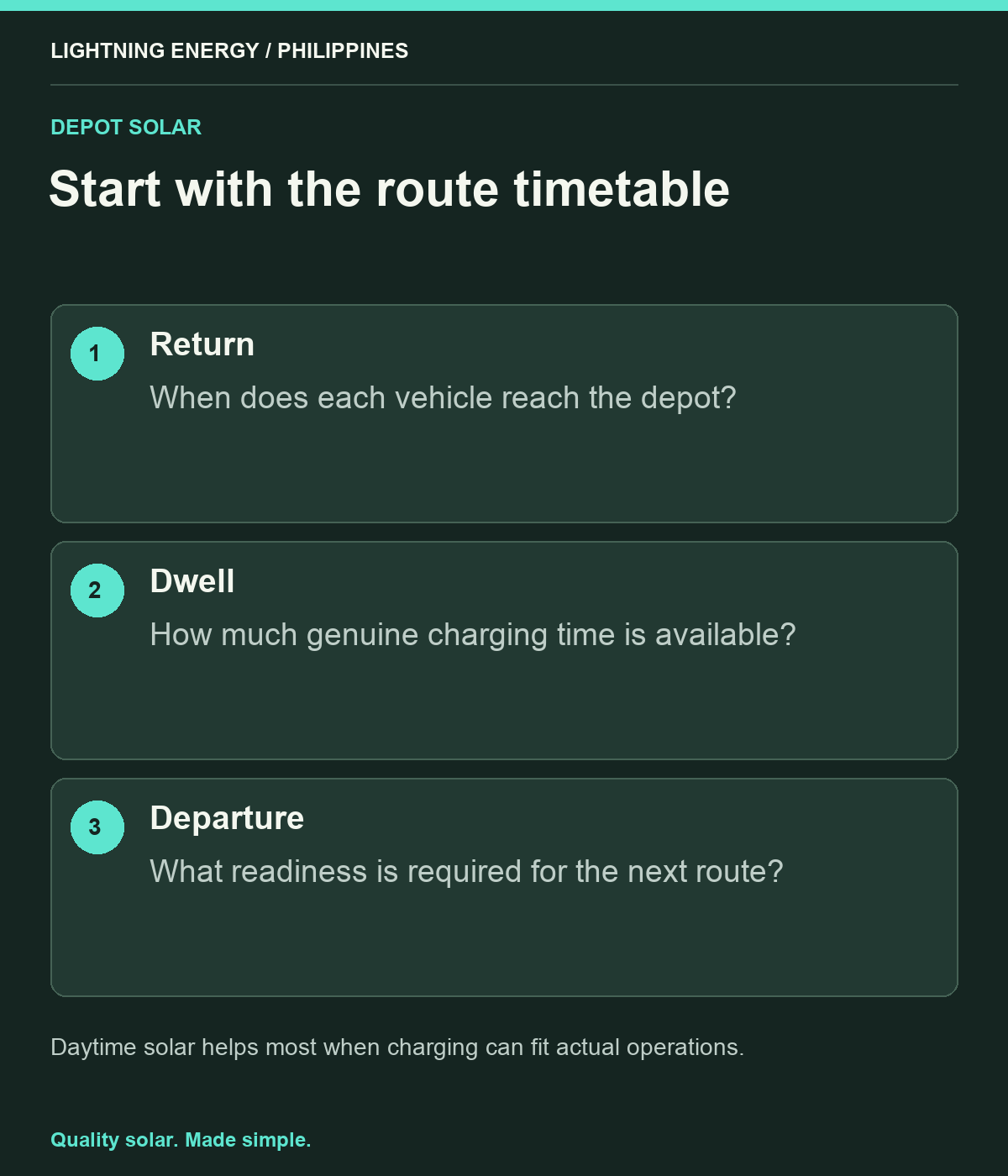
Map arrival and departure windows
Record when each vehicle returns, how long it stays and when it must leave again. Add variation for traffic, seasonal demand and route changes. Identify vehicles that genuinely remain at the depot during daylight. The IEA's Electricity 2026 analysis treats EV demand as one of the loads that changes flexibility needs. [1] For a single business, that means a charging model should use the fleet's real parking windows rather than assume all vehicles are continuously available.
Establish charging requirements with the vehicle supplier
Obtain the relevant vehicle and charger specifications, and ask the fleet team to define minimum readiness for each route. Have qualified professionals review the depot's electrical supply and simultaneous equipment demand. Include workshops, offices and other loads in the assessment. An illustrative fleet with staggered departures may have more scheduling freedom than one that dispatches every vehicle together. That is a planning distinction, not a claim about how much energy any particular model needs.
Compare controlled charging before adding storage
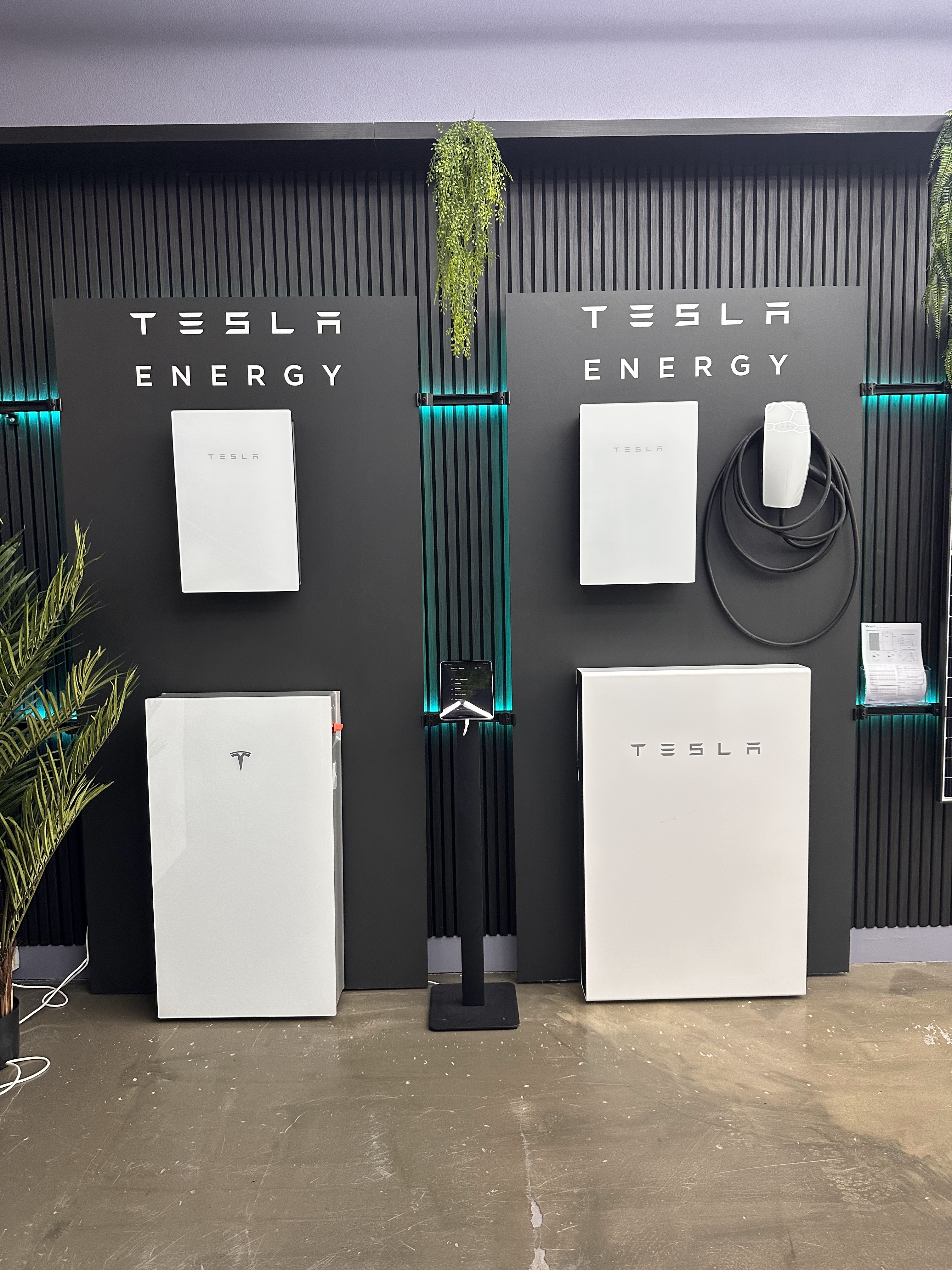
Ask the designer to evaluate whether charging can be scheduled within genuine dwell-time limits. A control plan must preserve route readiness and provide an authorised override for unexpected work. Storage can shift electricity across time, as the US Department of Energy explains. [2] It also adds equipment and losses, so assess the extra service it provides after reasonable charging coordination has been considered. Do not assume that a battery is necessary simply because a depot has both solar and electric vehicles.
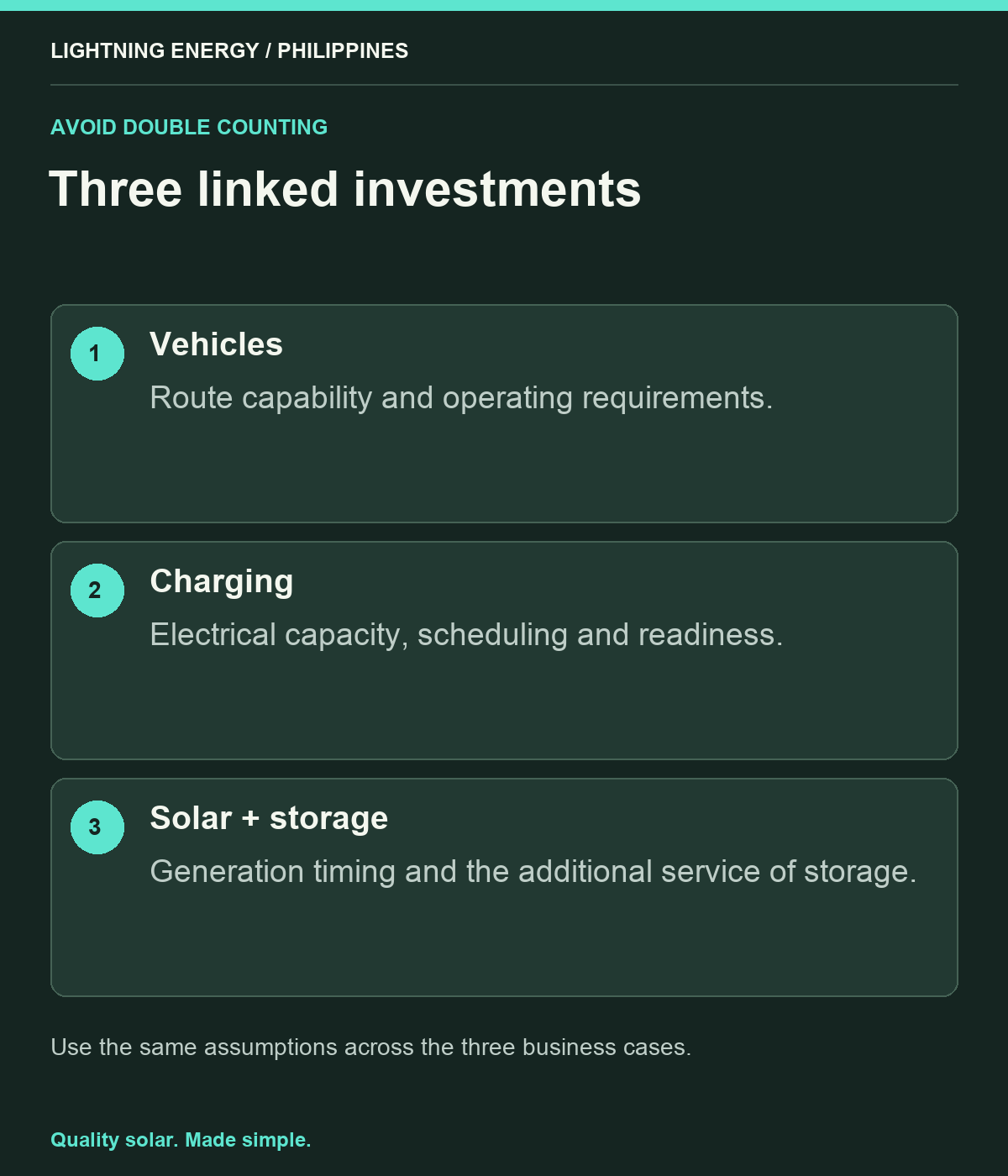
Separate the three business cases
Prepare one assessment for vehicles, one for charging infrastructure and one for solar with any storage. Show the shared assumptions so that benefits are not counted twice. For example, a projected reduction in purchased daytime electricity cannot also be counted as an independent saving from the battery if it describes the same energy. Keep uncertain route growth as a scenario. The combined project should remain understandable to the transport manager and finance team without requiring either to accept a single opaque payback figure.
Plan for an interrupted depot day
Decide what the business would do if charging were unavailable, a vehicle returned late or the site lost grid supply. Ask which services, if any, a proposed backup arrangement supports. Do not presume that a stationary battery can charge the whole fleet during an outage. That duty must be specified and engineered. The operational plan may include alternate scheduling or other approved arrangements outside the depot; identify those dependencies rather than presenting storage as the answer to every disruption.
Make controls and data part of procurement
Clarify who can change charging priorities, who receives alerts and how data can be exported for fleet reporting. Ask how the system behaves if communications fail. Keep driver access simple and reserve technical settings for authorised staff. The business should retain the information needed to compare planned and actual readiness, consumption and charging times. A well-designed dashboard is useful only if someone reviews it and the underlying records remain accessible when a supplier or manager changes.
Start with one operationally useful stage
Bring route logs, parking windows, bills and vehicle plans to a joint fleet-and-energy assessment. Lightning Energy can discuss rooftop generation and storage within the electrical and operational brief. A pilot should test route readiness as well as energy performance before a wider rollout. The best depot project makes charging fit the delivery business, with solar contributing where its timing is useful. It should not ask customers or drivers to reorganise the whole operation merely to make a brochure calculation come true.
Sources & further reading
Sources used for this guide. Policy and product details should be checked for your particular installation.
- IEA: Electricity 2026, Flexibility2026; accessed 27 September 2026
- US Department of Energy: Solar Energy and Storage BasicsAccessed 27 September 2026