Across Asia
Thailand’s Solar-and-Hydro Study: Coordination Is a Separate Design Task
Combining renewable resources requires an operating plan as well as equipment on the ground.
Two energy sources can look complementary on a diagram while still being difficult to coordinate in practice. The missing part is often the operating arrangement: who makes decisions, what limits apply and how the combined service is evaluated.
Thailand’s hybrid-solar research offers a useful lens for Philippine businesses considering more than one source of supply. The lesson is to assess the proposed relationship between assets, rather than assuming that adding another renewable technology automatically produces a dependable combined service.
Read the study at its intended scale
The IEA’s 2022 Thailand study examines hybrid photovoltaic arrangements, including links with hydropower and broader power-system flexibility. [1] Its system-level analysis is not a household design manual or a ready-made Philippine business case. Use it to identify questions for a local assessment. Which service is the project intended to improve? Which assets are available? Which operating rules constrain them? The answers define the relevant comparison more clearly than the simple statement that two renewable sources will work together.
Distinguish different kinds of combination
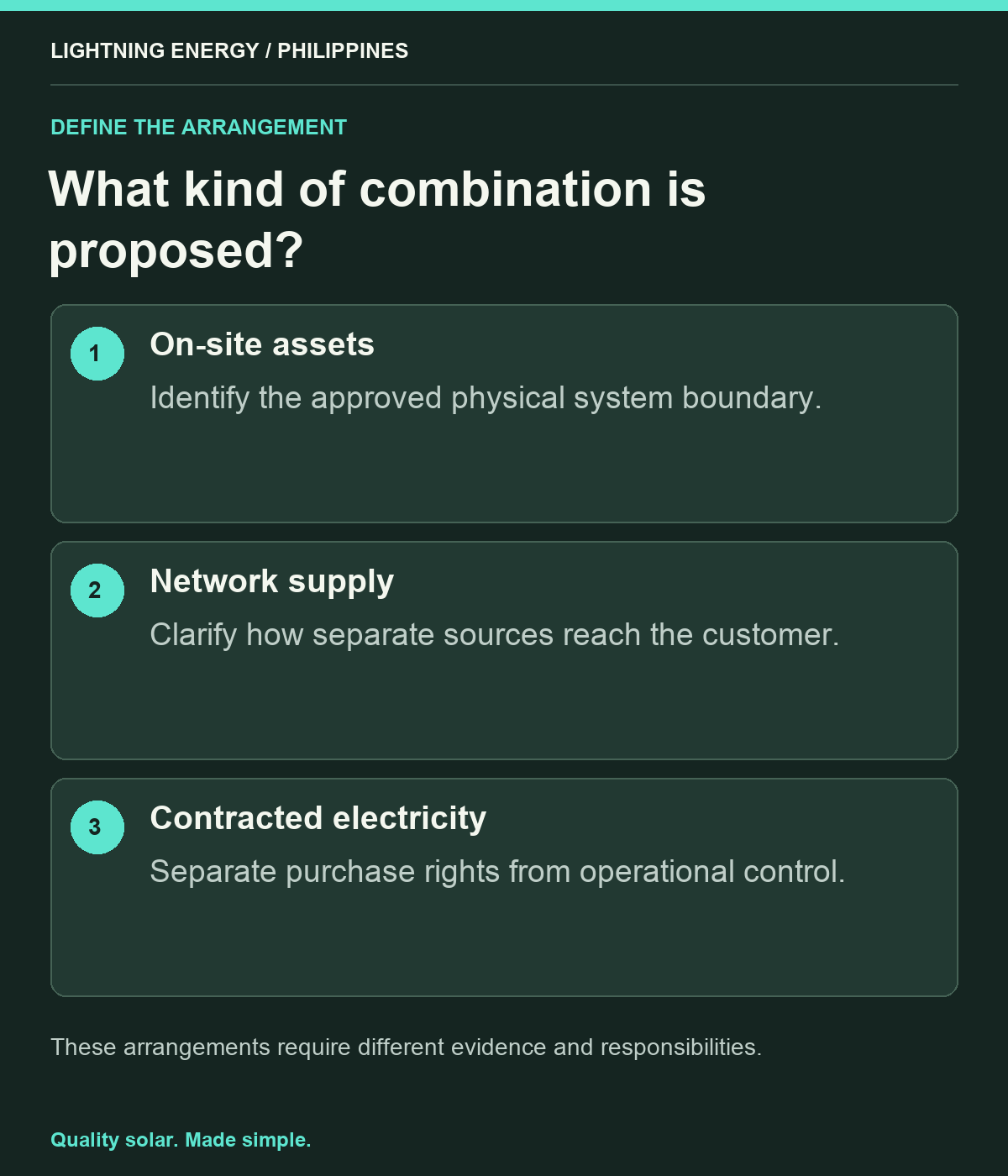
Write down whether the proposal involves assets at one site, separate sources supplying through a network, or a contractual arrangement for electricity. Each situation gives the owner different decisions to make. A business buying renewable electricity does not necessarily control the generator’s operation. An owner with equipment on site still needs to understand the approved system boundary. Avoid presenting these arrangements as interchangeable in a quotation, because the responsibilities and evidence needed to support the promised service are different.
Test the timing with matching data
Ask the assessment team to compare demand and resource information over consistent periods. Show seasonal variation as well as representative operating days, and state the uncertainty in any estimates. Nepal’s World Bank project report used dry-season solar complementarity within its own hydro-based context. [2] That example illustrates why location matters; it does not establish the same relationship elsewhere. A Philippine assessment should demonstrate its own timing assumptions rather than importing another country’s calendar into the model.
Give constraints equal space
List the practical and contractual limits that affect the proposal: permissions, maintenance windows, operating priorities and responsibilities for changes. Ask the specialists to explain how these limits appear in the assessment. For an illustrative industrial estate, a source may be available in theory while the estate’s agreement restricts how it can be used. The purpose of the list is to expose that dependency before purchase. A diagram that omits constraints can make the proposed coordination look simpler than it will be to operate.
Define the controller’s job in plain language
If active control is proposed, request a description of the decisions it will make and the authority under which it acts. Establish what happens when communication is unavailable or the site’s operating schedule changes. Ask which settings the owner may view and which require authorised specialist work. The business does not need to understand every software detail to demand a clear operational explanation. It should be able to identify the person accountable for keeping the agreed priorities reflected in the system.
Evaluate the combined service honestly
Agree how success will be assessed and which conditions fall outside the proposal. Annual energy production alone may not answer a question about supply at particular hours. Equally, a continuity objective should not obscure ordinary operating costs or maintenance commitments. Ask for the relevant measures to be reported separately. This makes it possible to understand a trade-off without treating a favourable result in one category as proof that every aspect of the project meets the owner’s requirements.
Start with a service map
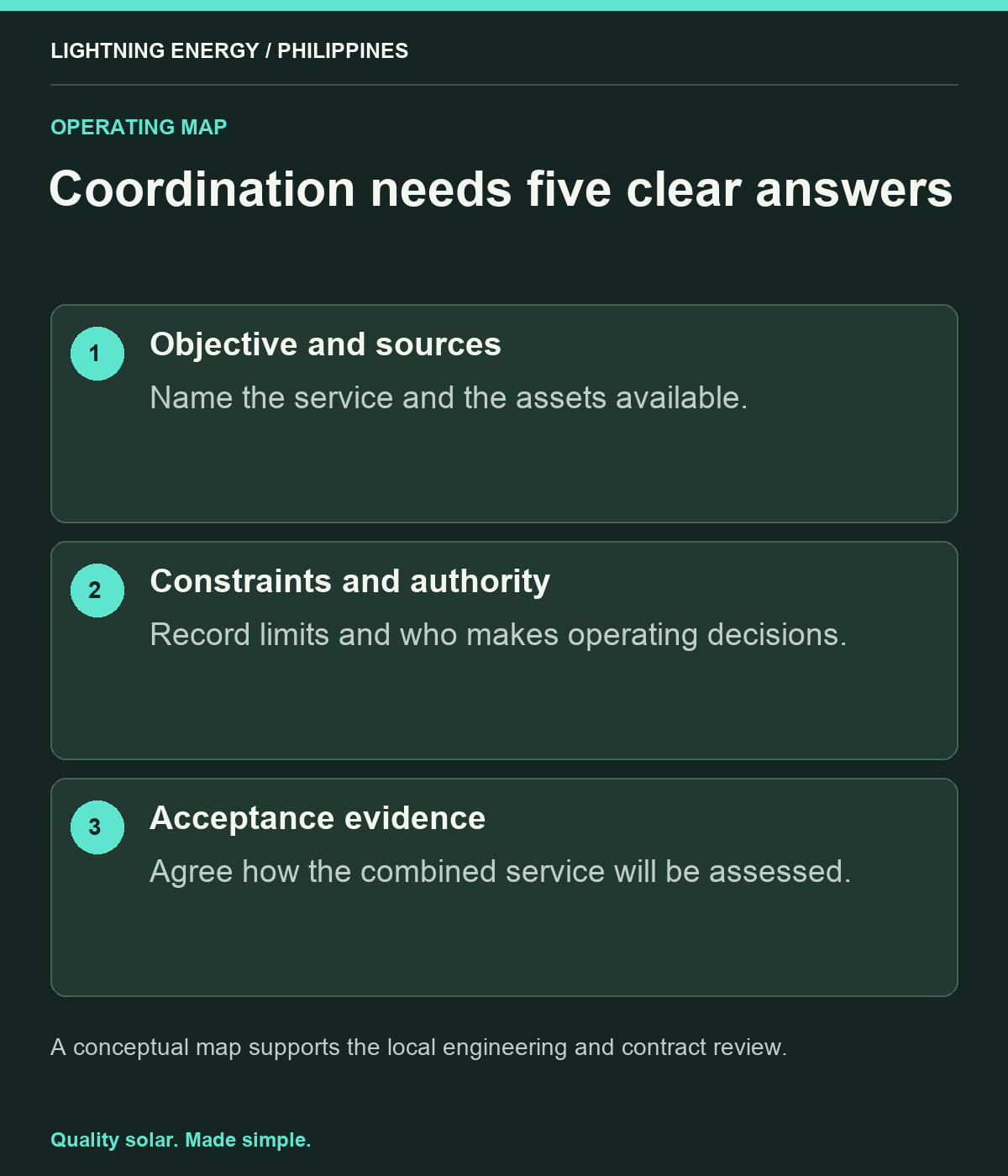
Prepare a simple map linking the business objective, available sources, constraints, decision authority and acceptance evidence. Lightning Energy Philippines can use that brief to discuss which solar or storage options warrant further assessment. Regional hybrid projects are valuable examples of systems thinking, but local coordination must be designed and documented. A clear service map helps the owner judge whether the proposed combination is useful, manageable and supported, without turning an interesting overseas study into a promise it never made.
Sources & further reading
Sources used for this guide. Policy and product details should be checked for your particular installation.
- IEA: How Hybrid PV Technologies Can Contribute to the Decarbonisation of Thailand’s Power System23 November 2022; accessed 27 September 2026
- World Bank: Nepal Grid Solar and Energy Efficiency completion report2023; accessed 27 September 2026