Across Asia
Bangladesh’s Solar Home Systems: Trust Was Part of the Infrastructure
Bangladesh’s experience shows why finance, component quality and after-sales service belong in the same solar conversation.
A solar home system is more than a collection of components when it reaches a household that depends on it. Someone must explain its limits, arrange payment, install it correctly and respond when it stops working. Bangladesh's long-running experience makes those responsibilities visible.
For Philippine buyers, the lesson is not to copy an older off-grid package into a modern household. It is to consider the service system around the hardware. A purchase becomes more useful when the owner knows what was supplied, what it can do and how support will remain available.
Put the programme in its historical setting
The World Bank's 2021 account describes Bangladesh's Solar Home System programme led by IDCOL as a route to electricity services in places where grid access was limited. [1] The dated story concerns particular systems and delivery arrangements. It does not describe the needs of every Philippine household or prove that a small off-grid system can supply modern whole-home demand. Read it as evidence that distribution and support arrangements can be central to an energy-access programme.
Notice the attention to quality and follow-up
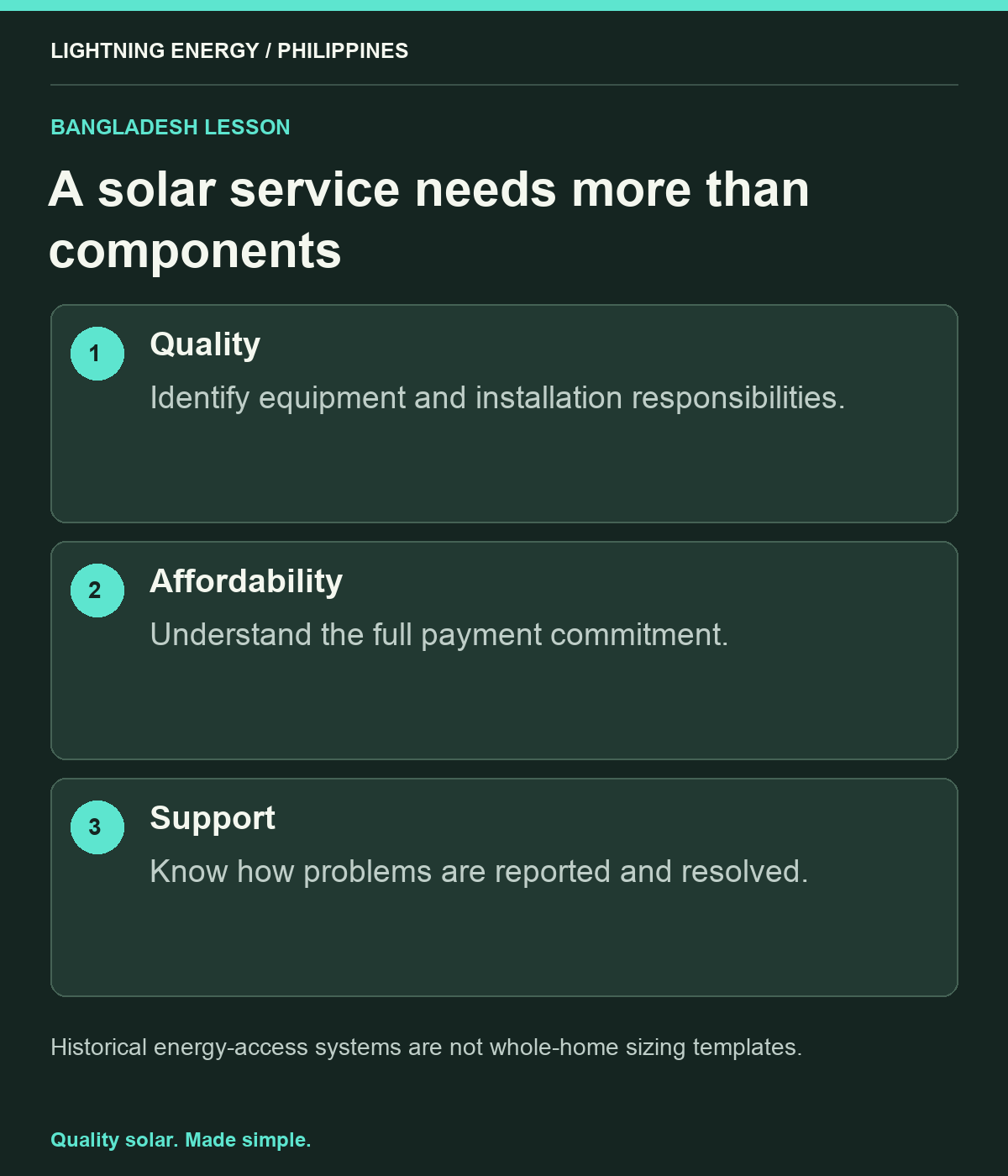
The World Bank's detailed programme history describes component verification, inspections and after-sales monitoring. [2] Those processes are less visible than panels but important to understanding the case. Our practical takeaway is to ask who verifies the proposed equipment and who closes a reported problem. A customer should not need to infer support quality from the appearance of a showroom. The offer should identify the exact system, installation responsibilities and a clear path for service after the sale.
Buy a stated level of service
Describe the electricity tasks the household needs before discussing a package. Lighting and communications, refrigeration and cooling, and a complete home have different requirements. Ask the designer to explain the assessed load and operating limits in plain language. Use an illustrative household expansion to test the proposal: if another appliance is added later, what needs review? Avoid assuming a system designed for a modest initial service can expand indefinitely without changes to generation, storage, controls or electrical work.
Keep affordability broader than the deposit
If financing is offered, review the total payment schedule, fees, ownership and responsibilities with appropriate advice. Retain a budget for maintenance and ordinary household needs. A small first payment can improve access, but it does not explain the full commitment. Conversely, an outright purchase can still leave service costs unclear. Bangladesh's historical programme is not a Philippine loan offer; the local buyer must assess the actual supplier and contract rather than assume the same institutional support exists.
Ask how remote service will work
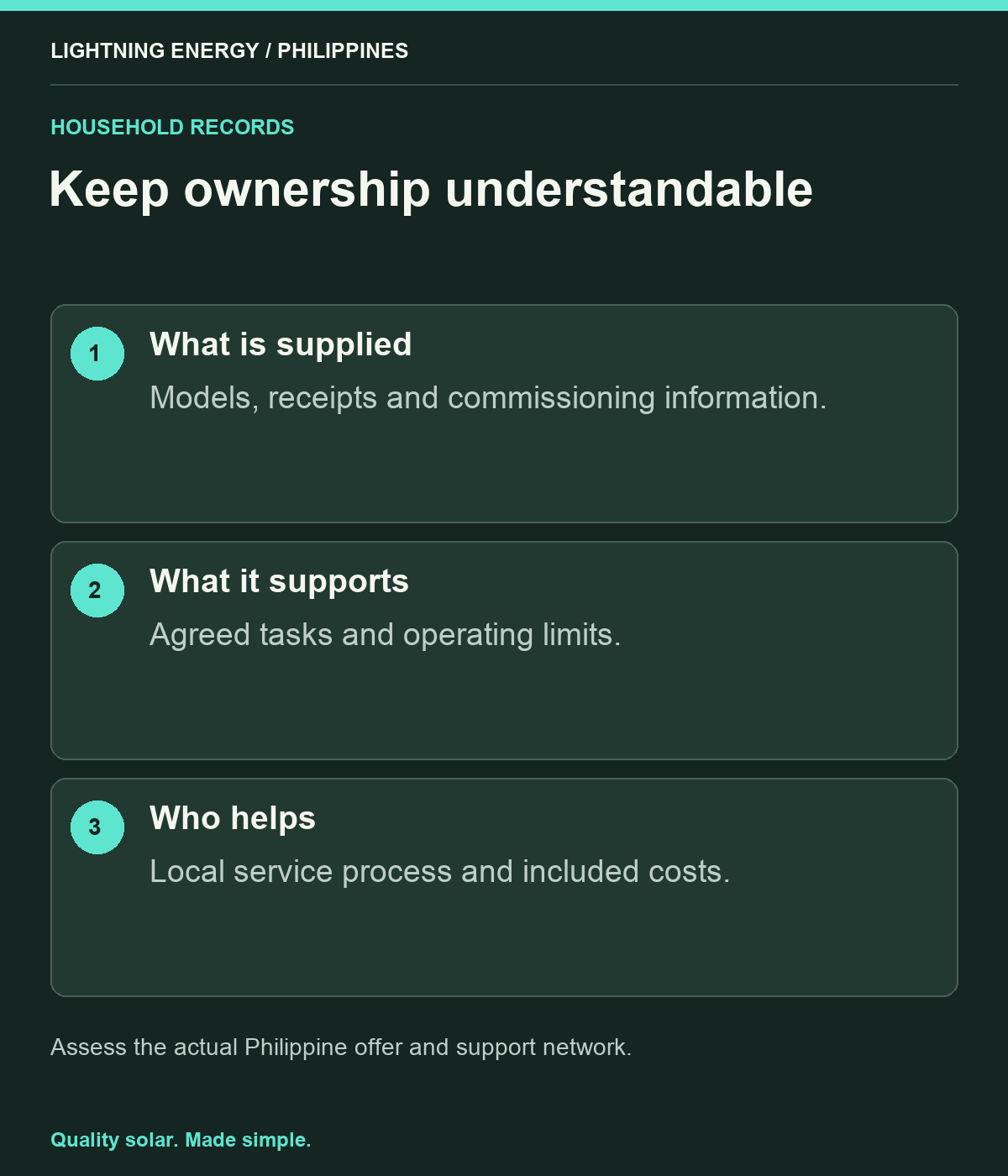
Identify the person or organisation receiving a fault report, the information they need and the process for arranging attendance. For a remote Philippine property, clarify travel and parts logistics. Distinguish a manufacturer's warranty from a local commitment to diagnose and restore the system. The household should understand which costs are included and which may arise later. Service promises become easier to evaluate when they describe actual steps and responsibilities instead of a broad assurance of lifetime support.
Preserve the evidence of the purchase
Keep receipts, equipment identifiers, commissioning records and the agreed operating explanation together. Record repairs and replacements. If the household changes or the property is transferred, the next user should be able to understand the system without relying on the original purchaser's memory. This is especially useful for equipment whose capabilities are not obvious from its appearance. Clear records also help a qualified technician distinguish the original design from later additions that may have changed the load.
Apply the delivery lesson in the Philippines
Bring the household's service needs, location and budget to Lightning Energy or the relevant project provider. Ask for an offer that explains both the equipment and the support arrangement. Bangladesh's story reminds us that confidence is built through repeated, verifiable service, not merely through access to hardware. A well-supported solar purchase gives the family an understood electricity service and a dependable way to seek help when its needs or the system's condition changes.
Sources & further reading
Sources used for this guide. Policy and product details should be checked for your particular installation.
- World Bank: Bangladesh’s Solar Home Systems8 April 2021; accessed 27 September 2026
- World Bank: Living in the Light—The Bangladesh Solar Home Systems Story2021; accessed 27 September 2026