Across Asia
Cambodia’s Solar Finance Lesson: A Low Price Needs a Clear Project
Cambodia’s early bankable solar projects illustrate why procurement, risk allocation and project scope sit behind headline prices.
A striking solar price can travel quickly across borders in a headline. The less visible part is the project behind it: who provides land, who pays for connections, what the contract requires and how investors understand the risks. Cambodia's experience is useful for examining that wider picture.
For Philippine residential and commercial buyers, the comparison should improve purchasing discipline rather than create an unrealistic price target. A utility project and a rooftop installation do different jobs under different arrangements. Their quoted figures cannot be treated as interchangeable simply because both use solar modules.
Look at what made the project financeable
ADB's account of solar development in Cambodia describes the Bavet project as a template for bankable private investment. [1] Its significance includes the structured project and financing arrangements, not only the generating equipment. The practical lesson for a smaller buyer is to make responsibilities visible. A clear design, identifiable counterparties and an understood service obligation can make an offer easier to assess than one built around a single attractive number with important items left unspecified.
Keep utility-scale cost evidence in context
IRENA's renewable-cost report primarily compares project-level generation costs, including utility-scale solar. [2] A levelised generation cost is not a Philippine installed rooftop quotation or a retail electricity tariff. The distinction matters when social posts imply that a household should obtain the same price seen in a large international project. Scale, financing, connection, site work and the service purchased can differ. Use broad cost evidence as context, then assess the complete local scope offered to the customer.
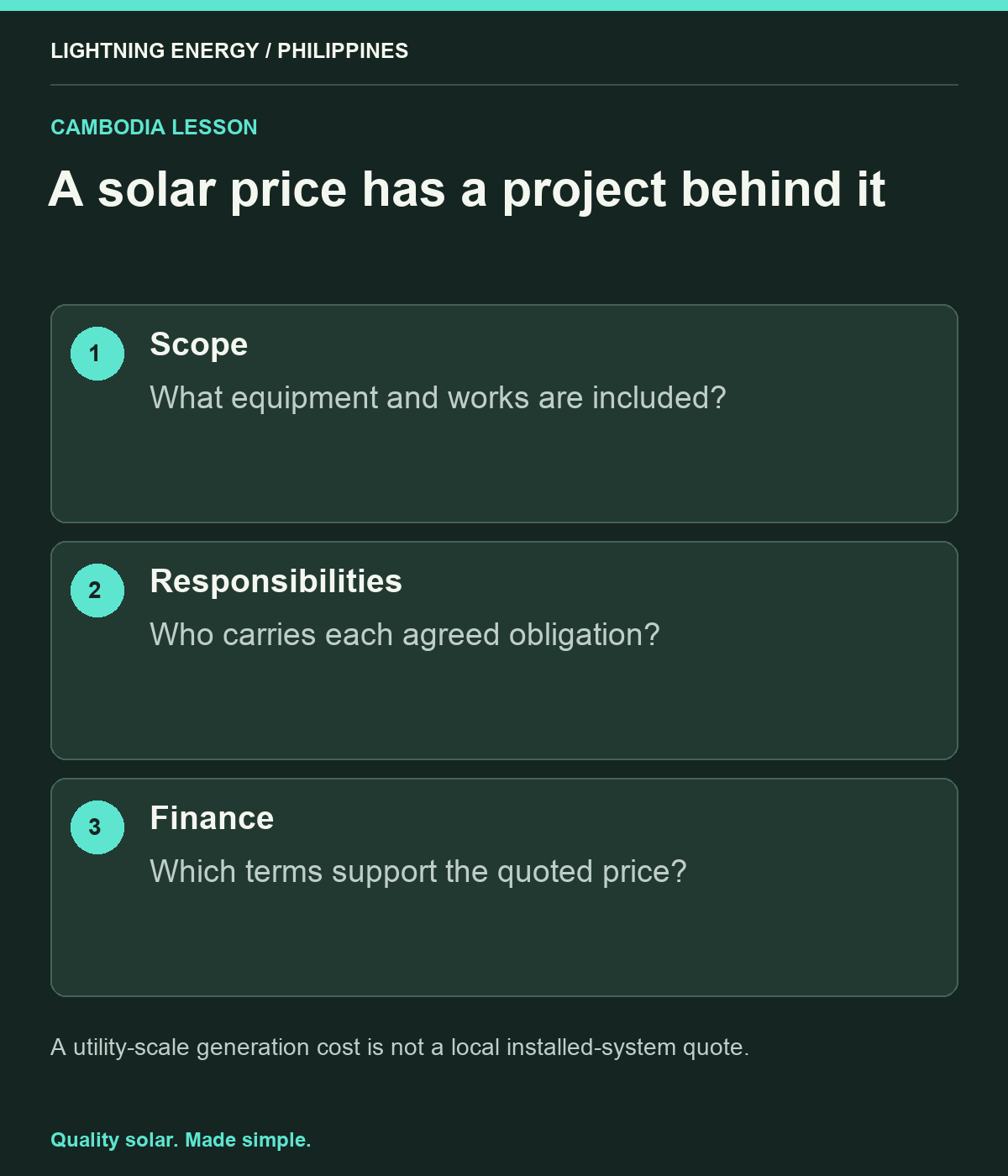
Build a scope table before negotiating
Ask each supplier to identify what is included: assessment, equipment, roof or structural work where needed, electrical works, approvals support, commissioning and handover. Note exclusions and who is expected to arrange them. An illustrative comparison might show one offer including necessary switchboard work while another leaves it to the owner. The cheaper headline is not yet a like-for-like price. Establish the common project boundary before asking which proposal represents better value.
Follow the risk to the party carrying it
Ask who is responsible if equipment is substituted, access changes or an identified site condition requires additional work. Have the actual commercial documents reviewed where appropriate. Do not assume that every uncertainty should sit with the supplier or that a broad disclaimer settles everything fairly. The useful outcome is an allocation both parties understand. A realistic price reflects a defined job; ambiguity can create later costs even when the original quotation looked competitive.
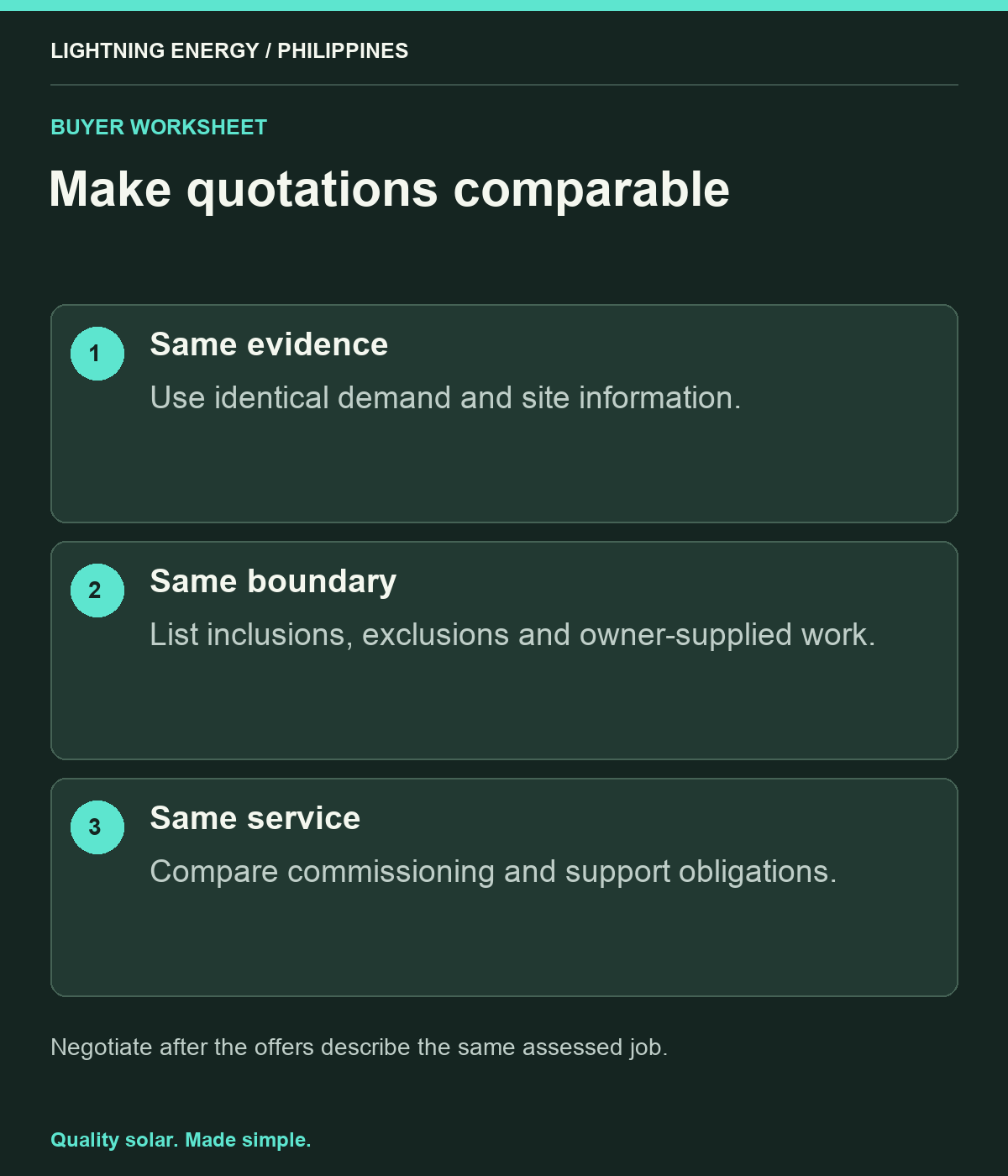
Compare evidence for performance
Give bidders the same demand and site information and ask them to state the assumptions behind generation and savings. Distinguish modelled output from any contractual performance commitment. A project in Cambodia does not demonstrate what a Philippine roof will produce. If a claim refers to a reference installation, ask how its conditions relate to the proposed site. The owner should be able to separate the supplier's relevant experience from a prediction that still requires local assessment.
Retain service in the value comparison
Ask what happens after commissioning, including monitoring access, routine support and warranty handling. A lower purchase price can remain good value, but only when the owner understands the responsibilities it retains. Avoid treating long warranty language as a substitute for a practical service route. Record who receives a fault report, what evidence is needed and which costs are included. These everyday arrangements belong in the comparison alongside equipment specifications and the installation timetable.
Use regional price stories as a prompt, not a promise
Bring the full local quotations to Lightning Energy for a scope-based discussion. Ask which items account for differences and what evidence supports the proposed performance. Cambodia's finance story shows that credible solar investment is built around an understood project. Philippine buyers can apply that principle at any scale: compare the same job, clarify responsibilities and evaluate the service that will remain available after the headline price has been paid.
Sources & further reading
Sources used for this guide. Policy and product details should be checked for your particular installation.
- ADB SEADS: Making Solar Projects Bankable in Frontier Markets13 February 2024; accessed 27 September 2026
- IRENA: Renewable Power Generation Costs in 20242025; accessed 27 September 2026