Solar FAQs
Will Solar Work on an East- or West-Facing Roof in the Philippines?
A roof does not need one perfect compass direction to deserve assessment. Compare layouts against shade, structure and your daily load.
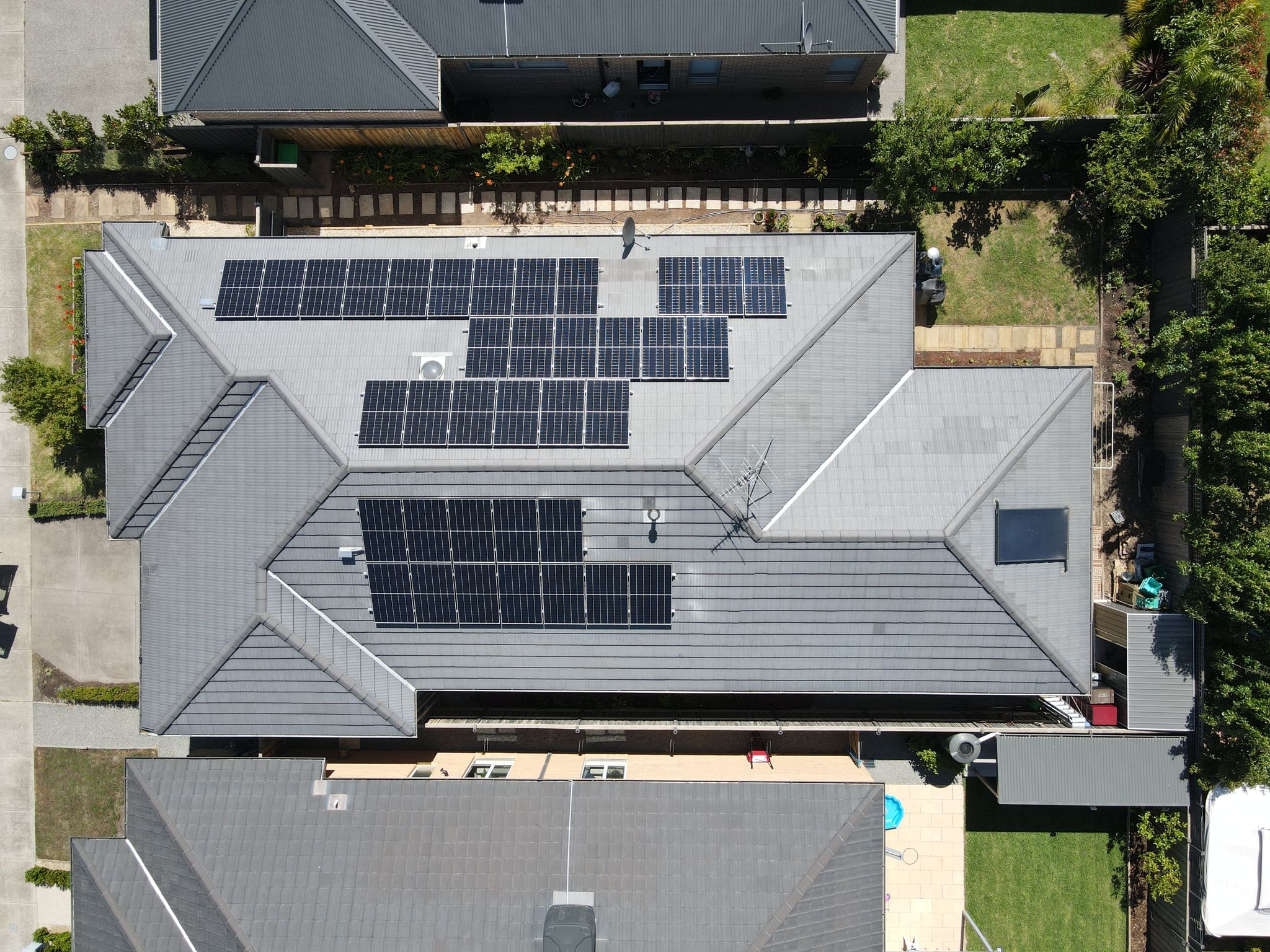
An east- or west-facing roof can be worth assessing. The right answer depends on the usable roof area, pitch, shading, local weather and when your household uses electricity. Ask for a comparison of the actual roof faces instead of accepting a blanket yes or no based on a compass direction alone.
Compare real layouts, not ideal roofs
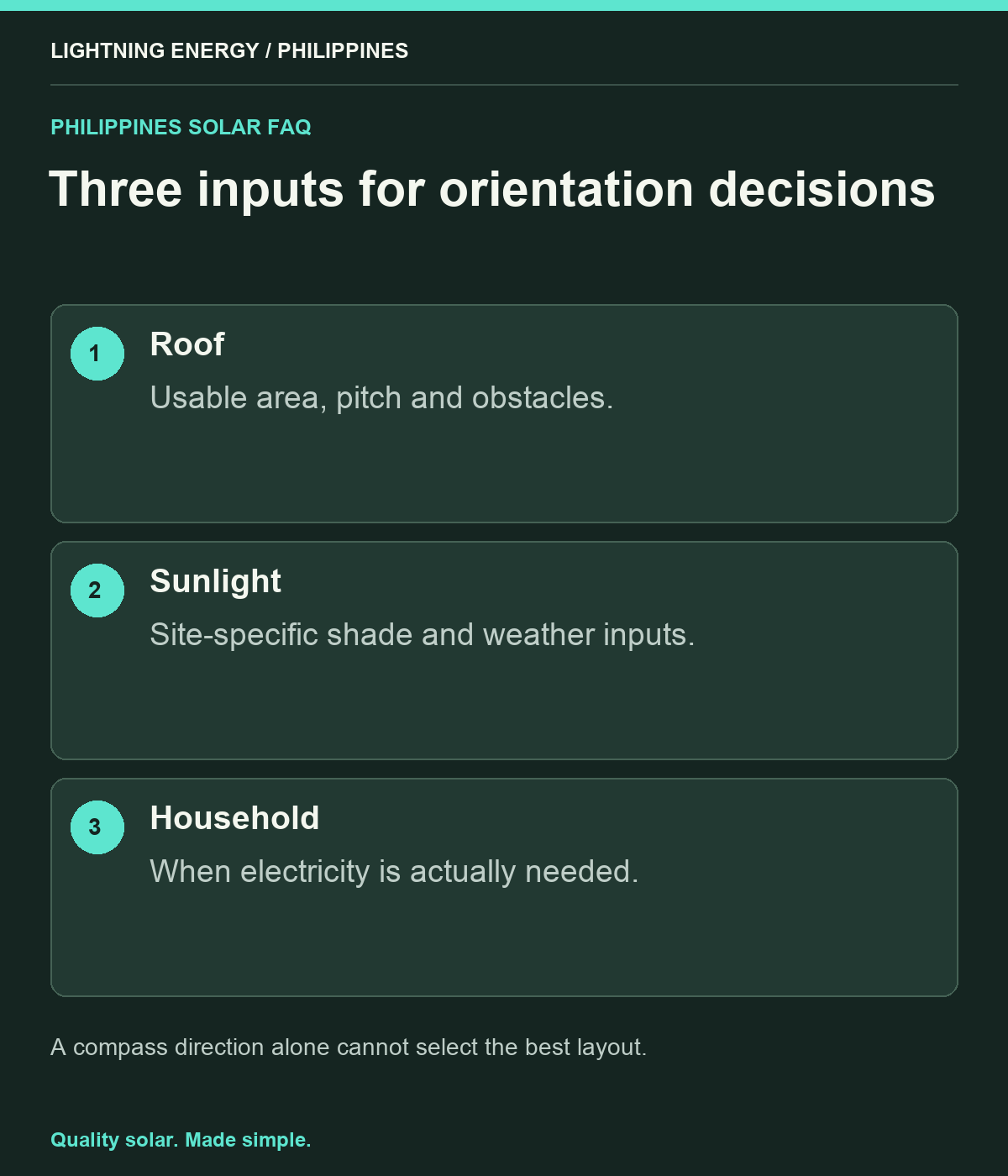
Start with an accurate roof plan showing orientation, pitch, obstacles and usable area. Request a design for the roof you own rather than a theoretical roof facing the supposedly perfect direction. Include safe access routes and areas that should remain clear for maintenance.
US DOE’s design guidance identifies location, orientation and load requirements as design inputs. [1] That physical principle is useful here, but a US example should not become a fixed Philippine roof-angle rule. A site-specific assessment can show whether an existing roof face is practical without introducing a costly support structure solely to change direction.
Ask for hourly shape as well as annual total
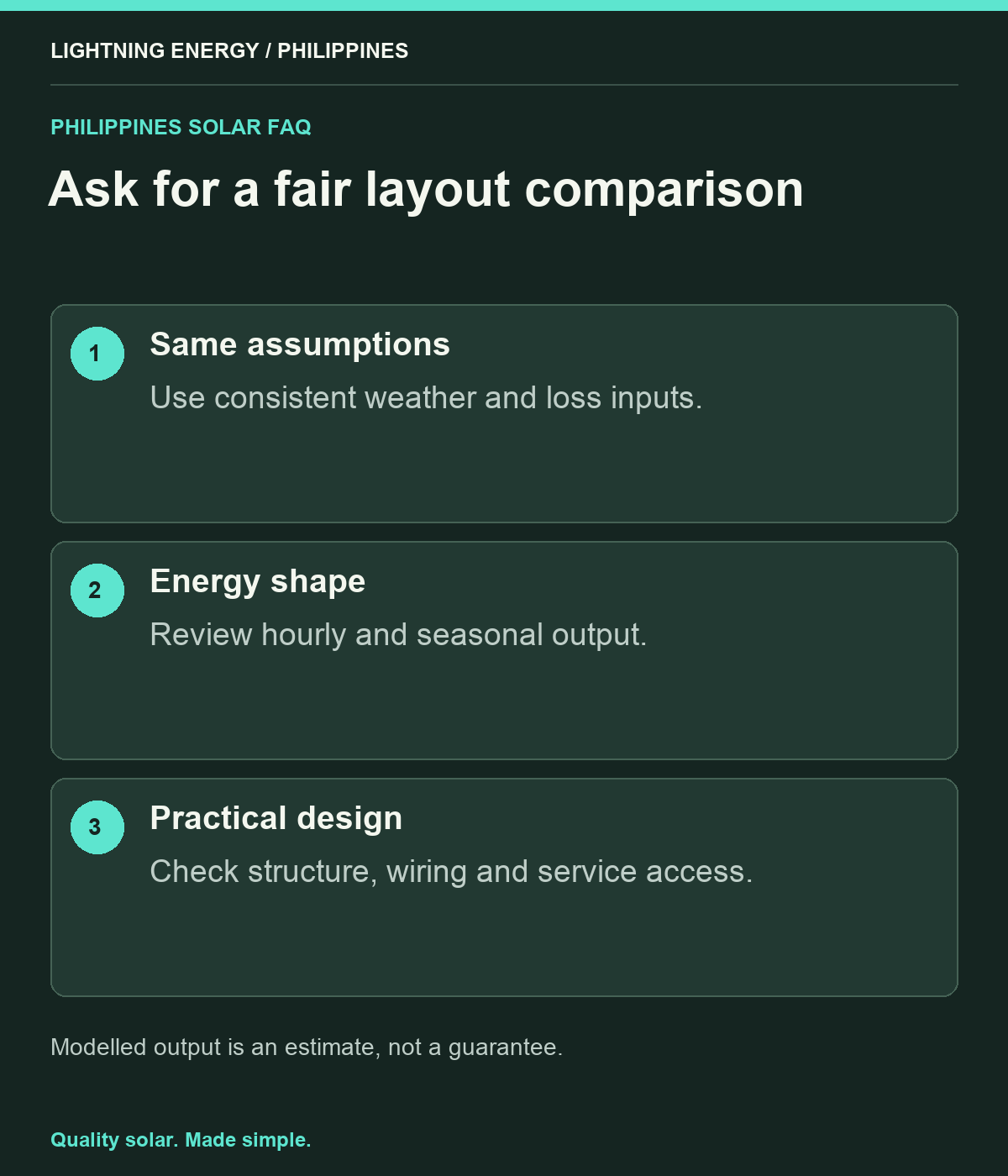
Two layouts can generate different patterns through the day. Ask the designer to show the expected shape and compare it with your appliance timetable. A home with regular morning activity may value a different pattern from one that runs substantial afternoon cooling.
Do not claim that an east-west layout always saves more or always generates less by a fixed percentage. Those outcomes depend on the actual site and assumptions. Request the same weather data, equipment and loss assumptions for each option so the comparison isolates the layout rather than quietly changing several inputs at once.
Keep modelling limits visible
PVWatts warns that its predictions depend on assumptions and do not represent every site-specific characteristic. [2] Use modelling as a decision aid, then add the roof survey and shade assessment that a generic map cannot fully provide.
Ask which weather location was selected, whether nearby obstructions were represented and how different roof faces were entered. Save the inputs with the proposal. If one option uses more panels, show both the total result and the result for comparable capacity. This prevents a larger array being mistaken for a more efficient orientation.
Use an illustrative household comparison
Imagine a family that works from home until mid-afternoon and another that is mostly away until dinner. Both are offered the same east-west array. Their direct use of solar may differ even if generation is identical, because their loads occur at different times.
Ask for a weekday and weekend scenario using your own routine. Do not shift essential activities merely to fit an attractive graph. If batteries are being considered, compare the roof layouts first, then show what storage changes. This keeps orientation, system size and storage from becoming one confusing bundle of assumptions.
Check the engineering behind multiple roof faces
Ask how the inverter and electrical design will accommodate arrays facing different directions. The installer should explain the chosen arrangement and verify equipment limits using the relevant manuals. You do not need to learn string design to request a documented compatibility check.
Also ask whether the two faces differ in roof condition, wind exposure or access difficulty. An apparently useful extra panel area may add disproportionate installation and maintenance work. Have qualified professionals assess these issues; do not climb onto a roof to estimate pitch or remove obstacles for a preliminary quotation.
Choose the layout you can maintain
Request a clear roof drawing, generation estimate range, direct-use assumptions and any cost difference between layouts. Include the practical consequences of future roof repairs. A good choice balances useful energy, installation quality and long-term access rather than chasing one idealised annual number.
Lightning Energy Philippines can compare the available roof faces against your household schedule. Bring bills and safe roof photographs, then ask why the recommended arrangement fits your home. An east- or west-facing roof deserves a measured assessment, with the limitations stated plainly and no unsupported claim that every orientation performs the same.
Sources & further reading
Sources used for this guide. Policy and product details should be checked for your particular installation.
- US Department of Energy — Solar Photovoltaic System Design BasicsAccessed 27 September 2026
- National Laboratory of the Rockies — PVWatts Calculator and Model NotesAccessed 27 September 2026