Across Asia
Korea’s Building-Integrated Solar Lesson: Design the Building and Power Together
Building-integrated photovoltaics require a joined-up construction brief, not just an electrical equipment schedule.
A solar facade or roof tile can make renewable generation part of a building’s architecture. It also changes the conversation: an element may now be expected to satisfy the building team and the electrical team at the same time.
Korea’s experience with building-integrated photovoltaics, often shortened to BIPV, offers a useful starting point for Philippine developers considering a new property or major renovation. The strongest brief names both jobs the proposed element must perform, and gives each job a responsible reviewer.
Use overseas programmes as context
IEA PVPS’s national survey covering Korea in 2022 describes support arrangements that included building-integrated solar. [1] That historical policy context helps explain industry interest, but it does not establish Philippine eligibility, building approval or financial support. A developer should commission a local assessment rather than borrow an overseas business case. Begin with the proposed building use, location and approval pathway, then identify whether integrated solar is being considered for function, appearance, energy production or a combination of these goals.
State the building function first
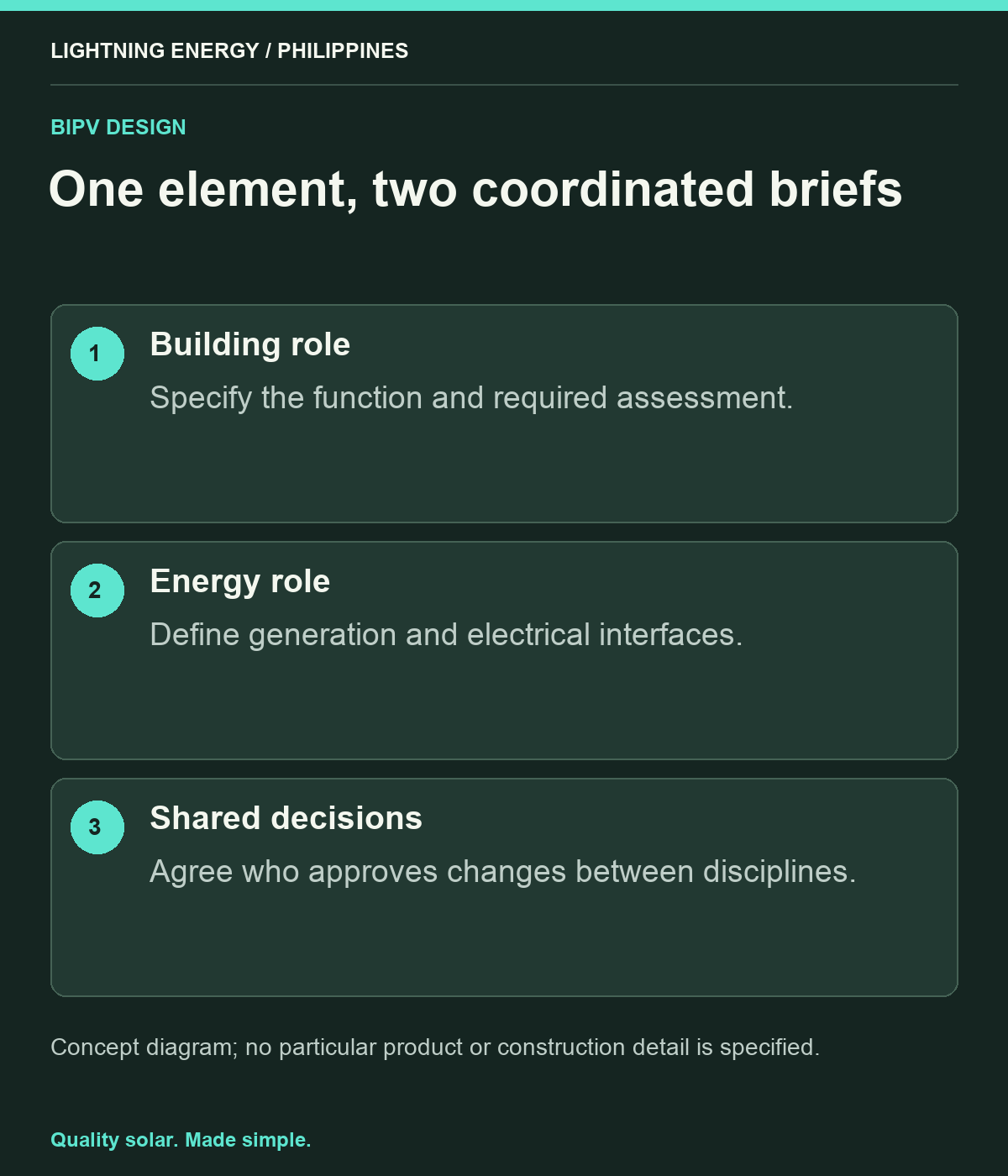
IEA PVPS’s business-case guide treats BIPV as a building component with value beyond electricity generation. [2] Translate that idea into a precise project requirement. Is the element part of the roof covering, a facade, shading or another specified assembly? Ask the architect to define the function it must fulfil and the evidence required. The electrical designer can then assess generation within those boundaries. An attractive rendering should not be allowed to leave the underlying building responsibility undefined.
Compare like with like
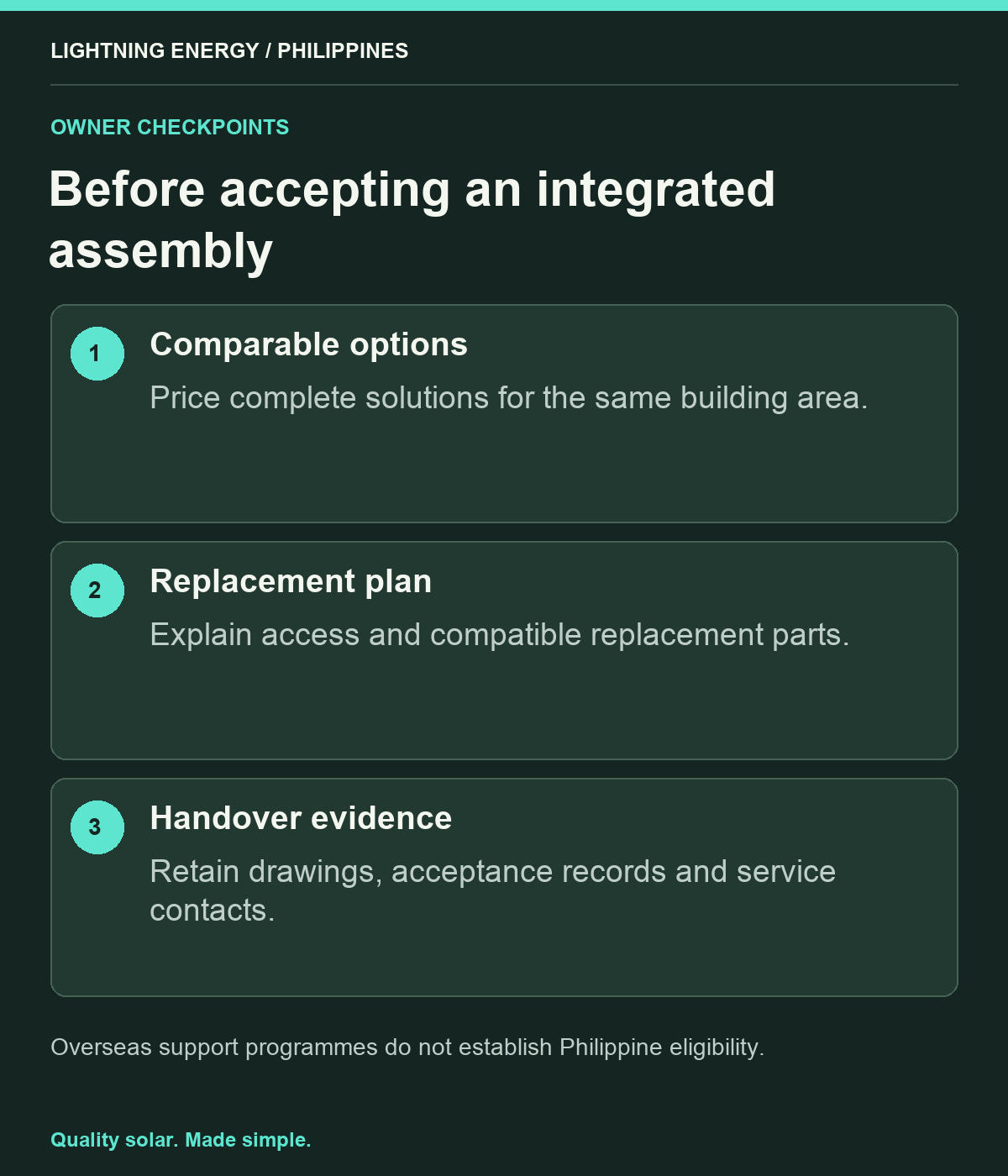
Create two complete options for the same area: a conventional building solution with a separate solar arrangement where feasible, and the proposed integrated assembly. Include the materials each option replaces, the work needed to install it and the access required for maintenance. Do not simply compare the price of a decorative facade with a solar module. For an illustrative office development, agree whether appearance is a requirement or a preference before using its value to justify a more complicated procurement choice.
Coordinate interfaces before ordering
Hold a design review involving architecture, structure, electrical work, construction and maintenance. Ask each discipline to mark the interfaces it relies on: dimensions, fixing details, cable routes, access and inspection points. The purpose is not for the owner to design those details. It is to ensure that specialists are working from the same version of the project. Record who approves a change when a supplier substitutes a component, since a change acceptable to one discipline may need review by another.
Decide how a future replacement works
A distinctive component creates a practical question: what happens if one section needs replacement after the original construction team has left? Ask for a documented procedure, access assumptions and the route for obtaining compatible parts. Consider the visual and functional treatment of a temporarily unavailable section. This is a procurement exercise, not a prediction of failure. It allows the owner to compare service arrangements before the building is occupied, when access restrictions and tenant expectations may be harder to change.
Keep acceptance criteria separate and connected
The handover should show that the building work and the electrical system have each met their agreed acceptance requirements. Name the people authorised to sign off each part and the records they will retain. Where responsibilities overlap, specify how disputes will be investigated rather than assuming a general warranty covers everything. An owner should be able to locate the relevant drawings, product identities, inspection records and service contacts without reconstructing the entire construction history from old email conversations.
Build a team brief before a sales brief
For a Philippine project, a useful first document is a shared design brief with the building function, energy objective, architectural preferences and maintenance constraints. Lightning Energy Philippines can contribute to the solar discussion while the appropriate building professionals assess their disciplines. BIPV can be an interesting option for the right project. Its appeal becomes easier to evaluate when the proposed building and energy services are both explicit, and the local team can explain how those services will be delivered and maintained.
Sources & further reading
Sources used for this guide. Policy and product details should be checked for your particular installation.
- IEA PVPS: National Survey Report of PV Power Applications in Korea 20222022 survey, published January 2024; accessed 27 September 2026
- IEA PVPS: Development of BIPV Business CasesAccessed 27 September 2026