Solar FAQs
Do I Need to Tell My Utility When Replacing a Solar Inverter?
Treat an inverter replacement as a documented system change and confirm the requirements of your actual Philippine distribution utility.
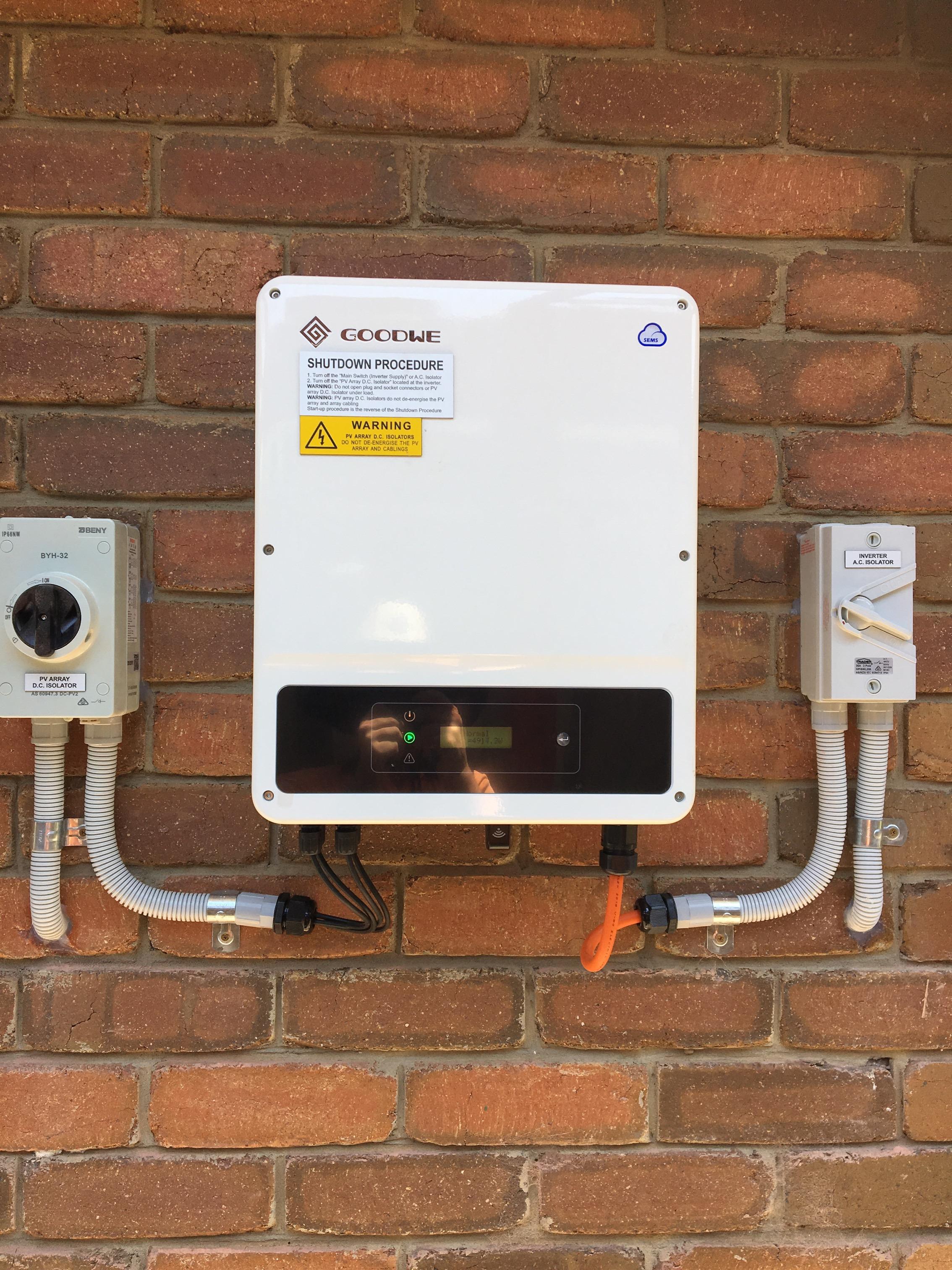
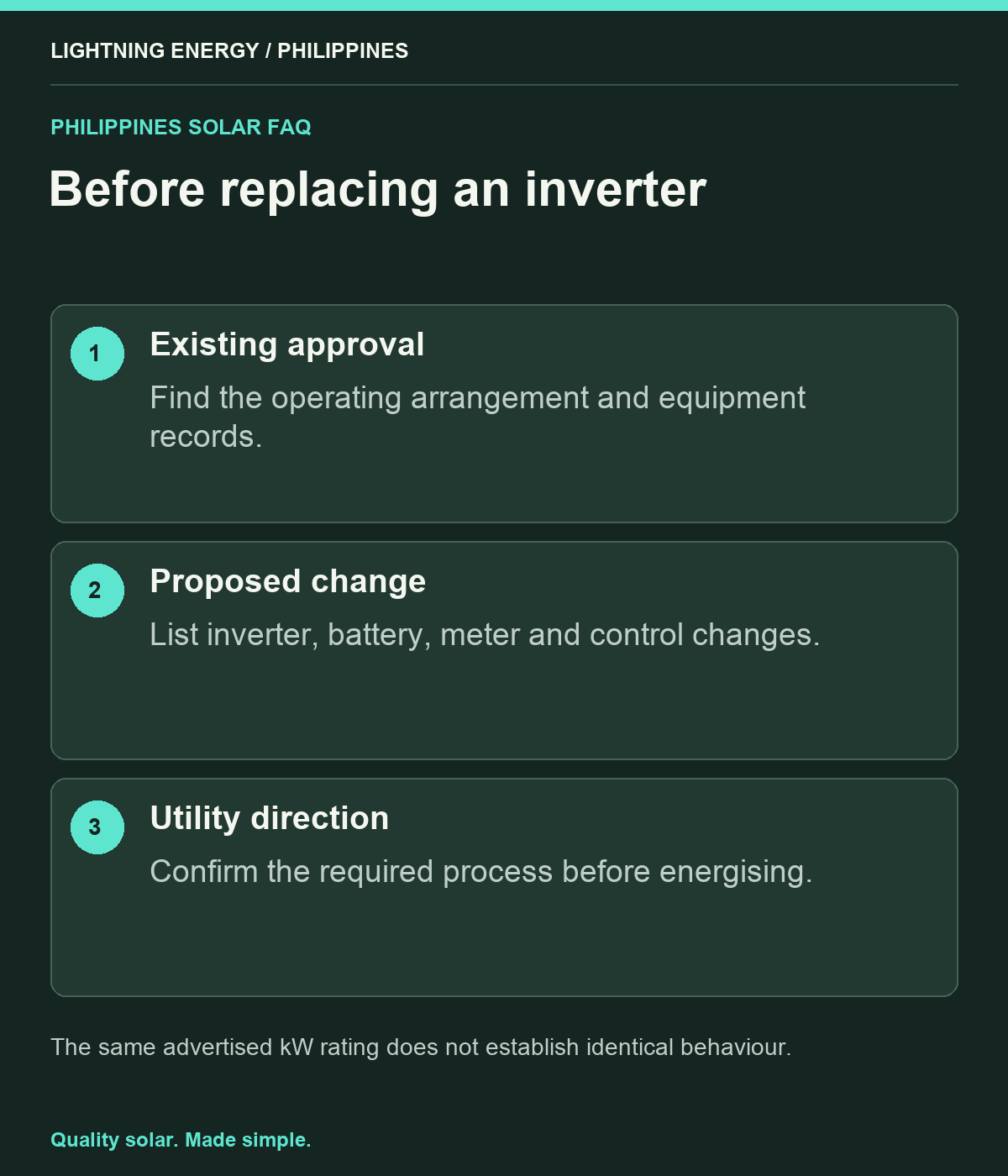
Ask your distribution utility and qualified installer before the replacement is energised. Whether an update, assessment or approval is required depends on the connection arrangement and what is changing. A replacement with the same advertised kilowatt rating is not necessarily identical in its technical behaviour. Keep the utility’s written direction with the updated system records rather than assuming the old approval covers every future inverter.
Establish the current connection arrangement
Find your approved equipment schedule, application records and operating conditions. Identify whether the system uses net metering, an approved zero-export arrangement or another permitted configuration. If records are missing, ask the utility and previous installer to help reconstruct them before ordering equipment.
Meralco’s published process includes technical and commissioning stages for net-metered systems. [1] This provides a clear reason to check how a later equipment change should be recorded, but it does not establish one universal replacement procedure for every Philippine utility or project.
Describe the proposed change precisely
Give the utility and installer the existing and proposed inverter model codes, rated output and relevant technical documents. State whether panels, batteries, protection, metering or export-control equipment are also changing. Avoid describing a larger redesign as a simple like-for-like swap.
For an illustrative household, replacing a failed inverter with another model of the same nominal size may still change monitoring, communication or battery compatibility. The practical question is whether the complete replacement arrangement remains supported and acceptable, not merely whether the number printed on the front looks familiar.
Do not confuse simplified rules with no obligations
DOE’s August 2026 own-use solar announcement describes simplified requirements for qualifying arrangements while retaining safeguards. [2] Eligibility depends on the actual system and current rules; the announcement is not blanket permission to modify any grid-connected installation without checking its obligations.
Ask the installer to identify the basis for the proposed approach and confirm it with the relevant distribution utility where needed. Keep a dated answer. If the household is also changing from zero export to net metering, treat that as a separate operating objective requiring its own appropriate process.
Preserve the agreed export behaviour
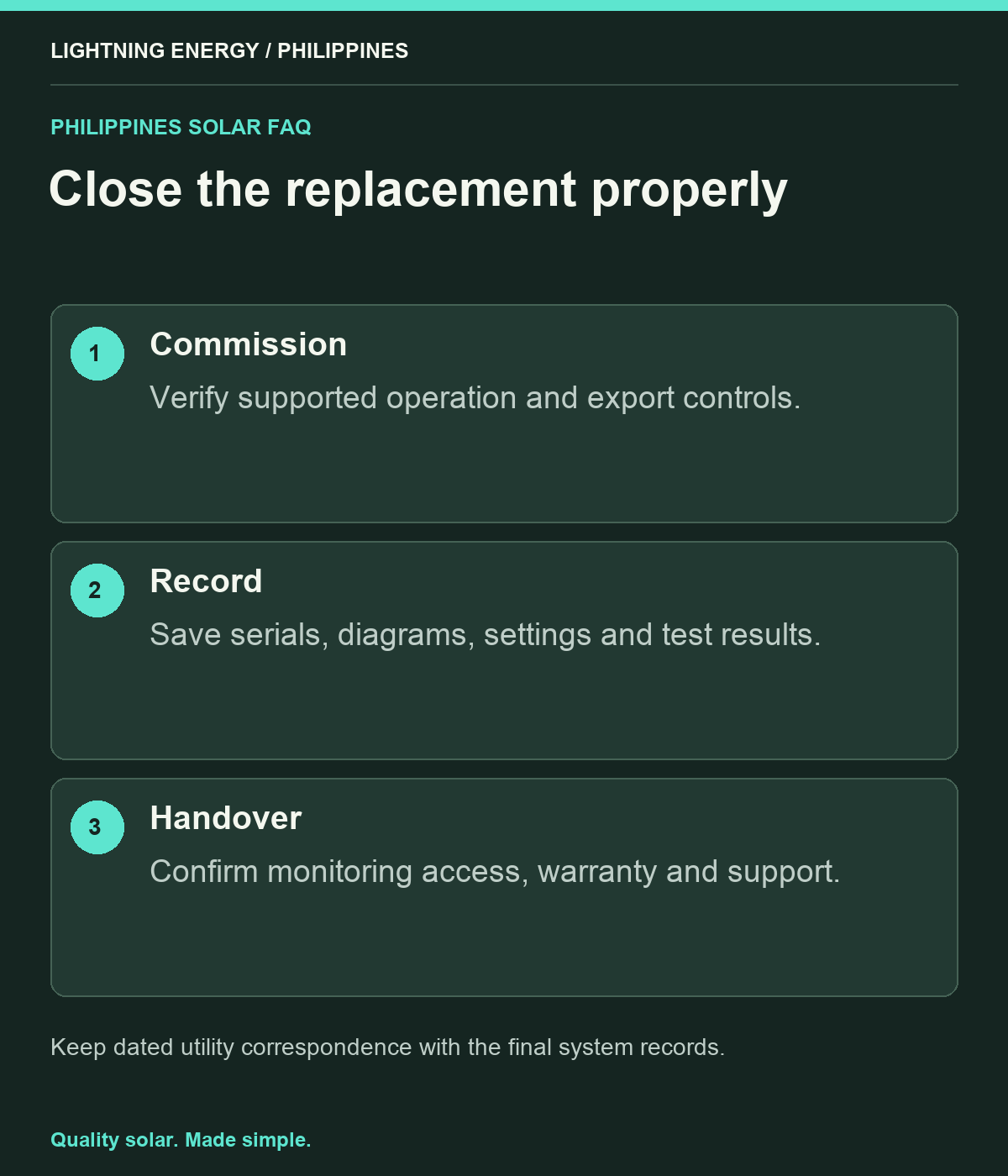
Request a commissioning check of the intended export-control arrangement and metering after the replacement. Have qualified personnel verify that the new equipment and settings work together as designed. Do not copy protected settings from an online video or assume a factory default matches your site.
Ask what happens if monitoring or control communications fail. The answer should come from the supported system design and the applicable utility conditions. Record the final configuration and any limits in the handover pack so future service personnel understand what the household is authorised to operate.
Update warranties and monitoring access
Record the replacement serial number, installation date, warranty terms and reason for replacement. Clarify whether it is a warranty remedy, a paid repair or an upgrade, because the commercial records may differ. Keep the original equipment information rather than deleting the service history.
Check legitimate owner access to the new monitoring platform and confirm which historical data remain available. Ask whether any meter or sensor configuration has changed. A new app should be reviewed for correct readings before the household uses it to judge savings or diagnose faults.
Close the job with a complete record
Request the updated diagram, equipment schedule, test records and any utility correspondence required for the change. Confirm that unresolved documentation or inspection items are listed with a responsible contact. The installation should not remain dependent on someone remembering a verbal explanation months later.
Lightning Energy Philippines can assess a replacement from your current system records and intended operating arrangement. The aim is a compatible, documented installation that continues to meet the relevant requirements. Checking the process before buying the inverter is usually more useful than discovering missing records when the replacement is ready to operate.
Sources & further reading
Sources used for this guide. Policy and product details should be checked for your particular installation.
- Meralco — Net-Metering Application ProcessAccessed 27 September 2026
- DOE Philippines — Own-Use Solar Rules, 20 August 2026Accessed 27 September 2026