Solar for business
Solar Claims That a Philippine Business Can Explain with Evidence
Use clear boundaries, generation records and attribute ownership to communicate a solar project accurately.
Installing solar gives a business something concrete to discuss with customers and staff. The difficult part is choosing language that matches what the project actually does. A rooftop array, a lower electricity bill and a claim of fully renewable operations are not interchangeable descriptions.
For Philippine businesses, a useful communication process starts with a few verified records and a clear boundary. The goal is not elaborate marketing. It is a statement that the facilities team, finance team and customer-facing staff can all explain in the same way.
Begin with the simplest verifiable statement
Record the equipment installed, commissioning date and location. If capacity is stated, use the documented unit and distinguish the relevant rating. Avoid adding a generation or savings claim before evidence exists. ADB's Manila headquarters example describes rooftop solar serving part of building demand. [1] That wording illustrates a useful discipline: say what the installation supplies rather than implying that a visible array necessarily covers every activity or every hour of the site's operation.
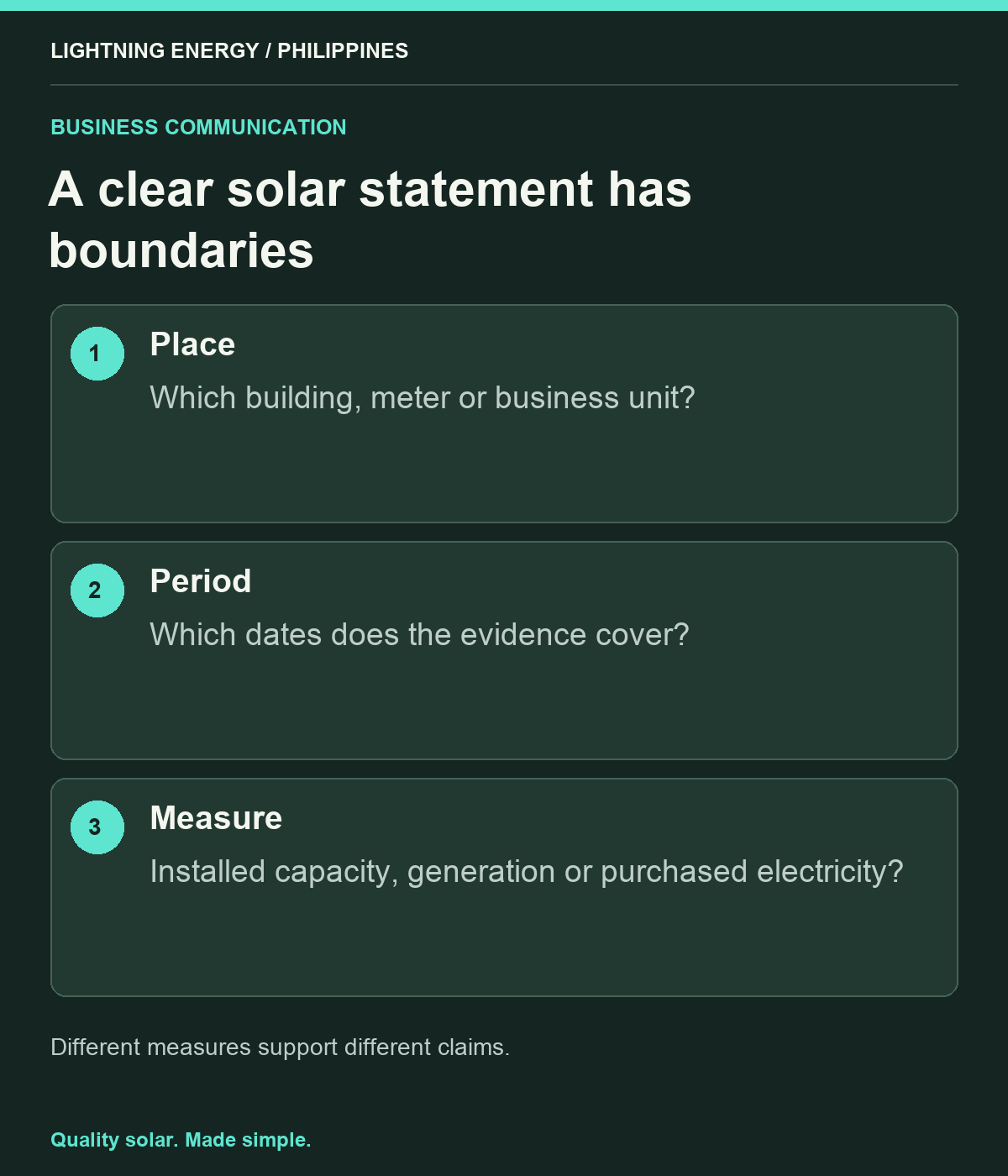
Put a time period on performance figures
A generation figure should identify the period it covers and the source of the data. Keep measured results separate from a design estimate. If the business expands or closes temporarily, note that context when comparing electricity bills. An illustrative monthly update might report solar generation and purchased electricity separately, then explain a change in operating hours. That is clearer than presenting a bill reduction as entirely caused by solar when demand or prices also changed during the comparison period.
Define the organisational boundary
Decide whether the claim concerns one building, one meter, one business unit or the whole company. A rooftop at headquarters does not automatically describe every branch or supplier. Keep transport, other fuels and off-site activities separate unless the assessment explicitly includes them. The person preparing a statement should be able to point to the records and scope that support it. If a customer asks what was measured, the answer should not depend on reconstructing assumptions after a campaign has already been published.
Understand that energy attributes need attention
GHG Protocol's Scope 2 Guidance addresses contractual instruments and quality criteria for purchased-energy accounting. [2] Businesses making formal renewable-energy or emissions claims should obtain appropriate advice about their actual arrangements, including any relevant attribute ownership. This article does not determine the accounting treatment of a particular project. The practical action is to ask the question before marketing language is finalised, especially where a third party owns the equipment or environmental attributes are transferred separately.
Keep everyday language proportionate
Consider a factual statement such as having commissioned a rooftop solar system at a named facility, supported by the installation records. More ambitious statements need more evidence. Avoid describing a battery as proof that operations use renewable electricity at every hour; its charging source and duty matter. Do not turn an annual energy balance into a claim of uninterrupted renewable supply. A short, precise message often communicates the achievement better than a sweeping label whose boundaries the business cannot explain.
Establish a review and approval routine
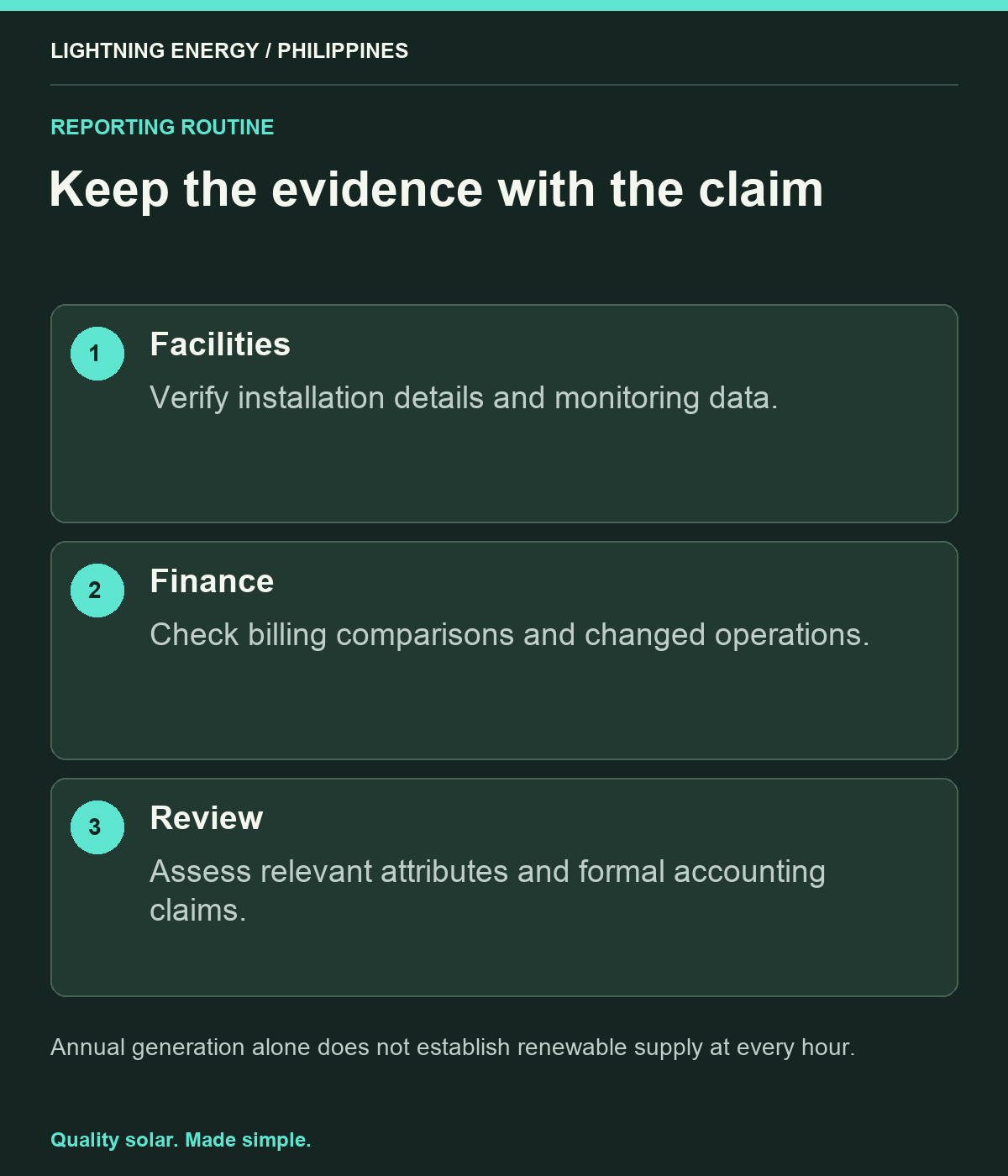
Have facilities verify the technical information, finance check relevant billing figures and the appropriate adviser review formal accounting or environmental claims. Save the supporting records with the approved wording. Set a date to revisit the statement if equipment, ownership or operations change. This need not become a large administrative exercise. A single evidence sheet can prevent several departments from publishing slightly different numbers and makes it easier to correct a figure if a monitoring or reporting issue is later identified.
Build reporting into the solar purchase
Ask for monitoring access and the documentation needed to describe the system accurately. Lightning Energy can discuss the physical installation and its measured performance within the agreed scope. The business should retain ownership of the evidence behind its public statements. A credible solar story is specific about place, period and outcome. It allows customers to see a real improvement while leaving room for the next step, without suggesting that one project has already solved every part of the company's energy use.
Sources & further reading
Sources used for this guide. Policy and product details should be checked for your particular installation.
- ADB: Setting a Solar Power Example in the Philippines2012; accessed 27 September 2026
- GHG Protocol: Scope 2 GuidanceAccessed 27 September 2026