Solar FAQs
Why Is Exported Solar Worth Less Than Electricity I Buy?
Understand why an exported kWh and an avoided purchase can have different values, and how that changes sensible household decisions.
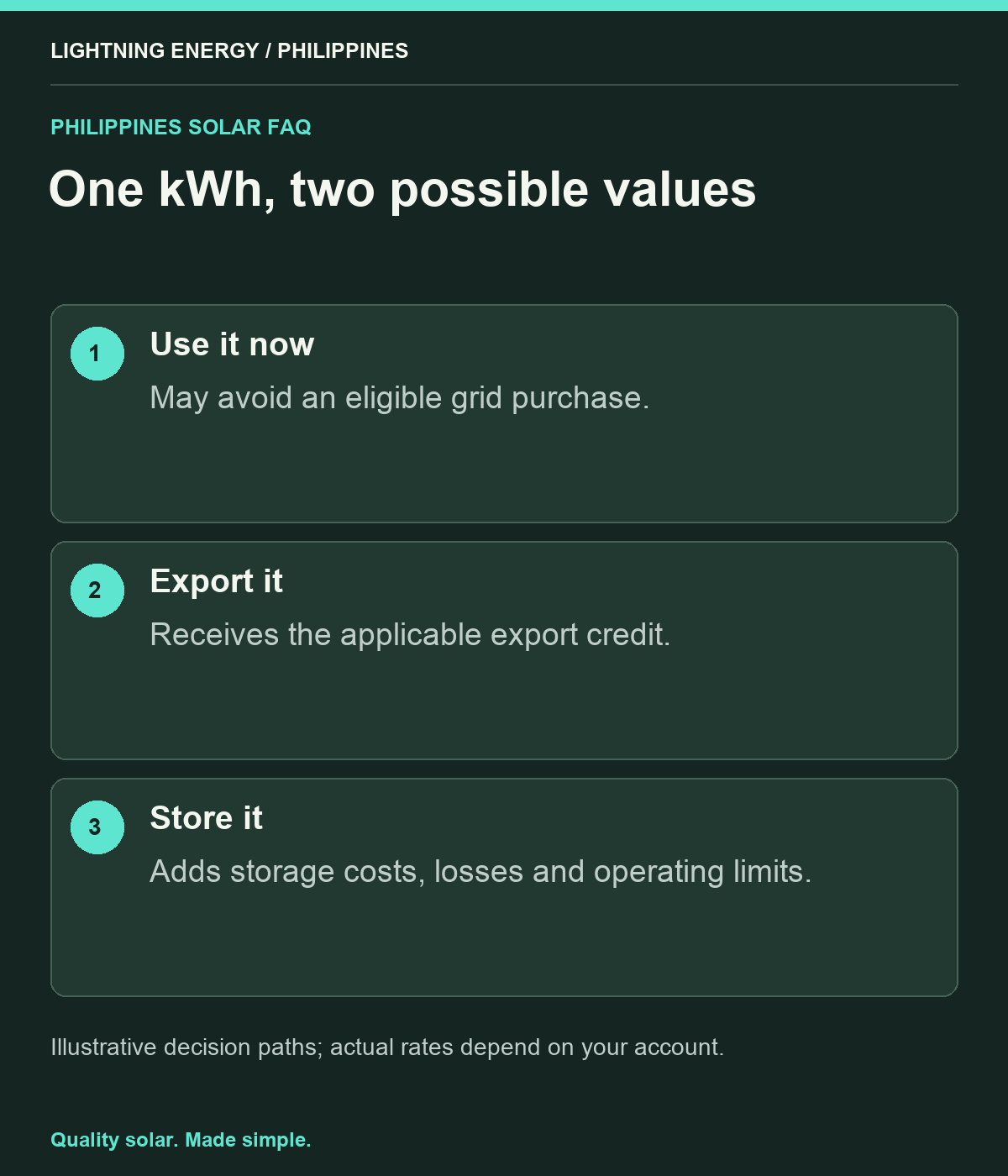
An exported kilowatt-hour does not automatically cancel the full cost of a kilowatt-hour bought later. Your utility’s export-credit method and your purchase tariff are separate calculations. For a Philippine household, this distinction matters when comparing a larger panel array, daytime appliance scheduling and battery storage. Start with your actual tariff documents rather than a generic savings percentage.
Find the two rates separately
Meralco’s published method values exports using its monthly blended generation charge, excluding other generation adjustments, rather than the complete retail rate. [1] That is a Meralco example, not permission to copy one peso figure into every Philippine proposal.
Ask your own distribution utility for its applicable method and latest bill explanation. Identify the billing month, rate components and any account-specific terms. A proposal should state which rate it uses for exported electricity and which avoided charges it uses for electricity consumed directly. If both columns contain the same number, request an explanation before accepting the result.
Follow an illustrative pair of kilowatt-hours
Suppose, purely for explanation, that an avoided purchase is worth P12 per kWh and an export earns P6 per kWh. Using 1 kWh of solar immediately would avoid P12 under those assumptions; exporting it would create P6 of credit. These are invented teaching figures, not current rates or a savings forecast.
If you export in the afternoon and buy after dinner, calculate each transaction separately. Do not subtract energy quantities first and apply a single retail rate to the difference. A spreadsheet that keeps imports, exports and their rates separate makes the assumption visible and easy to change.
Move useful loads, not unnecessary consumption
Look for tasks you already need to do: laundry, a scheduled pump cycle or charging suitable devices. Consider whether they can safely run during available sunshine without disrupting the household. Moving a necessary task can be useful; running an appliance for no purpose is still consumption.
Start with one change for a week and review the result. Keep comfort, noise restrictions and appliance instructions in mind. A family working from home may have different opportunities from a household empty during weekdays. The best schedule is one that people can follow without constantly watching the inverter screen.
Check whether you can measure the result
FIMER distinguishes basic production reporting from consumption monitoring that reveals how energy is used and exchanged. [2] Ask what your own system measures before using an app percentage to judge a schedule change.
Record a baseline and a trial period with similar household routines. Weather will vary, so avoid treating a single sunny day as proof of annual savings. Note which load moved, how often it operated and whether grid imports actually fell during the relevant period. A clear, limited experiment is more informative than assuming every daytime appliance is fully powered by solar.
Evaluate a battery as a separate purchase
The gap between purchase and export values is one input to battery economics, not the whole answer. Storage has an installed cost, operating limits, energy losses and a finite warranty. Ask the proposal to separate bill reduction from the value you personally place on outage support.
Use the same house, tariff assumptions and solar forecast when comparing with and without a battery. Include a conservative case with less surplus sunshine and a higher backup reserve. If the proposal only works when every day is perfect, ask for a more realistic range and an explanation of which assumption drives the result.
Request an auditable savings table
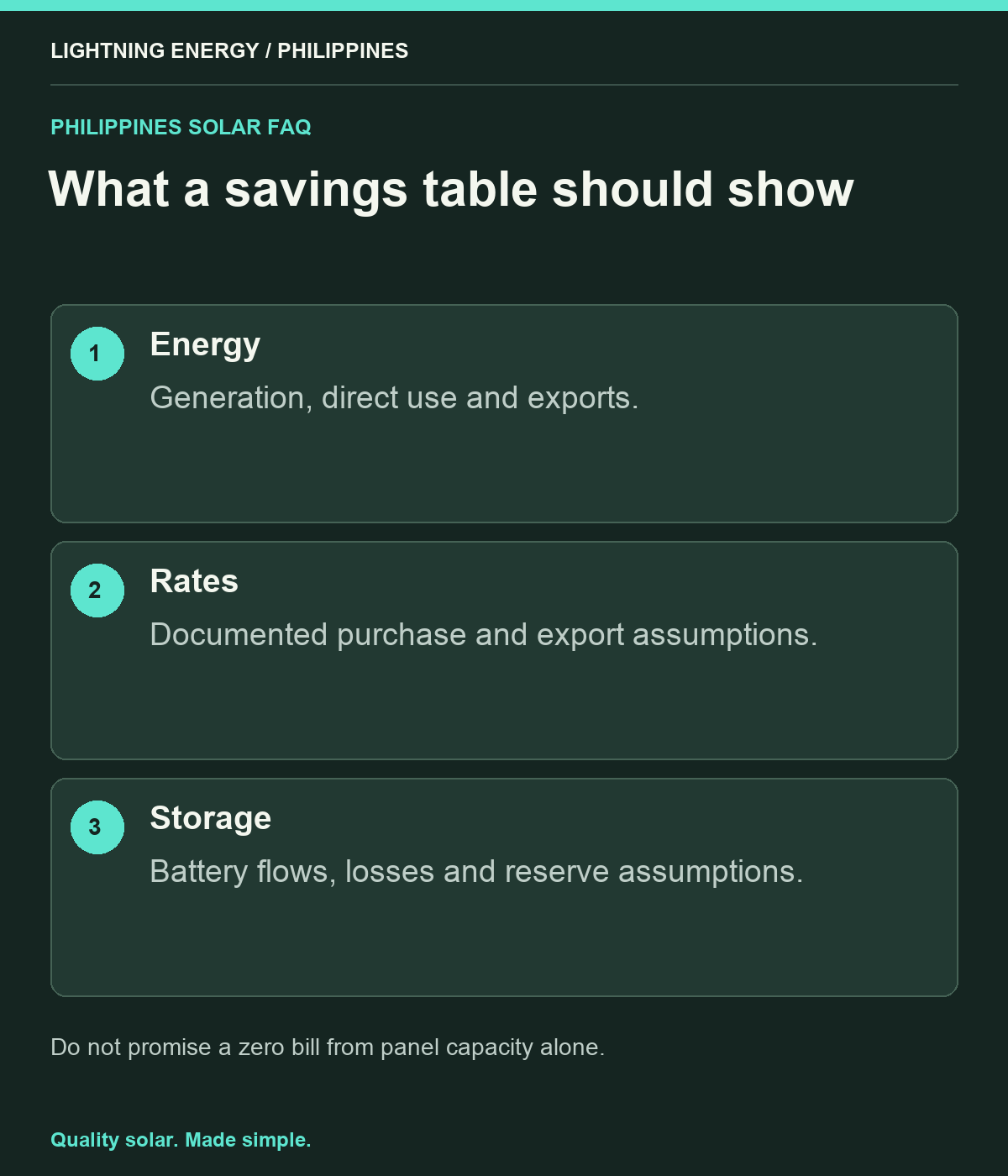
A useful quotation lists expected solar generation, direct household use, exports, battery flows where relevant, and the rates applied to each. Ask for annual totals as well as monthly variation. Keep fixed charges and other bill items visible rather than promising they disappear automatically.
Lightning Energy Philippines can help you compare those assumptions against your bills and routine. Bring the latest utility statement and a simple daytime appliance timetable. The objective is a system whose value you understand, with export credits treated as one part of the case and no unsupported promise that solar will erase every charge.
Sources & further reading
Sources used for this guide. Policy and product details should be checked for your particular installation.
- Meralco — Net-Metering Billing FAQsAccessed 27 September 2026
- FIMER — What Is Consumption Monitoring?Accessed 27 September 2026