Solar FAQs
Is Solar Worth Considering if I Rent My Home?
Tenants need a plan for consent, ownership and moving costs before buying fixed solar or battery equipment.
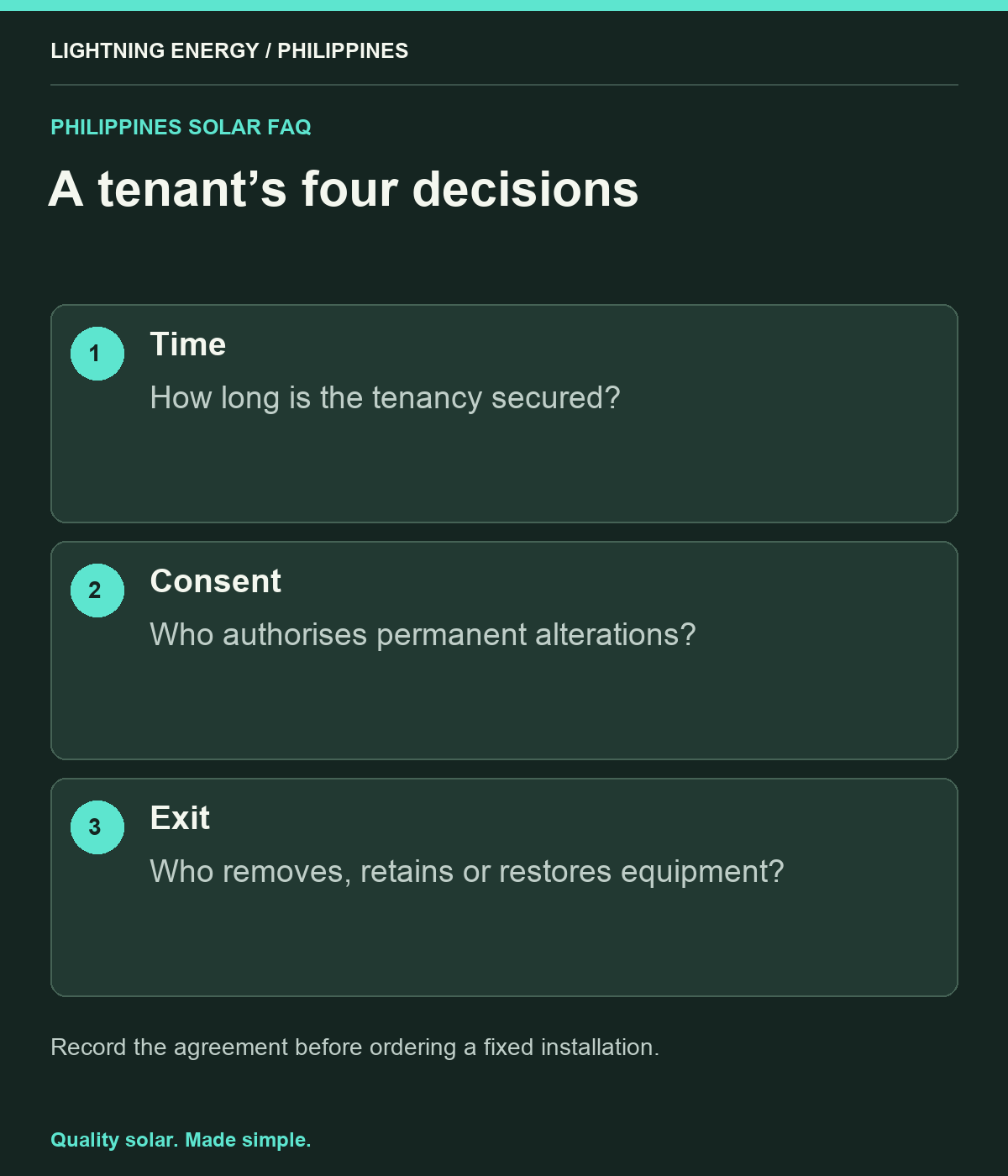
A tenant can explore solar, but the decision needs more than an electricity bill. Establish the landlord’s consent, the remaining lease period, ownership of the equipment and the cost of leaving or relocating it. A portable backup product and a permanently connected rooftop system are different purchases, with different practical limits.
Match the project to the tenancy
Start with the date you expect to leave, not an optimistic long-term savings chart. A short lease may make a permanent installation difficult to justify unless the landlord shares the investment or agrees another arrangement. Keep any renewal possibility separate from the period already secured.
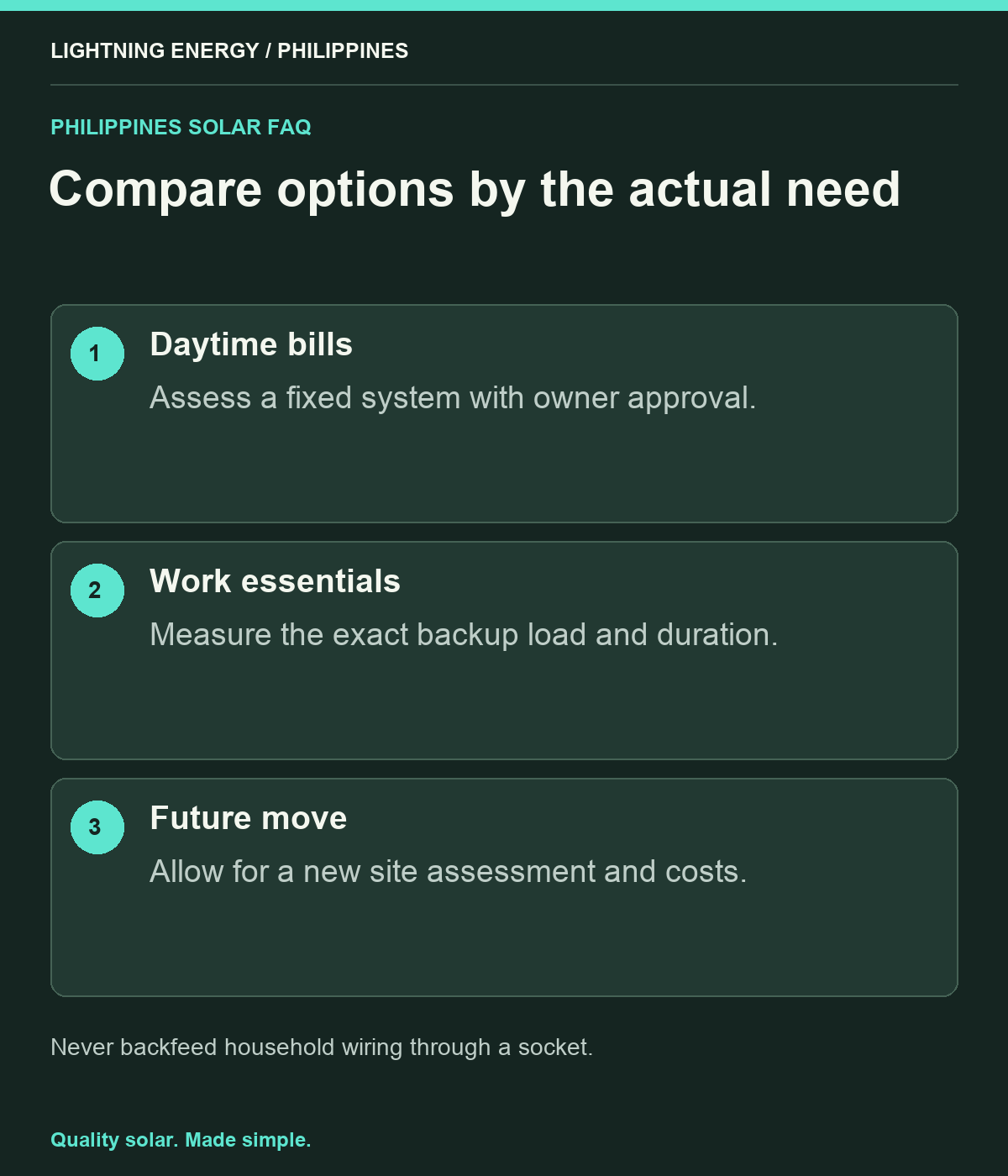
Write down your real objective: reducing daytime purchases, keeping a work laptop online, or supporting selected loads during outages. The appropriate solution might be smaller than the first package offered. Avoid buying a large fixed system simply because it could be useful at a future property that has not yet been chosen.
Get a written agreement before physical work
Agree who authorises roof penetrations, cable routes, equipment placement and access for servicing. State who owns the equipment during the tenancy and after it ends. Ask an appropriate adviser to review unclear lease terms or disputes rather than assuming a general online answer settles them.
Include restoration and removal responsibilities. If the landlord wants the system to remain, define how that decision will be made and documented. A friendly conversation is a good beginning, but it should be converted into a clear arrangement before money is committed or the building is altered.
Keep utility paperwork aligned
Meralco publishes an account-name modification process, including proof-of-occupancy requirements. [1] Ask your actual utility how the account and applicant should be arranged for the proposed system, rather than assuming the person paying for panels can automatically apply under someone else’s service.
If the landlord holds the electricity account, involve them early. If you hold it, ask what happens when the tenancy ends. Keep connection permissions separate from the lease agreement: approval by one party does not substitute for approval by another. A short written sequence can prevent conflicting expectations between tenant, landlord, installer and utility.
Do not assume equipment will fit the next home
US DOE’s homeowner guidance identifies roof condition, shape and shading as factors in solar suitability. [2] The general physical point applies when considering relocation: another roof may need a different layout, mounting system or electrical design. The source’s US incentives and programmes are not Philippine offers.
Ask for a removal-and-reinstallation estimate only as a scenario, with exclusions clearly stated. Transport, inspections, replacement mounting parts and damage risk can affect the result. A product being removable does not mean moving it is free, simple or always permitted by its warranty.
Compare a small, concrete backup need
For an illustrative work-from-home requirement, list a laptop, internet equipment and a desk light, then measure their combined demand and desired duration. Compare suitable products against those numbers and their manufacturer instructions. Do not infer whole-home capability from a photograph of a compact power station.
Any product connected to fixed household wiring needs an appropriate, professionally designed connection. Never backfeed a house through a wall socket or improvised lead. If using a portable unit for plug-in equipment, follow its approved uses and charging instructions, and keep the limits visible to everyone in the household.
Ask for a tenancy-aware proposal
Bring the lease end date, landlord’s preliminary position, bills and your priority load list to Lightning Energy Philippines. Request alternatives that clearly distinguish permanent rooftop work from other suitable options. Include ownership, maintenance and exit costs in the comparison.
A sensible decision may be to proceed, negotiate a landlord-funded installation, or defer fixed solar until your housing situation is clearer. The useful outcome is an honest match between the investment and the time you control the property, with no assumption that a future move will automatically preserve the same savings or system design.
Sources & further reading
Sources used for this guide. Policy and product details should be checked for your particular installation.
- Meralco — Modify a ServiceAccessed 27 September 2026
- US Department of Energy — Homeowner’s Guide to SolarAccessed 27 September 2026