Across Asia
Uzbekistan’s Solar-and-Storage Contract: Think in More Than One Lifetime
A utility project in Uzbekistan illustrates why solar and storage can have different contractual horizons within one installation.
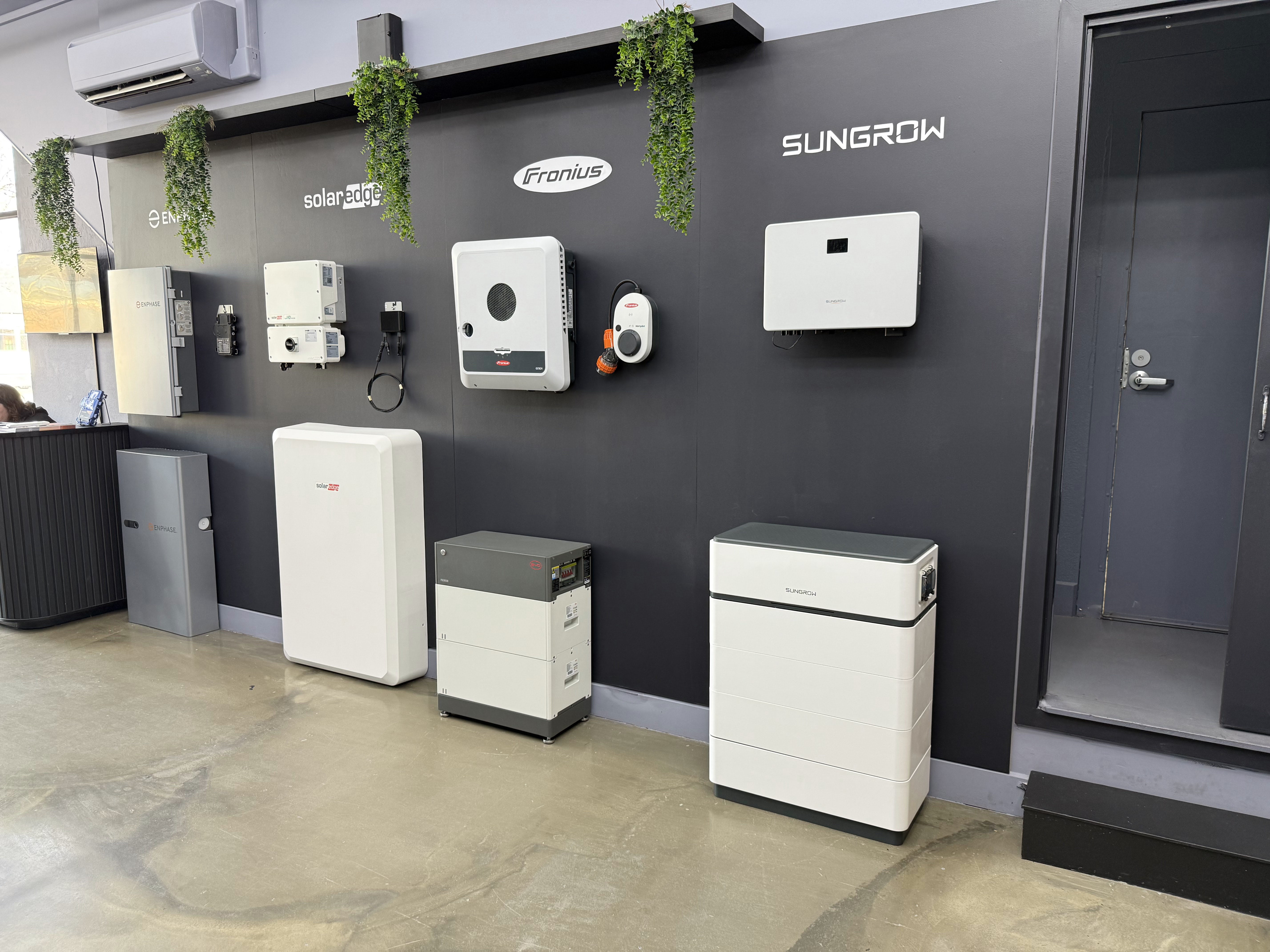
Solar and batteries are often sold together as a single system, but their responsibilities and contractual periods do not have to be identical. A project in Uzbekistan provides a useful example of why buyers should examine the components separately even when they operate together.
For Philippine households and businesses, this is a long-term ownership lesson. A proposal should explain what happens after the initial installation, including service, replacement and the end of particular commitments. A single combined package name can hide decisions that occur at different times.
Read the contract detail behind the announcement
In May 2024, the World Bank described financing for an Uzbek solar project with a battery component. Its account identified a 25-year power-purchase agreement and a 10-year operating term for the storage component. [1] These are contract features of that specific project, not universal equipment lifetimes. They show why a combined installation can contain different commercial horizons. A reader should not infer that every battery lasts exactly ten years or that every solar system carries a comparable agreement.
Separate technical life from a contractual promise
A warranty period, an operating contract and a financial model can describe different things. Ask the supplier to identify each clearly for the proposed panels, inverter, battery and supporting equipment. NREL's maintenance guidance treats operating-cost planning as part of long-term asset performance. [2] Our practical recommendation is to build an ownership timeline showing which obligations apply at each stage. The owner can then see where a service arrangement ends or where a future decision remains unpriced.
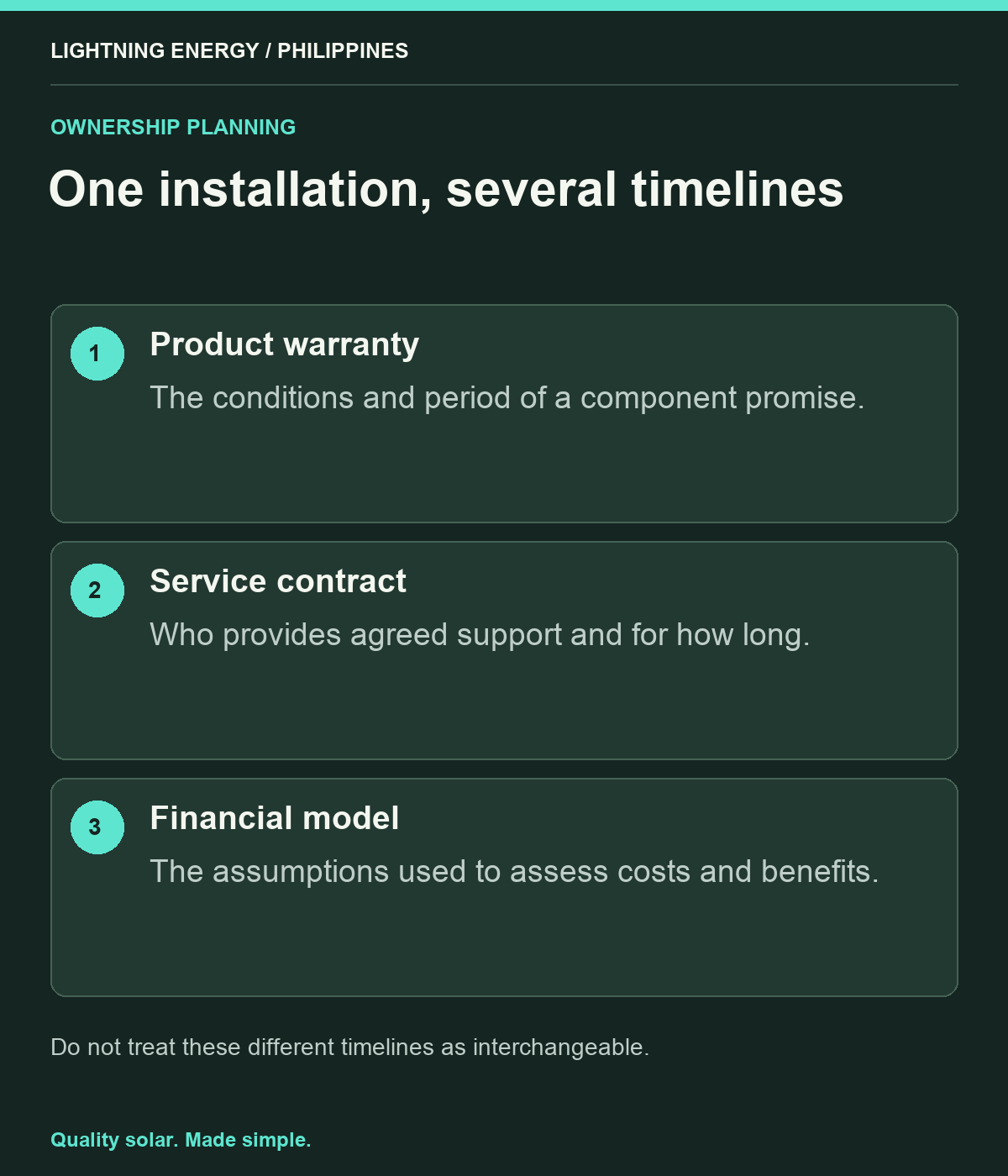
Ask how the combined system is maintained
Clarify who diagnoses an issue that involves both the inverter and battery, and which party coordinates any manufacturer claim. Keep exact compatibility records and approved substitutions with the handover pack. A system assembled from several products should still have an understandable service route. Avoid relying on a collection of separate warranty documents without an explanation of who helps the owner navigate them. The installed arrangement, not just each component in isolation, is what the household or business uses.
Include replacement as a scenario, not a prediction
Ask the proposal to identify potential future replacement responsibilities without inventing a fixed failure date. Compare a reasonable range of ownership assumptions if the financial decision depends on long-term costs. Do not present an optimistic no-replacement model as certainty or assume that the first component to need attention makes the whole system worthless. A clearly labelled scenario helps the owner understand budget exposure while leaving technical decisions to future assessment of actual condition and available equipment.
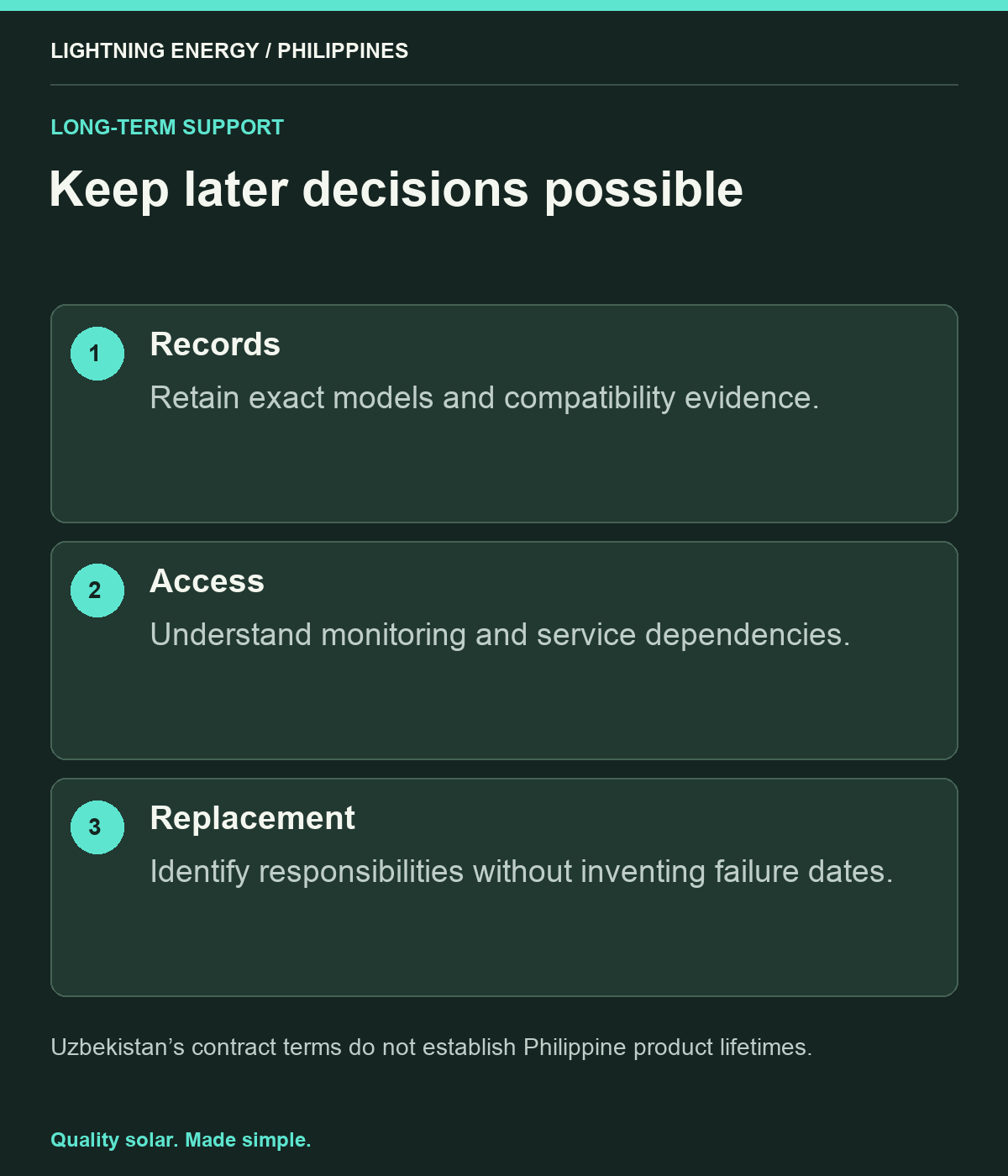
Consider the end of a support period
Find out what information and access the owner retains if a service agreement expires or the supplier relationship changes. Keep drawings, settings records where appropriate and equipment identifiers available to authorised professionals. Ask whether monitoring depends on a subscription or platform and what alternatives are documented. These questions are particularly relevant when a product's practical operation relies on software as well as hardware. The long-term plan should remain understandable even if the original sales contact is no longer involved.
Keep the foreign financing context separate
Uzbekistan's project involved institutional finance and a utility power-purchase arrangement. Those terms do not establish a Philippine residential warranty, loan or tariff. Use the case to improve questions rather than to set expectations about local contract duration. Any financing or service offer should be reviewed on its actual wording and applicable requirements. The buyer's objective is to know which risks and responsibilities are included, which remain with the owner and which require a later decision.
Build an ownership timeline before choosing
Bring the product documents, proposed service scope and payment terms to Lightning Energy and the appropriate advisers. Ask for an explanation of how the combined system will be supported through its different stages. Uzbekistan's contract detail is useful because it makes time visible. A well-understood Philippine installation should do the same: show what is delivered now, what is promised later and how the owner can make informed decisions as equipment, support arrangements and needs change.
Sources & further reading
Sources used for this guide. Policy and product details should be checked for your particular installation.
- World Bank: Uzbekistan Solar and Battery Storage Financing21 May 2024; accessed 27 September 2026
- NREL: Best Practices for Operation and Maintenance of Photovoltaic and Energy Storage Systems, third edition2018; accessed 27 September 2026