Solar FAQs
Will a Water Tank or Neighbour’s Building Shade My Solar Panels?
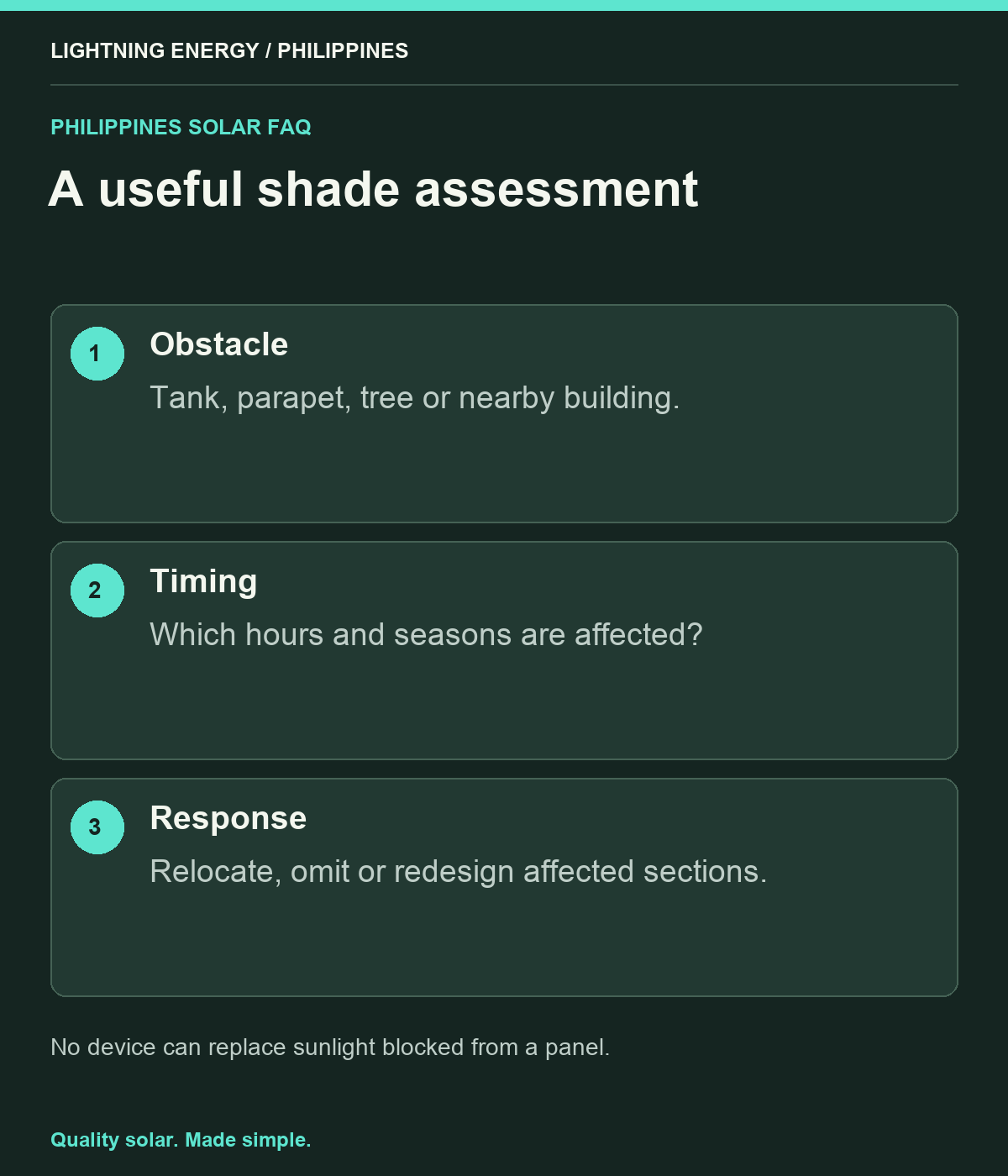
Small roof obstacles can cast moving shadows. A useful shade assessment checks times and seasons before choosing panel positions.
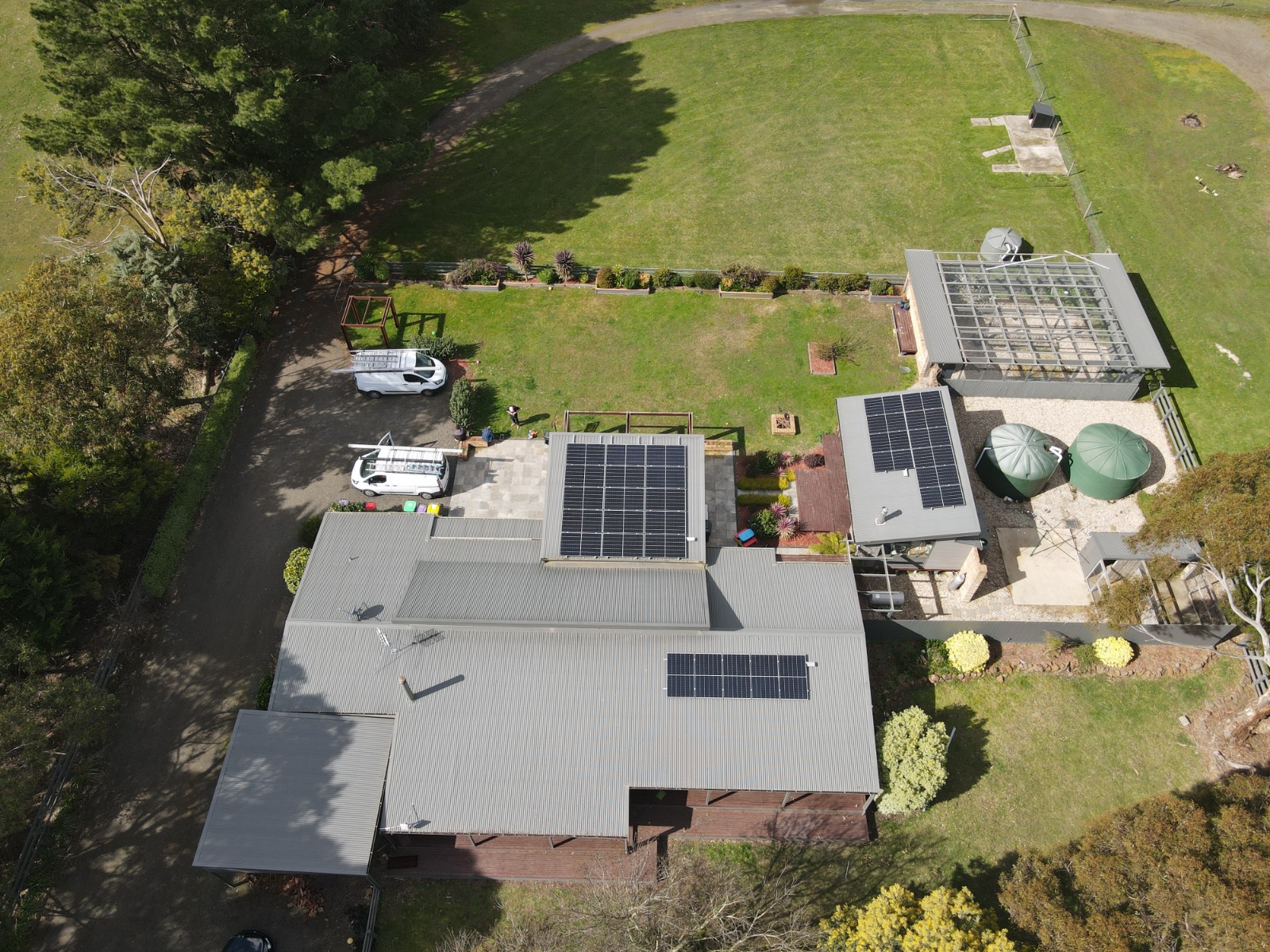
Possibly, and one midday photograph cannot settle the question. A water tank, parapet, tree or neighbouring building can affect different panels at different times. Ask the designer to assess the changing shade pattern before filling every available roof rectangle with modules. Sometimes moving or omitting a panel is more sensible than adding equipment to compensate.
List fixed and changing obstructions
Mark tanks, antennas, roof ridges, neighbouring structures and trees on the site plan. Note planned extensions or replacement tanks that may change the picture. Take photographs only from safe, accessible locations; the installer should collect any roof-level information using suitable methods.
JinkoSolar’s installation manual identifies shading as a performance and potential safety consideration. [1] Treat that as a reason for careful layout, not a claim that one small shadow will shut down every system. The effect depends on the module, electrical arrangement, timing and extent of the shade.
Ask which hours matter
A shadow early in the morning and one across a large part of the array during strong sunshine are not automatically equivalent. Ask for the estimated energy consequence across the year, not just a dramatic shaded photograph. Request the assumptions behind the estimate.
Consider your household’s demand at the affected times. If a proposed panel area is shaded precisely when the family expects to run cooling, the layout deserves closer attention. Keep the production question separate from the savings question: lost potential generation and lost avoided purchases are related, but they are not the same calculation.
Compare layout changes before accessories
Ask for an option that leaves the most affected area clear or relocates panels to a better roof face. Compare the resulting usable generation, installed cost and access. The largest possible panel count is not always the strongest design.
SMA describes inverter-based shade management as one available approach. [2] Its manufacturer claims do not establish the best solution for every roof. Request a site-specific comparison of appropriate inverter arrangements, module-level electronics where relevant and a simpler layout. No electronic device can recreate sunlight that does not reach the panel.
Use a practical tank example
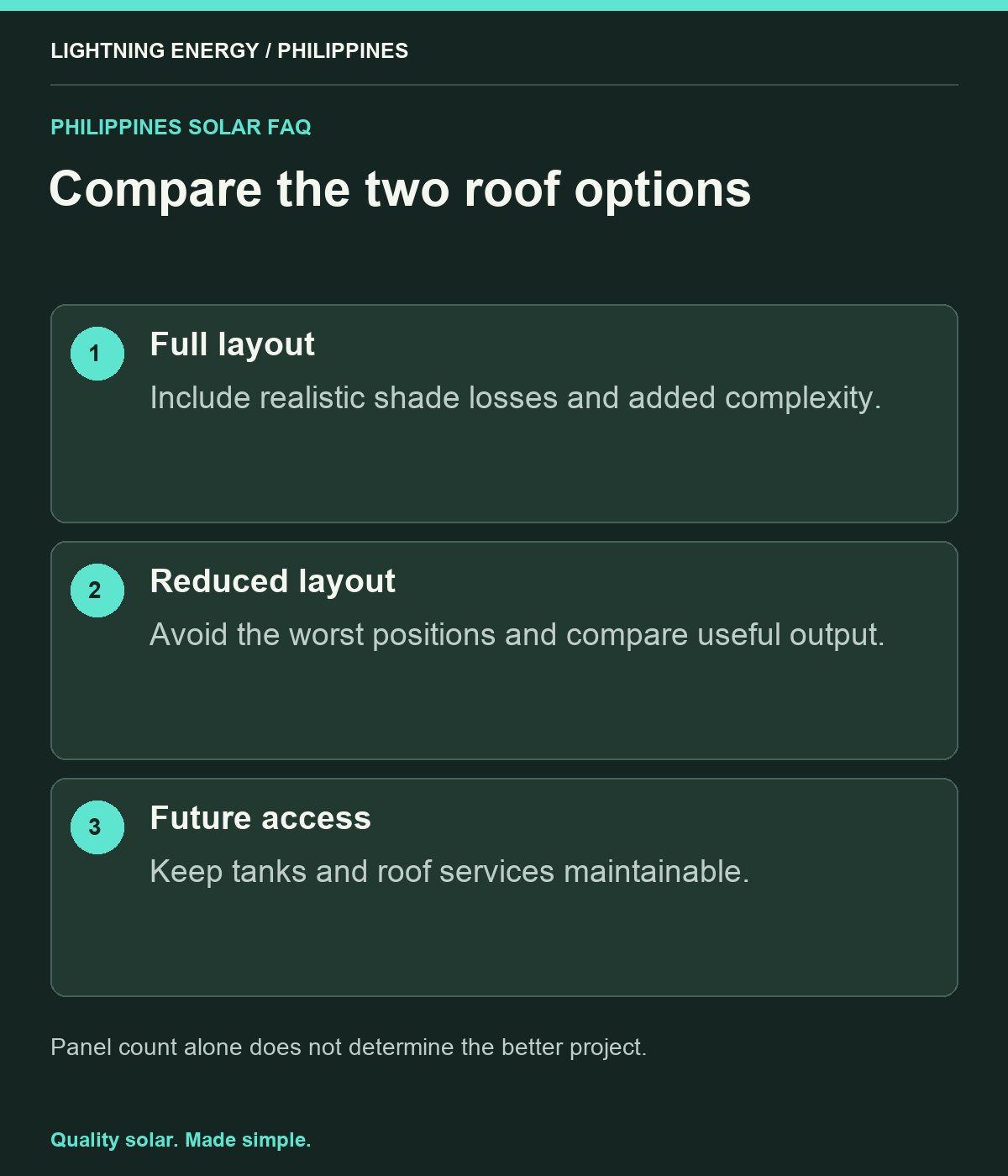
Imagine an illustrative roof with room for twelve panels, but a tank casts a recurring shadow over two proposed positions. Ask for a twelve-panel design with realistic shade losses and a ten-panel design avoiding those positions. Do not assume either will win before comparing their annual energy, cost and maintenance implications.
If tank relocation is considered, include plumbing, structural and access consequences. Solar should not make essential water infrastructure harder to service. Obtain the property owner’s agreement and professional assessment before moving anything; a panel layout is not authority to alter another building system.
Check future shade and neighbour uncertainty
Ask what happens if nearby vegetation grows or an adjacent property is developed. A proposal cannot guarantee that the surrounding environment will remain unchanged for decades. Record known planned construction and distinguish it from speculation.
For trees, consider ownership, local permissions and the value of shade for the house itself. Do not assume trimming is permitted or desirable simply because it may increase panel exposure. The installer can model a current scenario and an alternative, while the homeowner handles any property or tree-management decision through the appropriate process.
Keep the shade report with the handover
Save the layout and assessment so future technicians know why particular roof areas were used or avoided. If output later changes, compare new obstacles with the original record before assuming equipment failure. A dated photograph from a safe viewpoint can be helpful evidence.
Ask Lightning Energy Philippines to explain the shade assumptions in ordinary language. You should understand which obstacle matters, when it matters and how the proposed design responds. That explanation is more useful than a blanket promise that premium panels or optimisers make shading irrelevant, and it gives you a clear basis for comparing alternatives.
Sources & further reading
Sources used for this guide. Policy and product details should be checked for your particular installation.
- JinkoSolar — Global Installation Manual, 2024Accessed 27 September 2026
- SMA — ShadeFix Technology and Design ApproachAccessed 27 September 2026